The genus Ferocactus, commonly known as barrel cacti, comprises approximately 30 species of stout, heavily spined cacti belonging to subfamily Cactoideae of the Cactaceae family. Native to the arid regions of Mexico and the south-western United States, these robust plants are immediately recognisable by their strongly ribbed, cylindrical to globose bodies, prominent areoles, and formidable spination — some species bearing flattened, hooked central spines capable of tearing flesh. The genus name is derived from the Latin ferox, meaning fierce or ferocious, an apt description of their defences.
Classification and nomenclature
The genus Ferocactus belongs to the order Caryophyllales, family Cactaceae, and subfamily Cactoideae, tribe Cacteae. It was described by Nathaniel Lord Britton and Joseph Nelson Rose in 1922. The genus was segregated from the broadly conceived Echinocactus of earlier authors, and the current circumscription is well-supported by morphological and molecular data. Close relatives include Echinocactus and Sclerocactus.
Morphological description
Habit and dimensions
Ferocactus species are solitary or occasionally clustering, ranging from small, globose plants 20–30 cm in diameter to tall cylindrical specimens exceeding 3 metres in height. Most cultivated species are broadly barrel-shaped, becoming more cylindrical with age. Growth is slow: large specimens in the wild may be hundreds of years old. The body is firm and robust, with prominent ribs running the full length of the plant.
Stems and areoles
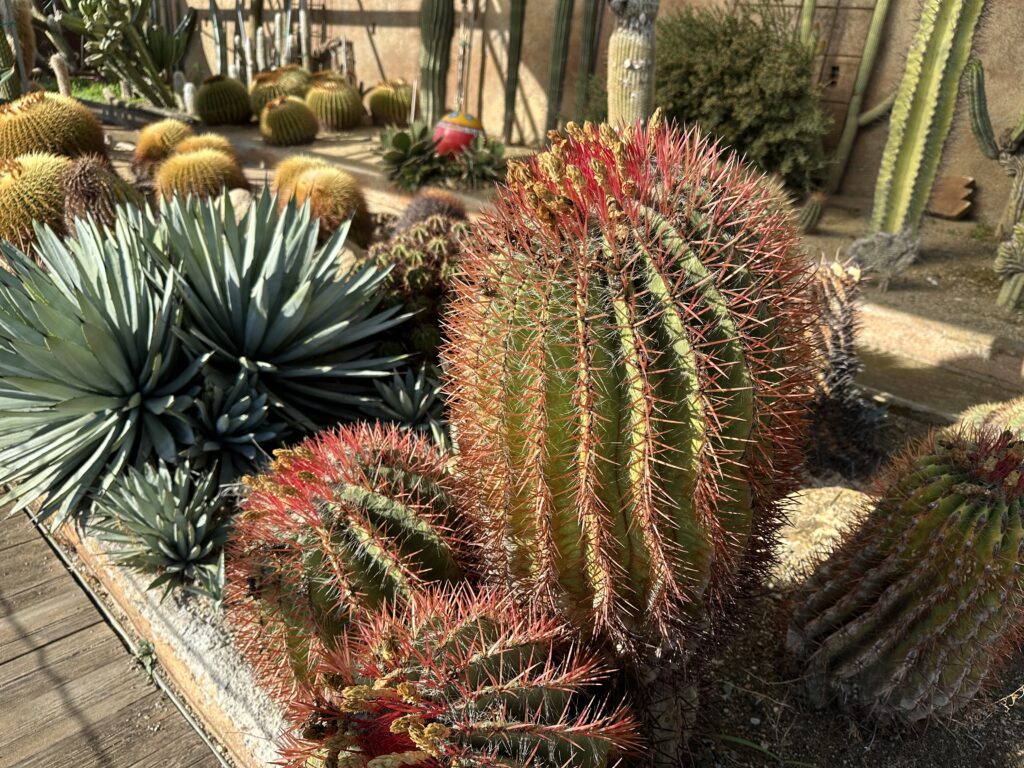
The ribs are typically 13–30 in number, well defined, and slightly wavy or crenate between the areoles. Areoles are large, well spaced along the rib crest, and densely felted with white or buff wool, particularly in younger growth. Spination is the hallmark of the genus: each areole bears a cluster of radial spines and typically 1–4 central spines. In many species, the principal central spine is distinctly flattened, transversely ridged, and strongly hooked at the tip — a feature of considerable diagnostic and ornamental value. Spines range in colour from red, orange, and yellow to grey and cream.
Flowers
Flowers are borne in a ring from the woolly areoles at or near the apex of the plant during summer. They are small to medium-sized (3–7 cm), funnel-shaped, and diurnal, opening on sunny days and closing at night. Colour ranges from yellow to orange and red, occasionally purple. The outer tepals are often striped or keeled in a contrasting colour. Flowers are succeeded by fruits that often remain on the plant for months.
Fruits
The fruits are fleshy, oblong to oval berries, dry and scaly in texture rather than juicy, typically yellow, remaining attached to the plant long after the seeds have matured. They are eaten by rodents, birds, and other wildlife in the desert, which disperse the seeds. The fruits of several species are edible by humans, and the mucilaginous flesh was used historically as a source of emergency moisture by travellers in the desert — though this use is discouraged for wild plants.
Distribution and habitat
Ferocactus species are concentrated in the Sonoran and Chihuahuan deserts of Mexico and the south-western United States (Arizona, California, New Mexico, Texas). Mexico holds the greater part of the genus’s diversity, with species occurring from Baja California and Sonora eastward to Tamaulipas and southward into Oaxaca. Habitats include rocky desert flats, bajadas, canyon walls, and gravelly slopes, generally at low to moderate elevations. The plants often face south or south-west, a tendency so marked that Ferocactus cylindraceus is traditionally known as the compass barrel cactus.
Main species
Ferocactus wislizeni — the fishhook barrel cactus of the Sonoran desert; reaching 2 m with spectacular red-and-yellow hooked spines and yellow to orange flowers.
Ferocactus cylindraceus — the California barrel cactus or compass barrel; a tall, cylindrical species of the Mojave and Sonoran deserts, with bright red-orange spines.
Ferocactus pilosus — native to central Mexico; notable for its brilliant red spines in youth and its clustering habit in older specimens; one of the most ornamental barrel cacti in cultivation.
Ferocactus latispinus — the devil’s tongue barrel; a relatively compact Mexican species bearing broad, flattened, hooked central spines and attractive purple-red flowers produced unusually late in the season.
Ferocactus emoryi — Emory’s barrel cactus; a large Arizona and Sonoran species with stout, recurved red spines and yellow-orange flowers; one of the classic barrel cacti of the south-western United States.
Cultivation
Climate and exposure
Ferocactus species require maximum sunlight and thrive in a hot, dry summer climate. They are well suited to outdoor cultivation in Mediterranean and desert-climate gardens and are increasingly used in low-water, xeriscape planting schemes. In temperate climates, they perform best under glass or in a heated greenhouse, though plants can spend the summer months outdoors in a sheltered, sunny position.
Substrate and watering
An extremely well-drained, low-nutrient substrate is essential. Coarse grit, crushed granite, or pumice should comprise the majority of the growing medium. Watering should be moderate during the active growing season; Ferocactus benefits from a pronounced dry rest during winter, when watering should be withheld entirely. Overwatering at any season risks root and stem rot, to which the genus is particularly susceptible in cool, damp conditions.
Cold hardiness
Cold tolerance varies by species. Ferocactus wislizeni and F. cylindraceus tolerate light frosts of −5 to −8 °C if conditions are dry. Mexican species such as F. latispinus are generally less frost-tolerant. In all cases, wet, cold conditions are more damaging than dry cold, and winter protection is advisable in climates with regular frost and high atmospheric humidity.
Conservation
Several Ferocactus species are threatened by habitat loss through agricultural conversion, urban expansion, and off-road vehicle activity in desert habitats. The genus is fully listed under CITES Appendix II, and collection from wild populations in both Mexico and the United States is strictly regulated. Several Baja California endemic species are of particular concern. Cultivated specimens are produced in specialist nurseries from seed and represent the only responsible source of plants for collections.