Euphorbia regis-jubae Webb & Berthel. is a semi-succulent shrub endemic to the Canary Islands, belonging to the family Euphorbiaceae. Closely related to the Canarian euphorb group, it displays morphological characters intermediate between Euphorbia balsamifera and Euphorbia lamarckii. Its name honours King Juba II of Mauritania (50 BC–23 AD), who is said to have documented the medicinal uses of euphorbias.
Classification and nomenclature
Systematic position and taxonomic status
Order Malpighiales, family Euphorbiaceae. The taxonomic status of E. regis-jubae is among the most debated in Canarian botany. Two main interpretations exist:
- Distinct species — endemic to Lanzarote, Fuerteventura, and Lobos islet; also recorded on Tenerife, La Palma, and Gran Canaria by some authors
- Stabilised natural hybrid — derived from hybridisation between E. balsamifera and E. lamarckii, explaining its intermediate morphology
Recent molecular analyses support an ancient, stabilised hybrid origin with considerable variation between island populations.
Synonyms
Tithymalus regis-jubae (Webb & Berthel.) Sojak; Euphorbia balsamifera subsp. balsamifera var. regis-jubae (Webb & Berthel.) Maire & Weiller.
Morphological description
Habit and dimensions
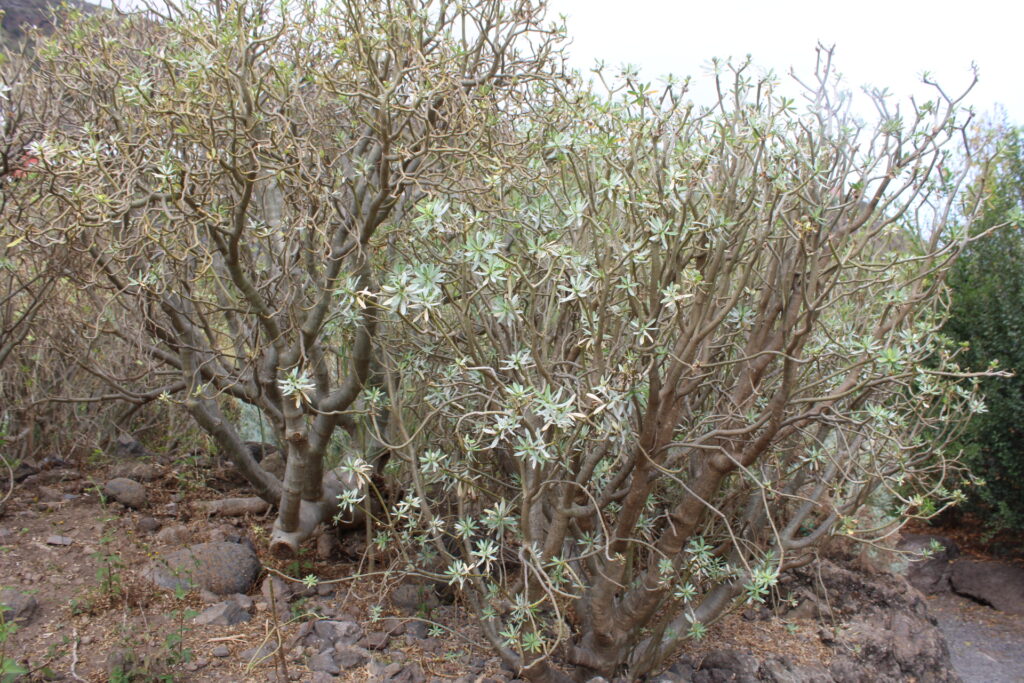
Euphorbia regis-jubae forms a dense shrub or small tree, generally 1 to 4 metres tall. Its habit is multi-stemmed and profusely branched, with fleshy stems emerging from a woody base that becomes notably thick and gnarled with age. This characteristic thickened base is clearly visible on the old specimens photographed at the Parque del Drago in Icod de los Vinos, Tenerife, where the trunks display a striking sculptural quality.
Stems
Stems are cylindrical, fleshy, and inerme (spineless). Bark on older stems is grey to greyish-brown; new growth is greener. Branching is dense and dichotomous.
Leaves
The leaves are the principal diagnostic character. They are lanceolate to narrowly lanceolate, 20–50 mm long and 4–10 mm wide, glaucous (silvery blue-green), arranged in loose rosettes at branch tips. Their shape is intermediate between the obovate leaves of E. balsamifera and the very linear leaves of E. lamarckii. Deciduous in the dry season.
Cyathia and reproduction
Cyathia are yellowish-green, grouped in terminal cymes. Flowering occurs in winter–spring. The species is monoecious. Fruits are 3-lobed capsules.
Ecology and distribution
Range
In the strict sense, Euphorbia regis-jubae is endemic to the eastern Canary Islands: Lanzarote, Fuerteventura, and the islet of Lobos. Populations on Tenerife, Gran Canaria, and La Palma are sometimes assigned to this taxon, though they may represent local hybrid forms or closely related entities. The specimen photographed at the Parque del Drago in Icod de los Vinos illustrates the presence of this species — or a very closely related form — on Tenerife.
Habitat
An arid to semi-arid coastal species, occurring between sea level and 600 m altitude. It colonises rocky and volcanic slopes, ravines, and embankments alongside other Canarian xerophytes: Euphorbia canariensis, Kleinia neriifolia, Opuntia spp.
Comparison with related species
- vs E. balsamifera: longer, lanceolate leaves (not obovate); less aromatic latex
- vs E. lamarckii: broader leaves; generally less erect habit; different range
- vs E. canariensis: non-columnar stems, inerme (no ribs or spines)
Cultivation
More robust than E. lamarckii and easier in cultivation than E. balsamifera. Requires maximum sun, sharply draining substrate, and good summer warmth. Tolerates brief light frost (−3 to −5°C if dry). Water moderately in the growing season; reduce in winter.
References
Webb, P.B. & Berthelot, S. (1836–1850). Histoire Naturelle des Îles Canaries. — Molero, J. & Rovira, A.M. (1992). Euphorbia subg. Euphorbioideae in the Canary Islands. — Rincón-Barrado, M. et al. (2024). Phylogenetics of the Euphorbia balsamifera complex in Macaronesia.