Euphorbia (family Euphorbiaceae) is not merely a large genus — it is a world unto itself. With approximately 2,000 species, it is the second-largest genus of flowering plants (after Astragalus) and by far the largest genus of succulent plants, containing roughly 500–650 succulent species — more than all the cacti in any single cactus genus. It spans every continent except Antarctica, every altitude from sea level to over 3,000 m, and every growth form from tiny annual weeds to 30-metre rainforest trees. It includes the poinsettia, the pencil cactus, the crown of thorns, some of the most coveted collector’s succulents on Earth, and some of the most dangerous plants known to man. Understanding this genus — its structure, its diversity, and its evolutionary logic — is the key to navigating what would otherwise be an overwhelming maze of species.
The Cyathium — The Unifying Feature
What unites 2,000 species that look nothing alike? A single, extraordinary structure: the cyathium. Found in no other plant genus, the cyathium is a false « flower » — actually a highly condensed inflorescence consisting of a cup-shaped involucre containing multiple male flowers (each reduced to a single stamen on a pedicel) surrounding a single female flower (reduced to a stalked ovary). The rim of the involucre bears glands, often with colourful appendages or nectaries, which attract pollinators. What appears to be one flower is actually an entire miniature inflorescence, functionally equivalent to a single flower but structurally unique.
The cyathium is the definitive diagnostic character of Euphorbia. If a plant has cyathia, it is an Euphorbia. If it lacks them, it is not — regardless of how much it resembles one. This is why the former segregate genera Monadenium, Synadenium, Pedilanthus, and Endadenium were absorbed back into Euphorbia: molecular evidence showed they were deeply nested within the genus, and their modified cyathia were simply variations on the Euphorbia theme.
Taxonomy — Four Subgenera
Molecular phylogenetic studies (Steinmann & Porter 2002; Bruyns et al. 2006; Horn et al. 2012) have established that Euphorbia comprises four well-supported, monophyletic subgenera. This framework, refined by subsequent studies (Yang et al. 2012; Dorsey et al. 2013; Peirson et al. 2013; Riina et al. 2013), is the current standard classification.
Subgenus Esula Pers. — the herbaceous spurges
The most basal subgenus. Approximately 480 species in 21 sections. Predominantly herbaceous plants from Eurasia, the Mediterranean, and Africa. This subgenus includes most of the frost-hardy, non-succulent species used in European garden horticulture, as well as the notorious invasive leafy spurge of North America.
Key sections and species for growers:
- Section Myrsiniteae — succulent-leaved Mediterranean perennials:
- Euphorbia myrsinites (myrtle spurge, hardy to –20 °C)
- Euphorbia rigida (gopher spurge, hardy to –15 °C)
- Section Helioscopia — common garden spurges:
- Euphorbia peplus (petty spurge)
- Euphorbia helioscopia (sun spurge)
- Section Esula:
- Euphorbia esula (leafy spurge, invasive in North America)
- Euphorbia cyparissias (cypress spurge)
- Section Lathyris:
- Euphorbia lathyris (caper spurge, reputed mole deterrent)
- Section Tithymalus:
- Euphorbia characias and Euphorbia wulfenii (Mediterranean shrubby spurges, among the most popular perennials in European garden design)
- Section Aphyllis — leafless or near-leafless shrubs of Macaronesia and Arabia:
- Euphorbia balsamifera (Canary Islands and North-West Africa, the only Euphorbia with non-toxic, edible latex)
- Euphorbia aphylla (Canary Islands)
Subgenus Athymalus Neck. ex Rchb. — the African succulents
Approximately 150 species in 7 sections. Mainly African, with centres of diversity in southern and eastern Africa. This is the subgenus that contains the spectacular medusoid euphorbias, many globular species, and pencil-stemmed succulents. It is the most taxonomically complex subgenus for collectors.
Key sections and species:
- Section Anthacanthae — the largest section in the subgenus. Contains the medusoid euphorbias, many globular/cactoid species, and geophytic species:
- Euphorbia caput-medusae (Medusa’s head)
- Euphorbia flanaganii (Medusa’s head)
- Euphorbia inermis
- Euphorbia obesa (baseball plant)
- Euphorbia meloformis
- Euphorbia valida
- Euphorbia polygona
- Euphorbia horrida
- Euphorbia symmetrica
- Section Balsamis — pencil-stemmed species:
- Euphorbia larica (Arabian Peninsula)
- Section Lyciopsis — spiny shrubs:
- Euphorbia cuneata
- Section Somalica — approximately 11 species of partly succulent shrubs and small trees restricted to the Horn of Africa (Somalia, SE Ethiopia, Djibouti) and Socotra, including three Socotran endemics. Representative species:
- Euphorbia socotrana (Socotra — Vulnerable)
- Euphorbia hamaderoensis (Socotra)
- Euphorbia oxystegia (Horn of Africa)
- Section Antso — the sole Malagasy representative:
- Euphorbia antso
Subgenus Chamaesyce Raf. — the poinsettias, sandmats, and pencil trees
Approximately 600 species in 15 sections. The second-most species-rich subgenus. Extraordinarily diverse in growth form: annual C₄ weeds, pencil-stemmed succulents, shrubs, trees, and some of the world’s most commercially important ornamental plants. Pantropical, with centres of diversity in the Americas, Africa, and Madagascar.
This is one of the few plant lineages at any taxonomic level to include members with C₃, C₄, and CAM photosynthesis — a remarkable case of photosynthetic pathway diversification within a single clade.
Key sections and species:
- Section Poinsettia:
- Euphorbia pulcherrima (poinsettia, ~70 million plants sold annually in the US alone)
- Euphorbia cyathophora (fire-on-the-mountain)
- Section Articulofruticosae Bruyns — jointed, pencil-stemmed succulents from southern Africa (primarily South Africa and Namibia). These leafless or near-leafless shrubs have independently evolved a « pencil-stemmed » growth form convergent with the unrelated section Tirucalli in subgenus Euphorbia. Several species use CAM photosynthesis, confirmed by stable carbon isotope analysis (δ¹³C):
- Euphorbia ephedroides — the best-studied species in the section, with CAM photosynthesis confirmed. Its jointed, cylindrical stems resemble those of Ephedra, hence the specific epithet. Native to Namibia and South Africa.
- Euphorbia rhombifolia — also tested positive for CAM photosynthesis. Native to the Eastern Cape, South Africa.
- Euphorbia stapelioides — its name reflects a striking morphological resemblance to Stapelia (Apocynaceae), a remarkable case of convergent evolution.
- Euphorbia herrei — named in honour of the renowned succulent collector Adolar Hans Herre. Highly sought after by specialist collectors.
- Euphorbia juttae — endemic to Namibia, valued in cultivation for its attractive glaucous, segmented stems.
- Section Anisophyllum — the sandmats (former genus Chamaesyce). Small, prostrate, C₄ photosynthesising herbs. The only known lineage at or below genus level that contains all known types of photosynthesis (C₃, C₃-C₄ intermediates, C₄, and CAM).
- Section Alectoroctonum — diverse New World herbs and succulents:
- Euphorbia antisyphilitica (candelilla, source of candelilla wax — a key industrial raw material used in lip balms, food processing, and as a vegan alternative to beeswax)
- Euphorbia xanti (Baja spurge — a fast-growing, rhizomatous, semi-succulent shrub from Baja California, Sonora, and Sinaloa with fragrant pink-and-white cyathia, increasingly used in water-wise landscaping in the southwestern United States; hardy to approximately –4 °C)
- Section Espinosae — African shrubs and trees from deciduous woodlands:
- Euphorbia umbellata (formerly Synadenium grantii, a popular succulent houseplant known as « African milk bush »)
- Section Frondosae — leafy succulent shrubs from southern and East Africa.
Note on Euphorbia tirucalli: The pencil cactus (Euphorbia tirucalli) is placed in subgenus Chamaesyce by molecular phylogenies (Yang et al. 2012; Horn et al. 2012), but its exact sectional affiliation within the subgenus remains debated. Despite its « pencil-stemmed » growth form — superficially similar to the southern African species of section Articulofruticosae and to Euphorbia arbuscula in section Tirucalli (subgenus Euphorbia) — molecular evidence places it clearly in subgenus Chamaesyce rather than subgenus Euphorbia. This is a striking example of convergent evolution: three independent lineages within Euphorbia have evolved essentially identical leafless, cylindrical, photosynthetic stems.
Subgenus Euphorbia — the succulent giants
The largest subgenus: approximately 660 species in 21 sections arranged in four major clades. This is where most of the spectacular succulent trees, spiny shrubs, and caudiciform species reside — the species that make Euphorbia the dominant succulent genus of Africa, Madagascar, and southern Asia.
Key sections and species:
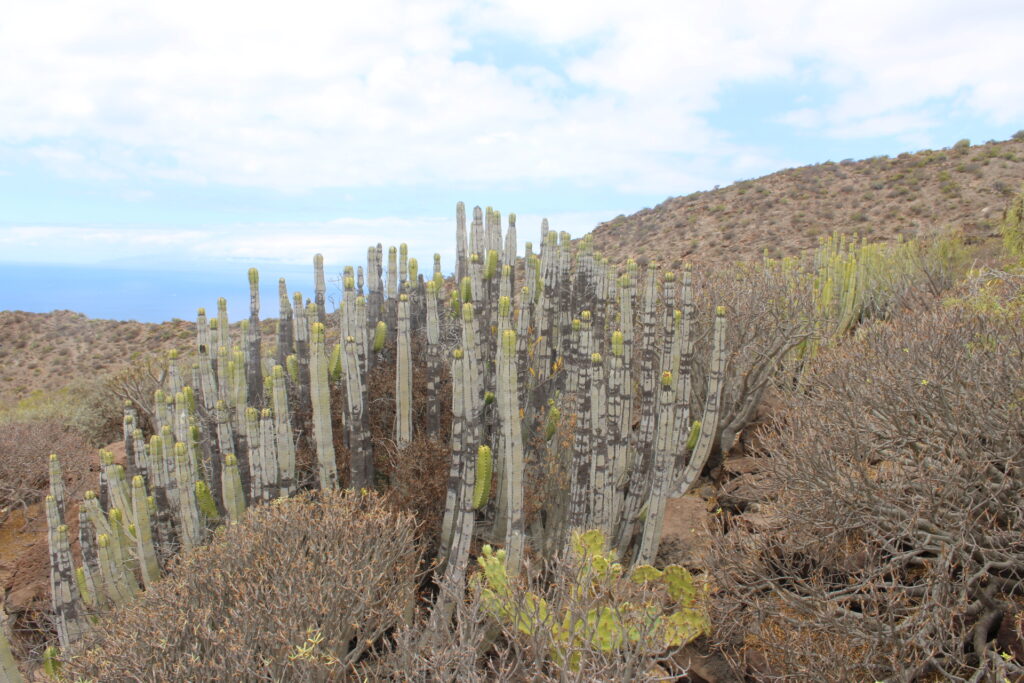
- Section Euphorbia — the candelabra trees, large succulent shrubs, and cactoid species of Africa and Asia:
- Euphorbia ingens (naboom, up to 15 m — the most widespread candelabra euphorbia, from Eritrea to South Africa. The East African plants formerly called « Euphorbia candelabrum » are in fact this species, as demonstrated by Bruyns & Berry 2019)
- Euphorbia ammak (Arabian Peninsula, up to 10 m)
- Euphorbia candelabrum Welw. (a distinct species endemic to Angola — not the same as the East African plants historically misidentified under this name)
- Euphorbia abyssinica (Horn of Africa — the species incorrectly sold in the horticultural trade as « Euphorbia eritrea » or « Euphorbia erythraea« , a name that has no valid standing in botanical nomenclature)
- Euphorbia grandicornis (cow’s horn euphorbia)
- Euphorbia trigona (African milk tree)
- Euphorbia lactea (including the ‘Cristata’ form — the « coral cactus »)
- Euphorbia antiquorum (type species of the genus)
- Euphorbia resinifera (resin spurge — a Moroccan cactoid species of immense historical and chemical significance: it is believed to be the species used by Euphorbus, the physician of King Juba II of Mauretania, from whom the entire genus takes its name; its latex contains resiniferatoxin, one of the most potent naturally occurring irritants known — approximately 1,000 times more pungent than capsaicin — now studied as a non-opioid analgesic for severe chronic pain)
- Section Monadenium — the former genus Monadenium, now absorbed into Euphorbia. East African succulents with distinctive horseshoe-shaped cyathial glands:
- Euphorbia ritchiei (formerly Monadenium ritchiei)
- Euphorbia spectabilis (formerly Monadenium spectabile)
- Section Goniostema — Malagasy succulent shrubs and trees. One of the most horticulturally important sections of the genus, centred almost entirely on Madagascar:
- Euphorbia milii (crown of thorns — hundreds of cultivars, particularly popular in Thailand where massive-flowered hybrids have been developed)
- Euphorbia lophogona (crested euphorbia of Madagascar’s eastern forests)
- Euphorbia didiereoides (Endangered)
- Euphorbia viguieri (tall, spiny-stemmed Malagasy shrub)
- Euphorbia geroldii (thornless crown of thorns — one of the rarest Malagasy euphorbias, Critically Endangered)
- Euphorbia gottlebei (scarlet-bracted cliff-dwelling species from southern Madagascar)
- Euphorbia neohumbertii (striking orange-bracted species from limestone karst in northern Madagascar)
- Euphorbia pachypodioides (one of the most coveted collector’s plants in the genus — a small-stemmed, pachypodium-like species with bright red cyathia, Critically Endangered)
- Section Denisophorbia — Malagasy caudiciform and succulent species. Among the most collectible euphorbia species in the world, prized for their extraordinary leaf patterns and compact caudiciform habit:
- Euphorbia cylindrifolia (tiny, round, dark leaves on creeping stems)
- Euphorbia decaryi (spiralling rosettes of undulate leaves)
- Euphorbia francoisii (the jewel of the section — dozens of leaf forms with extraordinary variegation patterns, highly collectible)
- Euphorbia ambovombensis (Critically Endangered)
- Euphorbia primulifolia (primrose-leaved euphorbia, rosette-forming geophyte)
- Euphorbia cap-saintemariensis (the smallest species in the section, from the extreme south of Madagascar, Critically Endangered)
- Euphorbia razafindratsirae (recently described, Critically Endangered)
- Section Tirucalli Boiss. — pencil-stemmed trees and shrubs of the Old World tropics and islands. Despite the name, Euphorbia tirucalli itself is now placed in subgenus Chamaesyce (see above); this section within subgenus Euphorbia contains a distinct group of leafless, cylindrical-stemmed species, primarily insular:
- Euphorbia arbuscula (section Tirucalli, subgenus Euphorbia) — a leafless, semi-succulent tree endemic to the island of Socotra (Yemen), reaching 3–7 m tall, with a dense coralliform crown of glaucous blue-green cylindrical stems. Uses CAM photosynthesis to survive extreme drought, flowering during the hot, dry season. Classified as Near Threatened by the IUCN and extremely rare in cultivation. Two subspecies: subsp. arbuscula (tree, coastal lowlands) and subsp. montana (shrub, montane zone).
- Section Pedilanthus — the slipper spurges, formerly the genus Pedilanthus. Distinguished by their strongly zygomorphic (bilaterally symmetrical) cyathia — a unique modification within the genus:
- Euphorbia tithymaloides (devil’s backbone, zigzag plant)
The Euphorbia Radiation of Socotra
The archipelago of Socotra (Yemen), a UNESCO World Heritage Site sometimes called the « Galápagos of the Indian Ocean », harbours an extraordinary insular radiation of Euphorbia: 11 endemic species found nowhere else on Earth. This represents one of the highest concentrations of endemic Euphorbia species per unit area anywhere in the world. Key species include:
- Euphorbia arbuscula Balf.f. — the blue ghost tree (see section Tirucalli above)
- Euphorbia abdelkuri Balf.f. — endemic to the island of Abd al Kuri. A spectacular species with spineless columnar stems linked by a single rootstock. Endangered.
- Euphorbia socotrana Balf.f. — shrub or small tree, with two subspecies (subsp. socotrana and subsp. purpurea)
- Euphorbia spiralis Balf.f. — the only spiny succulent euphorbia on Socotra
- Euphorbia obcordata Balf.f. — a tree from the dry shrublands
- Euphorbia hajhirensis Radcl.-Sm. — endemic to the central Hajhir Mountains, Socotra’s wet refugium
- Euphorbia schweinfurthii Balf.f., Euphorbia hamaderoensis A.G.Mill., Euphorbia kischenensis Vierh., Euphorbia leptoclada Balf.f., Euphorbia kuriensis Vierh. (Abd al Kuri)
The majority of Socotra’s endemic euphorbias were described by Isaac Bayley Balfour following his 1880 expedition, and many remain poorly studied.
Absorbed Genera — What Happened to Monadenium, Synadenium, and Pedilanthus?
One of the most consequential taxonomic changes in recent succulent botany has been the absorption of several formerly independent genera into Euphorbia, based on molecular evidence that they are deeply nested within it. If you grew up knowing these plants under their old names, the current taxonomy may be disorienting. Here is a quick reference:
- Monadenium → now Euphorbia (subg. Euphorbia, sect. Monadenium). East African succulents with horseshoe-shaped glands.
- Synadenium → now Euphorbia (subg. Chamaesyce, sect. Espinosae). Synadenium grantii = Euphorbia umbellata.
- Pedilanthus → now Euphorbia (subg. Euphorbia, sect. Pedilanthus). Slipper spurges with zygomorphic cyathia. Pedilanthus tithymaloides = Euphorbia tithymaloides.
- Endadenium → now Euphorbia.
- Elaeophorbia → now Euphorbia. West African trees.
- Chamaesyce → now Euphorbia (subg. Chamaesyce, sect. Anisophyllum). Prostrate herbs.
- Poinsettia → now Euphorbia (subg. Chamaesyce, sect. Poinsettia).
POWO and all major herbaria now follow this expanded circumscription. However, the old names remain common in the horticultural trade and in older literature, and many nurseries still sell plants under the former genus names.
Species Directory by Growth Form — A Grower’s Classification
For practical purposes, growers often classify euphorbias by growth form rather than by subgenus. The following categories reflect the way collectors and nurseries organise their stock, and the way most people search for information.
Candelabra trees and large succulent shrubs
- Euphorbia ingens
- Euphorbia ammak
- Euphorbia candelabrum
- Euphorbia abyssinica
- Euphorbia cooperi
- Euphorbia tetragona
- Euphorbia triangularis
- Euphorbia trigona (African milk tree)
- Euphorbia lactea (including cristata forms)
These are the species most often confused with columnar cacti.
Globular and cactoid succulents
- Euphorbia obesa (baseball plant)
- Euphorbia meloformis
- Euphorbia valida
- Euphorbia symmetrica
- Euphorbia horrida
- Euphorbia polygona
- Euphorbia suzannae
- Euphorbia bupleurifolia
Spherical to short-columnar bodies with ribs, mimicking Astrophytum, Ferocactus, or Echinocactus.
Medusoid euphorbias
- Euphorbia caput-medusae
- Euphorbia flanaganii
- Euphorbia inermis
- Euphorbia esculenta
- Euphorbia procumbens
- Euphorbia gorgonis
Central caudex with radiating snake-like arms — a growth form unique to Euphorbia and found nowhere else in the plant kingdom.
Caudiciform and pachycaul species
- Euphorbia stellata
- Euphorbia cylindrifolia
- Euphorbia decaryi
- Euphorbia francoisii
- Euphorbia ambovombensis
- Euphorbia primulifolia
- Euphorbia cap-saintemariensis
- Euphorbia pachypodioides
Swollen underground or basal caudex with seasonal deciduous branches or rosettes of leaves. Primarily Malagasy. Highly prized by collectors.
Pencil-stemmed succulents
- Euphorbia tirucalli (pencil cactus / firestick — subg. Chamaesyce)
- Euphorbia arbuscula (Socotra ghost tree — subg. Euphorbia, sect. Tirucalli)
- Euphorbia xylophylloides (Madagascar)
- Euphorbia larica (Arabian Peninsula — subg. Athymalus)
- Euphorbia dregeana (South Africa)
Leafless or near-leafless plants with green, photosynthetic, pencil-thin branches. A striking example of convergent evolution: this growth form has evolved independently in at least three separate subgenera of Euphorbia.
Spiny shrubs — the « crown of thorns » group
- Euphorbia milii (crown of thorns — hundreds of cultivars, particularly popular in Thailand)
- Euphorbia lophogona
- Euphorbia viguieri
- Euphorbia geroldii
- Euphorbia gottlebei
- Euphorbia neohumbertii
- Euphorbia pachypodioides
Predominantly Malagasy. Spiny stems with terminal leaf rosettes and colourful cyathial bracts.
Hardy Mediterranean and European spurges
- Euphorbia characias (Mediterranean spurge, –12 °C)
- Euphorbia myrsinites (myrtle spurge, –20 °C)
- Euphorbia rigida (gopher spurge, –15 °C)
- Euphorbia polychroma (cushion spurge, –30 °C)
- Euphorbia amygdaloides (wood spurge)
These are frost-hardy perennials widely used in ornamental garden design — a completely different world from the tender African succulents, yet the same genus.
Ornamental non-succulent houseplants
- Euphorbia pulcherrima (poinsettia)
- Euphorbia tithymaloides (devil’s backbone, formerly Pedilanthus)
- Euphorbia umbellata (formerly Synadenium grantii, « African milk bush »)
Common in the indoor plant trade but not typically grown as « succulents ».
Island endemics and collector’s rarities
- Euphorbia arbuscula (Socotra — IUCN Near Threatened)
- Euphorbia abdelkuri (Socotra, Abd al Kuri — Endangered)
- Euphorbia spiralis (Socotra)
- Euphorbia handiensis (Fuerteventura, Canary Islands — Endangered)
- Euphorbia lambii (La Gomera, Canary Islands)
- Euphorbia canariensis (Canary Islands)
Island-endemic species are disproportionately threatened and disproportionately coveted by collectors.
Geographic Distribution
Africa — the primary centre of diversity for succulent Euphorbia. Southern Africa (especially the Cape) is the hotspot for medusoid and globular species (subg. Athymalus). Eastern and central Africa host the great candelabra trees. The Horn of Africa and Arabian Peninsula share several species.
Madagascar — a secondary centre of extraordinary importance. The caudiciform and spiny species (sections Denisophorbia, Goniostema) are almost exclusively Malagasy. Many are CITES-listed and highly threatened. Madagascar hosts at least 170 native Euphorbia species, with an endemism rate exceeding 95%.
Socotra — a remarkable insular hotspot with 11 endemic Euphorbia species in a land area of approximately 3,800 km². This represents one of the highest concentrations of endemic Euphorbia diversity per unit area in the world.
The Americas — centre of diversity for subg. Chamaesyce (sandmats, poinsettia group) and for the slipper spurges (section Pedilanthus). Relatively few succulent species compared to Africa.
Eurasia and the Mediterranean — dominated by subg. Esula: herbaceous spurges, shrubby spurges, and the succulent-leaved species of section Myrsiniteae. No arborescent succulents.
Canary Islands and Macaronesia — Euphorbia canariensis, Euphorbia balsamifera, Euphorbia regis-jubae. Distinct endemic radiation.
Sources and Further Reading
- Plants of the World Online (POWO), Royal Botanic Gardens, Kew — Euphorbia L. powo.science.kew.org
- Horn, J.W., van Ee, B.W., Morawetz, J.J., Riina, R., Steinmann, V.W., Berry, P.E. & Wurdack, K.J. (2012). Phylogenetics and the evolution of major structural characters in the giant genus Euphorbia L. Molecular Phylogenetics and Evolution, 63(2): 305–326.
- Bruyns, P.V., Mapaya, R.J. & Hedderson, T. (2006). A new subgeneric classification for Euphorbia (Euphorbiaceae) in southern Africa based on ITS and psbA-trnH sequence data. Taxon, 55(2): 397–420.
- Bruyns, P.V. & Berry, P.E. (2019). The nomenclature and application of the names Euphorbia candelabrum Welw. and Euphorbia ingens in tropical Africa. Taxon, 68(4): 828–838.
- Dorsey, B.L., Haevermans, T., Aubriot, X., Morawetz, J.J., Riina, R., Steinmann, V.W. & Berry, P.E. (2013). Phylogenetics, morphological evolution, and classification of Euphorbia subgenus Euphorbia. Taxon, 62(2): 291–315.
- Yang, Y., Riina, R., Morawetz, J.J., Haevermans, T., Aubriot, X. & Berry, P.E. (2012). Molecular phylogenetics and classification of Euphorbia subgenus Chamaesyce (Euphorbiaceae). Taxon, 61(4): 764–789.
- Peirson, J.A., Bruyns, P.V., Riina, R., Morawetz, J.J. & Berry, P.E. (2013). A molecular phylogeny and classification of the largely succulent and mainly African Euphorbia subg. Athymalus. Taxon, 62(6): 1178–1199.
- Riina, R., Peirson, J.A., Geltman, D.V., Molero, J., Frajman, B., Pahlevani, A., Clark, L., Morawetz, J.J., Salmaki, Y., Zarre, S., Kryukov, A., Bruyns, P.V. & Berry, P.E. (2013). A worldwide molecular phylogeny and classification of the leafy spurges, Euphorbia subgenus Esula (Euphorbiaceae). Taxon, 62(2): 316–342.
- Steinmann, V.W. & Porter, J.M. (2002). Phylogenetic relationships in Euphorbieae (Euphorbiaceae) based on ITS and ndhF sequence data. Annals of the Missouri Botanical Garden, 89(4): 453–490.
- Carter, S. & Eggli, U. (2003). The CITES Checklist of Succulent Euphorbia Taxa. Federal Agency for Nature Conservation, Bonn.
- Court, D. (2000). Succulent Flora of Southern Africa. CRC Press.
Authority Pages — Best Online Resources for the Genus Euphorbia
The following pages are the most authoritative, comprehensive, and useful online resources available for the genus Euphorbia as a whole. They are listed in order of taxonomic authority first, then specialist databases, conservation, and community resources.
- POWO — Euphorbia L. — The accepted taxonomic reference from the Royal Botanic Gardens, Kew. Complete list of ~2,000 accepted species with distribution, synonymy, and classification. The single most important reference page for the genus.
- World Flora Online — Euphorbia L. — Morphological descriptions, nomenclatural data, and links to regional floras (Flora of North America, Flora of Tropical East Africa, Flora Brasiliensis, etc.).
- NCBI Taxonomy Browser — Euphorbia — The only freely accessible database showing the complete infrageneric classification (subgenera, sections, subsections) in a navigable tree view. Essential for understanding the phylogenetic structure of the genus.
- Wikispecies — Euphorbia subg. Chamaesyce — Detailed nomenclatural and taxonomic data with full section lists for this subgenus. Similar pages exist for the other subgenera.
- Euphorbia Planetary Biodiversity Inventory (Euphorbia PBI) — The coordinated NSF-funded research project led by Paul Berry (University of Michigan) and collaborators, producing the molecular phylogenetic framework that underpins the modern classification.
- GBIF — Euphorbia — Global Biodiversity Information Facility. Over 5 million occurrence records for the genus, with georeferenced distribution maps.
- iNaturalist — Euphorbia — Crowd-sourced observations with photographs from the wild across the globe.
- LLIFLE — Encyclopaedia of Succulents: Euphorbiaceae — The Living Encyclopaedia of Living Forms. Detailed cultivation information, photographs, and synonym lists for many succulent Euphorbia species. One of the best collector-oriented resources.
- Wikipedia — Euphorbia — General overview of the genus with taxonomy, distribution, and selected species.
- The Euphorbia Journal — Historic reference: the journal that documented many succulent Euphorbia species with detailed illustrations and field observations.
- JSTOR Global Plants — Access to type specimens, herbarium sheets, and historical botanical literature for Euphorbia species.
- IUCN Red List — Conservation assessments for threatened Euphorbia species, particularly the Malagasy endemics and island endemics.
- CITES Checklist of Succulent Euphorbia Taxa — The official CITES reference for international trade regulation (all succulent euphorbias are CITES Appendix II).
- Oxford Botanic Garden — The Euphorbia Collection — The UK National Plant Collection of Euphorbia, holding 65 species, 10 cultivars, and 163 taxa.