Euphorbia lamarckii Sweet is a semi-succulent shrub endemic to the Canary Islands, belonging to the large and diverse family Euphorbiaceae. Known locally as tabaiba salvaje (wild tabaiba), it is one of the most distinctive elements of the thermophilous scrub and transitional vegetation zones of the archipelago. Though closely related to Euphorbia balsamifera, it differs in its generally larger stature, more open branching habit, and tendency to inhabit slightly higher altitudes and less arid exposures.
Classification and nomenclature
Systematic position
Euphorbia lamarckii belongs to the order Malpighiales, family Euphorbiaceae, subfamily Euphorbioideae, tribe Euphorbieae. It was described by Robert Sweet in 1826, and named in honour of the French botanist Jean-Baptiste de Lamarck. The species has a complex taxonomic history and is sometimes confused with related taxa, particularly in the context of natural hybridisation with E. balsamifera (yielding E. ×regis-jubae Webb & Berthel.).
Synonyms
Key synonyms include: Euphorbia regis-jubae Webb & Berthel. (pro parte); Tithymalus lamarckii (Sweet) Sojak. The name E. regis-jubae is sometimes incorrectly applied to pure E. lamarckii material.
Morphological description
Habit and dimensions
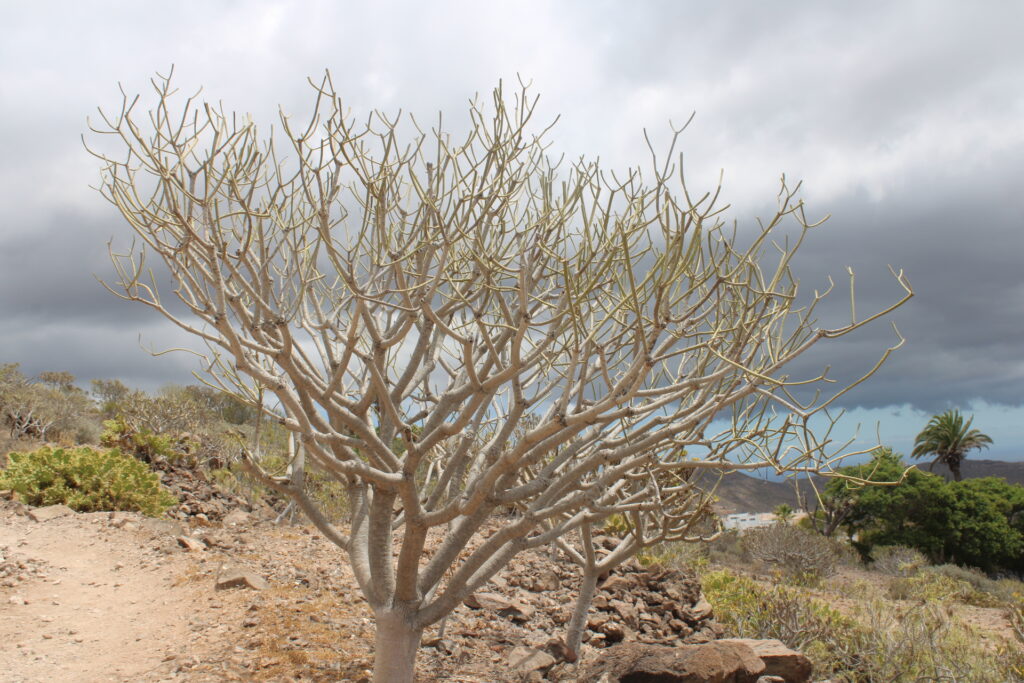
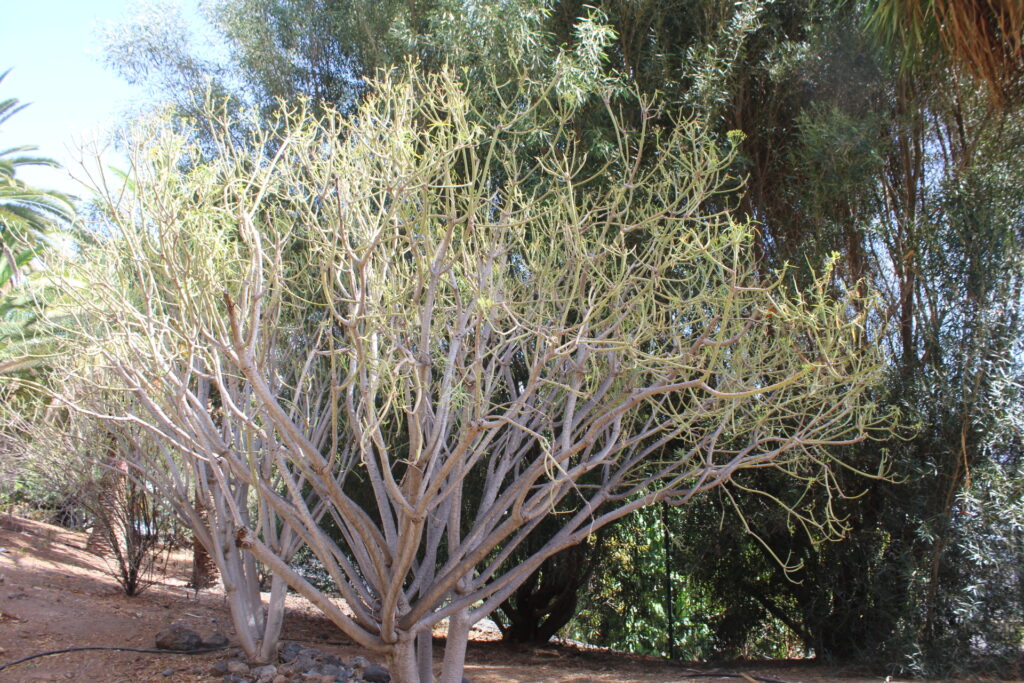
Euphorbia lamarckii forms a multi-stemmed shrub or small tree, typically reaching 2 to 5 metres in height. Its branching is notably more open and spreading than that of E. balsamifera, giving mature specimens a loose, airy silhouette — as clearly illustrated by the specimen photographed at the Palmetum de Tenerife. The bark is pale grey to whitish on older stems, strikingly bleached in appearance.
Stems and branches
The stems are semi-succulent, cylindrical, and entirely inerme (spineless). They store water reserves that sustain the plant through the dry season. The branching is dichotomous and relatively sparse compared to E. balsamifera, producing a more tree-like overall form. Older stems develop a smooth, pale greyish bark with characteristic transverse leaf-scar markings.
Leaves
Leaves are linear to linear-lanceolate, 15–60 mm long and 3–7 mm wide — distinctly longer and narrower than those of E. balsamifera. They are glaucous green, glabrous, and deciduous: shed during the summer drought to minimise water loss. The plant resumes growth with the onset of autumn rains.
Flowers and cyathia
As in all euphorbias, the actual flowers are reduced; the apparent « flower » is a cyathium — a cup-shaped involucre bearing nectar glands. In E. lamarckii, cyathia are solitary or grouped in terminal cymes, pale yellowish-green, with 5 spreading nectary glands. The species is monoecious. Flowering occurs in late winter to spring.
Ecology and distribution
Range
Euphorbia lamarckii is endemic to the Canary Islands, occurring on Tenerife, La Palma, Gran Canaria, and El Hierro. Unlike E. balsamifera, which extends to North Africa, this species is strictly Macaronesian. It is absent from the drier eastern islands (Lanzarote, Fuerteventura) where E. balsamifera dominates.
Habitat
The species occupies the transitional zone between the coastal euphorbia scrubland (dominated by E. balsamifera) and the thermophilous woodland above. It is most frequent between 200 and 800 m altitude, in areas with slightly more moisture than the purely arid coastal belt, though it tolerates seasonal drought well. It often forms mixed stands with Euphorbia canariensis, Pistacia atlantica, Olea europaea subsp. cerasiformis, and endemic Canarian shrubs.
Distinguishing Euphorbia lamarckii from E. balsamifera
The two species are frequently confused in the field. Key diagnostic features:
- Leaves: longer and narrower in E. lamarckii; shorter and more obovate in E. balsamifera
- Latex: strongly aromatic (balsamic) in E. balsamifera; less so in E. lamarckii
- Altitude: E. lamarckii tends to occur at greater elevations
- Range: E. balsamifera extends to Africa; E. lamarckii is Canary Islands only
- Bark: distinctly pale grey to white in E. lamarckii
Cultivation
Euphorbia lamarckii is occasionally grown in Mediterranean gardens and botanical collections. It requires full sun, excellent drainage, and a dry atmosphere. It tolerates mild frost (down to approximately −3°C when dry) and is generally more cold-tolerant than many succulent euphorbias. Watering should follow the Mediterranean pattern: moderate in autumn and spring, dry in summer. It is a slow-growing plant that eventually develops considerable ornamental character.
Conservation
Euphorbia lamarckii is not currently listed as threatened on the IUCN Red List, though ongoing habitat degradation in the Canary Islands — particularly urbanisation, agriculture, and invasive species — continues to reduce natural populations. It is protected under Canarian regional legislation.
References
Sweet, R. (1826). Hortus Britannicus. — Webb, P.B. & Berthelot, S. (1836–1850). Histoire Naturelle des Îles Canaries. — Molero, J. et al. (2002). Chromosome numbers and taxonomic notes on Macaronesian Euphorbia. — Rincón-Barrado, M. et al. (2024). Phylogenetics of the Euphorbia balsamifera complex.