Euphorbia balsamifera is a dioecious succulent shrub native to the Canary Islands and the Atlantic coast of northwest Africa. Known in Spanish as tabaiba dulce (sweet tabaiba), it occupies a singular position within the genus Euphorbia: unlike virtually all other succulent species in this vast genus, its milky latex is not caustic. This remarkable exception allowed indigenous Canarian peoples to use the sap as a form of chewing gum — a relationship between humans and plant with no parallel in the family Euphorbiaceae. Today, Euphorbia balsamifera is the official vegetable symbol of the island of Lanzarote, a dominant element of the iconic tabaibal-cardonal vegetation of the Canary Islands, and the subject of cutting-edge phylogeographic research that has turned conventional assumptions about island colonisation upside down.
Taxonomy and Nomenclature
Euphorbia balsamifera was described by the English botanist William Aiton in 1789, in the first edition of Hortus Kewensis (volume 2, page 137). The species is classified within Euphorbia section Balsamis Webb & Berthelot (1846), a small clade within the subgenus Athymalus.
The specific epithet balsamifera derives from the Latin balsamum (balsam) and ferre (to bear), referring to the resinous, balsam-like quality of the dried latex — which, unlike the acrid latex of most Euphorbia species, has a mild, almost sweet character.
Synonyms (POWO):
- Tithymalus balsamifer (Aiton) Haw. (1812)
- Euphorbia rogeri N.E.Br. (1911)
- Euphorbia balsamifera var. rogeri (N.E.Br.) Maire (1938)
- Euphorbia balsamifera subsp. rogeri (N.E.Br.) Guinea (1948)
- Euphorbia capazii Caball. (1935)
Common names: sweet tabaiba, balsam spurge (English); tabaiba dulce, tabaibera dulce (Spanish); euphorbe de Cayor, euphorbe candélabre (French); Balsam-Wolfsmilch (German); ifernane, fernán (Berber/Saharan).
Taxonomic Clarifications: Three Species, Not One
Until recently, Euphorbia balsamifera was circumscribed broadly to include two subspecies spanning from the Canary Islands to the Arabian Peninsula: subsp. balsamifera in the west and subsp. adenensis in the east (Horn of Africa, southern Arabia). A major integrative study by Riina et al. (2020), combining phylogenomics, morphometrics, and climatic niche analysis, demonstrated that this broad concept actually encompassed three distinct species:
- Euphorbia balsamifera Aiton (sensu stricto) — Canary Islands, coastal Morocco, and Western Sahara.
- Euphorbia adenensis Deflers — Horn of Africa, Sudan (Red Sea coast), southern Arabian Peninsula, and Socotra. Now accepted as a separate species by POWO.
- Euphorbia sepium N.E.Br. — Sahel zone, from Mauritania and Senegal across to Niger, Nigeria, and Chad. Resurrected from synonymy.
The present article treats Euphorbia balsamifera in the strict sense (sensu stricto), as accepted by POWO: the western species restricted to the Canary Islands and the adjacent Atlantic coast of northwest Africa.
Description
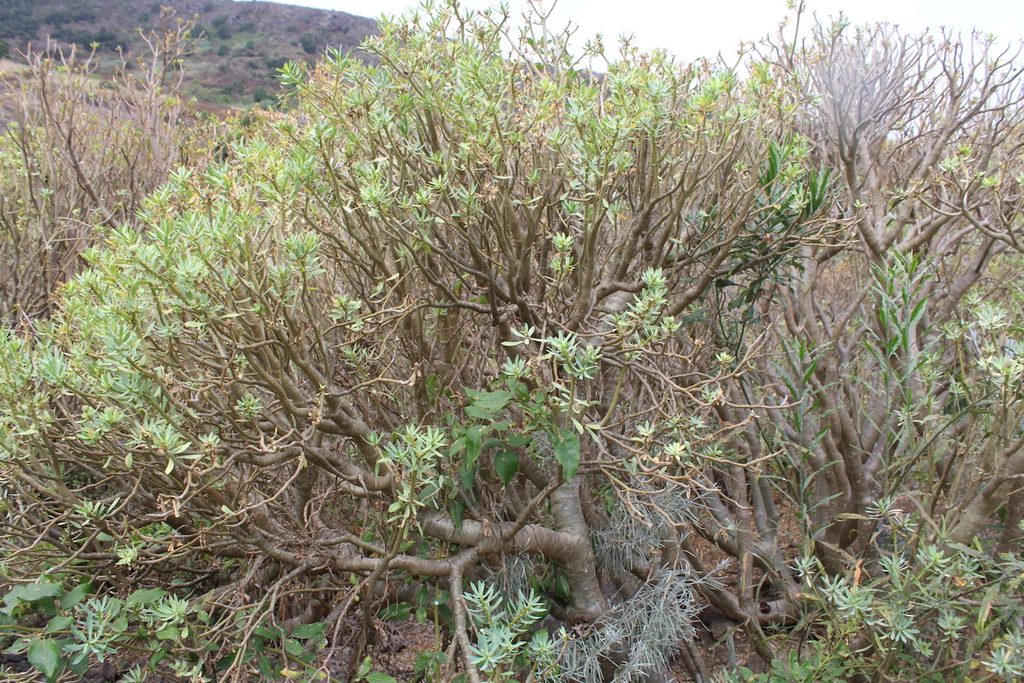
Euphorbia balsamifera is a semi-succulent, dioecious (male and female flowers on separate individuals) dendroid shrub, highly variable in size depending on exposure and growing conditions.
Habit and Stems
The plant ranges from low, wind-sculpted cushions barely 30 cm tall on exposed coastal cliffs to small trees reaching 3 to 5 m in sheltered valleys. It branches dichotomously (repeatedly forking in two) from the base, producing a rounded, dense, compact crown. The stems are semi-succulent, up to 15 cm in diameter, without spines — a notable contrast with most succulent euphorbias. The bark is smooth in young stems, becoming grey, knotty, and attractively gnarled with age. Old specimens develop a short, thickened, pachycaul trunk that gives them a bonsai-like appeal highly prized by collectors.
Leaves
The leaves are clustered in rosettes at the tips of the branches. They are fleshy, sessile, linear-lanceolate to ovate, 4 to 8 cm long by 4 to 8 mm wide, glaucous grey-green. The species can be evergreen in favourable conditions but is often deciduous during prolonged drought, shedding its leaves and relying on photosynthesis through the green stem tissue.
Flowers
Euphorbia balsamifera is dioecious: individual plants produce either male or female cyathia, not both. This is relatively uncommon in the genus Euphorbia, where most species are monoecious. The inflorescences are terminal, often reduced to a single, semi-sessile cyathium approximately 6 mm in diameter at the tip of each branch. Flowers are pale yellow to greenish-yellow, appearing in late winter to early spring.
Fruit and Seeds
The fruit is a small, three-lobed capsule typical of the genus. When ripe, it splits explosively to eject the seeds — a common dispersal mechanism among euphorbias.
Latex — The “Sweet” Exception
The most distinctive feature of Euphorbia balsamifera is its latex. While the milky sap of almost all Euphorbia species is intensely irritant, vesicant, and potentially dangerous to skin and eyes, the latex of Euphorbia balsamifera is remarkably mild — non-pungent and only slightly irritating. This is a unique characteristic among Canarian tabaibas and, indeed, among succulent euphorbias worldwide. It is this exceptional mildness that earned the plant its common name tabaiba dulce (sweet tabaiba), distinguishing it from the tabaibas amargas (bitter tabaibas) such as Euphorbia lamarckii and Euphorbia regis-jubae, whose latex is caustic.
Despite this relative mildness, the latex should still be treated with caution: it remains a skin irritant for sensitive individuals and should not be allowed to contact the eyes.
Distribution and Habitat
According to POWO, Euphorbia balsamifera (sensu stricto) is native to the Canary Islands, Morocco (southern Atlantic coast), and Western Sahara.
Canary Islands
Euphorbia balsamifera is present on all seven main islands of the Canary archipelago. It is one of the most abundant and characteristic species of the tabaibal-cardonal — the iconic succulent shrubland formation that dominates the dry, thermophilous coastal zone from sea level to approximately 800 m altitude. In this vegetation type, Euphorbia balsamifera grows alongside other succulent euphorbias (notably Euphorbia canariensis, Euphorbia lamarckii, Euphorbia regis-jubae) and associated species such as Kleinia neriifolia and Plocama pendula. The tabaibal dominated by Euphorbia balsamifera is one of the most widespread and ecologically significant plant communities in the Canary Islands.
On Lanzarote, Euphorbia balsamifera has been officially designated as the vegetable symbol of the island — a recognition of its ecological, cultural, and landscape significance in one of the driest and most volcanic of the Canary Islands.
Continental Africa
On the African mainland, Euphorbia balsamifera occurs in scattered populations along the Atlantic coast of southern Morocco and northern Western Sahara. These continental populations were long assumed to represent the ancestral stock from which the Canarian populations derived. However, recent phylogeographic research has overturned this assumption (see Biogeography).
Habitat
The species grows on rocky substrates (including volcanic lava flows, or malpaíses), sandy dunes (except highly mobile dune fields), coastal cliffs, and calcareous or gypseous soils. It thrives in full sun under extremely arid conditions, with annual rainfall as low as 100–200 mm. It is highly tolerant of wind — including salt-laden coastal winds — and extreme heat.
Biogeography: Back-Colonisation from Islands to Continent
Euphorbia balsamifera is one of the classical examples of the Rand Flora disjunction — a biogeographic pattern in which closely related plant taxa are found on opposite sides of Africa, separated by thousands of kilometres, as a result of the progressive aridification of the Sahara since the late Miocene.
A groundbreaking phylogeographic study published in Annals of Botany (2024) by Villaverde et al. used population genomic data (Hyb-Seq) and convolutional neural networks to reconstruct the colonisation history of Euphorbia balsamifera across the Canary Islands and northwest Africa. The results were remarkable:
- Colonisation of the Canary Islands followed an east-to-west stepping-stone pattern, beginning with Lanzarote and Fuerteventura (the oldest and nearest islands to Africa), then proceeding to the central and western islands.
- After initial colonisation, populations on Lanzarote and Fuerteventura went locally extinct and were subsequently recolonised from Tenerife and Gran Canaria — a finding consistent with the Surfing Syngameon Hypothesis.
- Most remarkably, the continental populations in Morocco and Western Sahara are not the ancestral source population: they originated from back-colonisation events from Lanzarote and Fuerteventura to the African mainland. In other words, the African plants descend from the island plants, not the other way around.
This finding challenges the widespread assumption that oceanic islands are evolutionary dead ends — mere sinks for continental biodiversity. Instead, the Canary Islands have acted as a source of genetic novelty, exporting new lineages back to the continent. Euphorbia balsamifera thus provides one of the strongest documented examples of island-to-continent back-colonisation in plants.
Ethnobotany and Cultural Significance
Guanche Uses
The indigenous Guanche people of the Canary Islands are believed to have used the mild latex of Euphorbia balsamifera as a form of natural chewing gum — a practice made possible only by the non-caustic nature of the sap. The latex was also reportedly used for dental hygiene.
Traditional Medicine
In Morocco and the Sahel, the latex has been used in traditional medicine, notably as a dental anaesthetic for the treatment of acute toothache (dental pulpitis). The leaves, stems, and roots have also been used in preparations with antibacterial properties, with studies confirming activity against Escherichia coli, Staphylococcus aureus, Pseudomonas aeruginosa, and Candida albicans.
Food
The leaves were traditionally gathered and cooked as a green vegetable in parts of the Canary Islands — again a use made possible by the atypically mild latex.
Livestock
While cattle do not browse the plant, sheep, goats, and camels in Senegal and the Sahel are reported to eat the leaves and fallen foliage.
Cultivation
Euphorbia balsamifera is an excellent plant for collectors, bonsai enthusiasts, and xeriscape gardens. Its spineless stems, compact rounded crown, and attractively gnarled trunk give mature specimens a sculptural quality that few other succulents can match. Large, old potted specimens command high prices in the specialist trade.
Light
Full sun. The species requires maximum light exposure. In insufficient light, stems elongate and the characteristic dense, rounded habit is lost. It tolerates light partial shade in extremely hot climates.
Soil
Well-drained, mineral-rich substrate. A mix of coarse sand, pumice, and a small proportion of organic matter is ideal. The species tolerates a wide range of soil types in the ground (including rocky, calcareous, and volcanic substrates) provided drainage is excellent.
Watering
Very drought-tolerant. Water sparingly during the growing season, allowing the substrate to dry completely between waterings. Reduce watering during the dormant period. Overwatering is the primary cause of failure — root rot develops rapidly in waterlogged soil.
An important note on growth rhythm: unlike many succulents, Euphorbia balsamifera has its main growth period in autumn and winter (corresponding to the cool, moist season in its native Canary Islands). It may enter a period of semi-dormancy during the hottest summer months. Adjust watering accordingly: slightly more generous in autumn/winter, very restrained in summer.
Temperature and Hardiness
Euphorbia balsamifera is moderately frost-sensitive but notably hardier than most tropical succulent euphorbias, reflecting its origin in the Canary Islands, where winter temperatures at lower altitudes occasionally approach 0 °C.
DavesGarden lists the species as hardy to USDA zone 9b, i.e. approximately -3.8 °C (25 °F). This makes it significantly more cold-tolerant than species like Euphorbia ingens or Euphorbia tirucalli, and real-world examples in southern France confirm that permanent outdoor cultivation is achievable in the most favourable zone 9b microclimates.
A documented success in Provence: Euphorbia balsamifera grows permanently in the ground at the Domaine du Rayol — the Jardin des Méditerranées designed by Gilles Clément — in Rayol-Canadel-sur-Mer (Var), within the Canary Islands section of this remarkable botanical garden. The site, which occupies a sheltered south-facing slope on the Corniche des Maures opposite the Îles d’Hyères, benefits from a particularly mild coastal microclimate with excellent air drainage and minimal frost. Photographs taken in January and May confirm the species thrives there year-round, displaying its characteristic deciduous summer rhythm and leafy winter growth. This is one of the most reliable documented examples of Euphorbia balsamifera grown outdoors in continental Europe north of the Canary Islands.
Key conditions for outdoor success in zone 9b: The Domaine du Rayol example illustrates that permanent outdoor planting is possible — but only where several conditions are met simultaneously: a sheltered coastal position with minimal frost frequency, excellent air drainage (slope or elevated site, avoiding cold air pooling), well-drained soil (rocky or sandy substrate), and protection from cold north or northwest winds. In less favourable zone 9b situations — inland valleys, flat terrain prone to cold air accumulation, or positions exposed to the mistral — the long-term risk of losing the plant during an unusually severe winter remains real. The species is more forgiving than Euphorbia ingens in this regard, but it is not immune to a sustained freeze below -4 or -5 °C, particularly if accompanied by wet conditions.
Practical recommendation: In the mildest coastal positions of the French Riviera and Var littoral, permanent outdoor planting in well-drained ground is a reasonable bet. Elsewhere in zone 9b, container culture with frost-free winter shelter (5–10 °C, bright conditions) remains the safer long-term strategy. In the Canary Islands, southern coastal Spain, coastal Portugal (Algarve), and other near-frost-free Mediterranean microclimates, Euphorbia balsamifera can of course be grown outdoors with full confidence.
What the forums say — and don’t say — about frost failures: A thorough review of the main English-language forums (DavesGarden, Agaveville, CactiGuide), French-language forums (CactusPro, Au Jardin), and reference databases (Llifle, World of Succulents) reveals a striking pattern: no documented case of a grower reporting the outright loss of an Euphorbia balsamifera to frost could be found. On DavesGarden, a contributor notes that the species “does take some frost despite published info that it doesn’t, but can lose or damage leaves — plant seems to survive OK, though.” On Agaveville, a Californian grower with specimens at Huntington Botanical Gardens (Pasadena, zone 10a) confirms the species is “fairly cold tolerant, at least down to around 25 °F” (-3.9 °C). On CactusPro, experienced French collectors consistently overwinter their Euphorbia balsamifera in unheated but frost-free verandas or cold greenhouses — not because they have lost plants to cold, but as a precautionary reflex. One CactusPro member (pfptero), who maintains an extensive Euphorbia collection including cold-tested species, writes explicitly that his Euphorbia balsamifera is “overwintered frost-free” alongside his Euphorbia piscatoria. Notably, however, the same grower did lose an Euphorbia dendroides — a species generally considered hardier than Euphorbia balsamifera — during the severe February 2012 cold event at -5 °C, in a pot with wet substrate. This indirect data point is a useful warning: wet substrate combined with sustained cold below -5 °C is a lethal combination even for relatively hardy species in this group.
The absence of documented frost deaths likely reflects two factors: the species genuinely tolerates brief light frosts better than most succulent euphorbias, and most collectors never give it the opportunity to fail by systematically sheltering it in winter. The Domaine du Rayol remains the best-documented proof that the species can survive repeated winters outdoors in continental Europe — in the right microclimate. The reference database Llifle recommends keeping the plant dry above 4 °C in winter, while World of Succulents gives a more conservative hardiness of -1.1 °C (30 °F), zones 10a to 11b.
Propagation
- Stem cuttings: The most practical method. Take a branch cutting in spring, allow the cut end to callus for several days to a week, and plant in a well-drained mix (50% peat or coir, 50% perlite). Keep in bright indirect light and water only when the substrate is dry. Rooting typically occurs within a few weeks.
- Seed: Seeds are viable but small and short-lived. Sow fresh seed as soon as possible in a warm, sunny position in well-drained cactus mix.
Pests and Diseases
Few problems. The species is not eaten by livestock or termites. Mealybugs are the most common pest in cultivation. Root rot from overwatering is the primary disease risk.
Conservation Status
Euphorbia balsamifera is not currently listed as threatened. It is locally abundant across the Canary Islands and forms a dominant component of the tabaibal vegetation. Like all succulent Euphorbia species, it is listed on CITES Appendix II, regulating international trade in wild-collected specimens.
FAQ
Why is Euphorbia balsamifera called “sweet”?
Unlike virtually all other Euphorbia species, its latex is not caustic or intensely irritating. The Canarian common name tabaiba dulce (sweet tabaiba) distinguishes it from the tabaibas amargas (bitter tabaibas) whose latex is acrid and dangerous.
Is Euphorbia balsamifera the same as Euphorbia adenensis?
No. Until recently, Euphorbia adenensis from the Horn of Africa and the Arabian Peninsula was treated as a subspecies of Euphorbia balsamifera. Molecular and morphological research (Riina et al., 2020) has demonstrated that they are distinct species, and POWO now accepts Euphorbia adenensis as a separate taxon.
Can I grow Euphorbia balsamifera as a bonsai?
Yes — and this is one of its most prized uses. Old specimens naturally develop a short, pachycaul trunk with attractively gnarled bark and a compact rounded crown that responds well to shaping. Large bonsai-style specimens are among the most expensive plants in the specialist succulent trade.
Is the latex of Euphorbia balsamifera safe to touch?
It is far milder than the latex of other Euphorbia species and does not cause the chemical burns typical of, for example, Euphorbia ingens or Euphorbia tirucalli. However, it is still a skin irritant for sensitive individuals and should be kept away from the eyes. Handle with normal garden gloves as a precaution.
Key Takeaways
Euphorbia balsamifera is that rarest of things: an Euphorbia you can almost trust. Its gentle latex, its austere beauty, and its extraordinary biogeographic story — from Rand Flora relic to island colonist to back-migrant to Africa — make it one of the most scientifically fascinating and horticulturally rewarding species in a genus of over 2,000. For growers in warm, dry climates, few succulents offer a more elegant combination of sculptural form, extreme drought tolerance, and sheer botanical intrigue.
Sources and References
Llifle (Encyclopedia of Living Forms) — Euphorbia balsamifera.
Plants of the World Online (POWO), Royal Botanic Gardens, Kew — Euphorbia balsamifera Aiton. Accepted name.
Villaverde, T. et al. (2024). “The sweet tabaiba or there and back again: phylogeographical history of the Macaronesian Euphorbia balsamifera.” Annals of Botany, 133(5–6): 883–898.
Riina, R. et al. (2020). “More than one sweet tabaiba: disentangling the systematics of the succulent dendroid shrub Euphorbia balsamifera.” Journal of Systematics and Evolution, 59(6): 1173–1190.
Marrero Gómez, M.C. et al. (2000). “Contribución al estudio etnobotánico de la tabaiba dulce (Euphorbia balsamifera).” Anuario de Estudios Atlánticos, 46: 19–76.