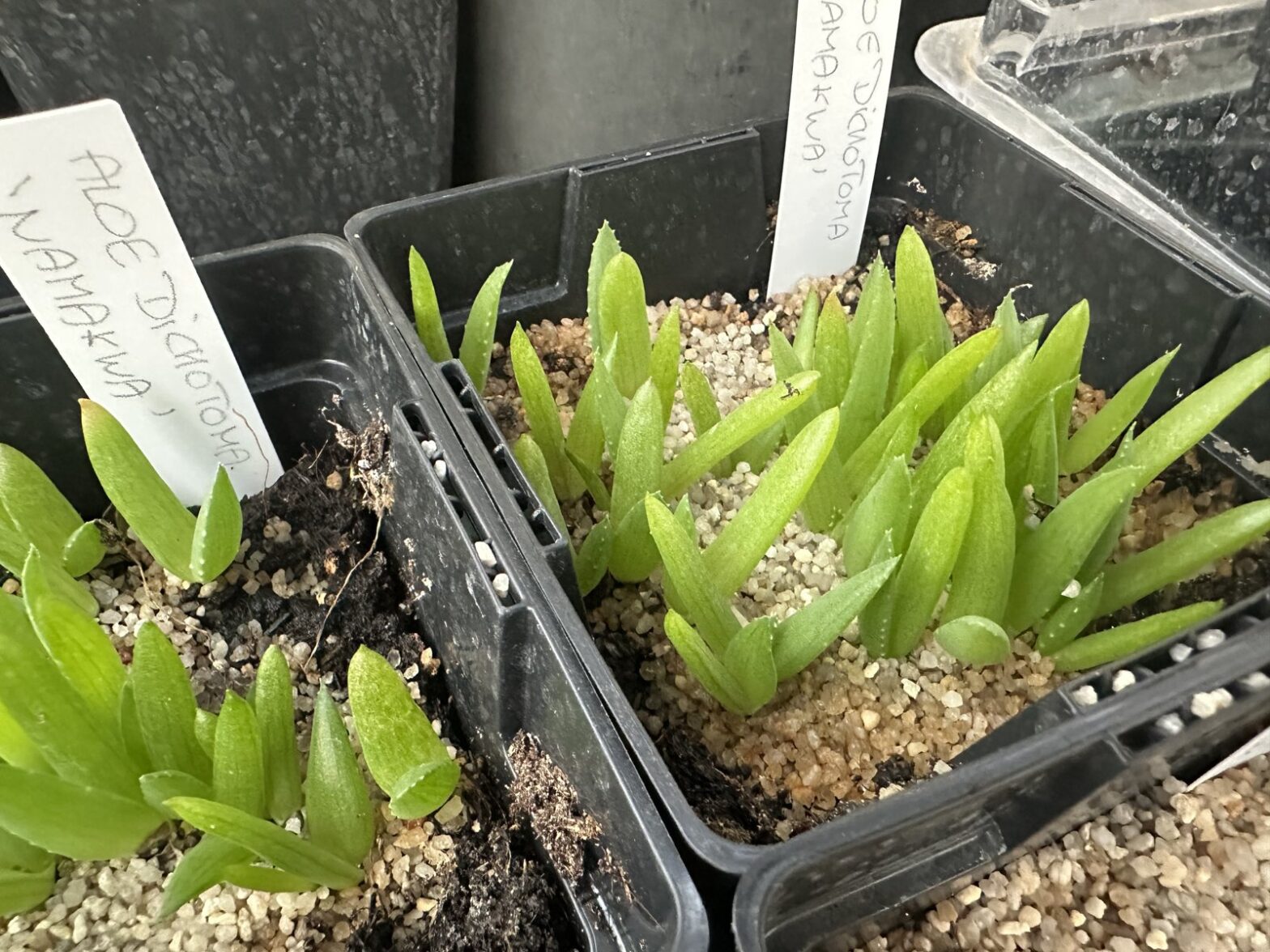
Growing aloes from seed is the only way to raise genuinely new plants, genetically distinct from their parents. It is also the way into many species that garden centres rarely stock, from small rockery aloes to the great tree aloes of the genus Aloidendron. Sowing itself is not difficult: fresh seed, kept warm on a clean, gritty mix, usually comes up within a few weeks. When aloe seed fails, the cause is almost always elsewhere — old seed, too little warmth, a mix that is too rich or too wet, and above all damping-off in the months after germination.
This guide deals with seed only, from ripe capsule to first repotting. For offsets, cuttings and tissue culture, see our overview How to Propagate Aloes: Offsets, Cuttings, Seeds and Micropropagation; for the genus as a whole, see The genus Aloe.
Getting aloe seed
You almost always need two plants
A lone aloe, however freely it flowers, often sets little or no seed. Research on several South African species has shown self-incompatibility at work: in Aloe tenuior, pollen from the same plant reaches its own ovules, yet self-pollinated flowers produced no fruit at all. In practice you need two genetically different individuals, raised from different seeds. Two offsets from the same mother plant are clones and behave as a single plant.
To hand-pollinate, pick up pollen from an open flower on plant A with a fine paintbrush and dab it onto the stigma of a flower on plant B, then do the reverse. Aloe flowers shed their pollen before their own stigma becomes receptive (protandry), so on the receiving plant choose flowers that have been open for a day or two, with the style extended beyond the stamens.
Garden seed is usually hybrid
Aloes hybridise readily, and their pollinators — birds and bees — move freely from one species to the next. Seed collected in a garden where several aloes bloom at the same time is very likely to be hybrid. The seedlings will be perfectly viable, but they will not match the label on the mother plant. If species identity matters to you, bag the inflorescence in fine mesh after hand-pollinating, or buy seed with documented provenance.
Harvesting the capsules
The aloe fruit is a three-chambered capsule, green when young, turning brown and dry as it ripens before splitting into three valves. Ripe seeds are numerous, flat, greyish-brown to black, and often surrounded by a papery wing that helps the wind carry them. Pale or whitish seeds are immature and will not germinate. Pick the capsules as soon as they turn brown and begin to split at the tip, and let them finish opening in a paper bag.
Fresh seed is best
Growers agree that aloe seed germinates best when fresh and loses vigour over the months. Sow within weeks of harvest if you can and, for bought seed, within the year. Until then, keep it cool and dry in a paper envelope.
What about Aloe vera?
Aloe vera has been propagated almost exclusively from offsets for centuries and rarely sets seed in cultivation. Packets sold online under that name sometimes contain other species or hybrids. If you simply want more Aloe vera plants, dividing offsets is far quicker and more reliable.
Aloe seed and CITES
The whole genus Aloe is listed in CITES Appendix II, except for around twenty species in Appendix I (among them Aloe polyphylla and Aloe pillansii, now Aloidendron pillansii) and Aloe vera, which is expressly excluded from the Appendices. For Appendix II species, the applicable annotation exempts seed, so no CITES permit is needed to trade it internationally; seed of Appendix I species remains regulated. Before importing, check the species on the official Species+ database or with your national CITES authority, as national rules (including EU Regulation 338/97) apply on top of the Convention.
When to sow
You have two options. Sow immediately after harvest, which gives the best germination, provided you can supply warmth and light (heat mat, grow light) if that falls in winter — common for winter-flowering species. Or sow in spring, once temperatures stay above 20 °C (68 °F), which gives the seedlings a full growing season before their first winter. In a Mediterranean-type climate, sowing under cover between April and June works for most species without extra heat.
Seed mix and containers
The sowing mix should be free-draining, lean and clean. Equal parts sieved seed compost (or cactus compost) and fine mineral grit — pumice or lava rock of 1–3 mm (about 1/16–1/8 in), perlite or washed sharp sand — works well. Avoid rich multipurpose composts, which stay soggy and encourage rot.
Sterilising the mix noticeably reduces damping-off: bake it moist in a covered dish for about half an hour at 100–120 °C (210–250 °F), or drench it with boiling water, then let it cool completely. Use clean pots or trays 6–10 cm (2½–4 in) deep, with drainage holes.
Sowing step by step
- Fill the pots to 1 cm (½ in) below the rim and firm lightly to a level surface.
- Water from below: stand the pots in a saucer of water until the surface darkens, then let them drain.
- Lay the seeds flat on the surface, 1–2 cm (½–¾ in) apart. Soaking is not necessary; if you do soak them, use water at room temperature, 20–25 °C (68–77 °F), for a few hours — never hot or warm water. The wings can be left on.
- Cover with a very thin layer, 1–2 mm (about 1/16 in), of fine sand or grit — just enough to anchor the seed and keep the surface dry around the necks of the future seedlings.
- Label each pot with the species or cross, sowing date and source.
- Cover with a clear lid, a clear plastic bag or a propagator to hold humidity during germination, and air it for a few minutes each day.
Temperature and light
Warmth is what matters most. Aim for 20–25 °C (68–77 °F) at the surface of the mix, ideally night and day; a thermostatic heat mat is the simplest way to get there. A study of three threatened South African aloes (Aloe modesta, Aloe peglerae and Aloe reitzii) tested temperatures from 15 to 30 °C (59–86 °F): at 15 °C, germination of A. modesta was clearly inhibited, while higher temperatures shortened germination time in the other two species.
Light is not required for germination — in the same study, all three species germinated faster in darkness than under light. Seedlings, however, need light from the moment they emerge. Keep the pots somewhere bright but out of direct sun (sun on a closed lid can overheat the seed), or under an LED grow light 20–30 cm (8–12 in) above, for 12–14 hours a day.
Germination
At 20–25 °C (68–77 °F), fresh aloe seed usually germinates within one to four weeks, often during the second week. Emergence is frequently staggered, so do not give up on a pot because only a few seeds have come up; wait at least six to eight weeks before drawing conclusions. Aloes are monocots: the seedling first appears as a thin green hook (the single cotyledon), which straightens and often carries the seed coat on its tip. The first true leaves follow a few weeks later; in many species they are arranged in two opposite ranks before the plant forms a rosette.
Seedling care
Preventing damping-off
Damping-off, caused by soil-borne fungi and water moulds (Pythium, Rhizoctonia, Fusarium and others), makes seedlings collapse at the base, often overnight. Prevention rests on three things: a sterilised, free-draining mix; a mineral top layer that dries quickly; and gradual ventilation as soon as seedlings appear. Open the lid a little more each day over one to two weeks, then remove it. Lift out any seedling that collapses straight away, along with the mix around it.
Watering, light and feeding
Unlike mature aloes, seedlings have almost no water reserves, so do not let them dry out for days at a time in their first months. Water from below or with a mister whenever the surface is dry. Increase light gradually: a pale, stretched, flopping seedling needs more light; one that turns red or brown has had too much too soon. After one to two months, a cactus fertiliser at a quarter of the label rate, once a month during the growing season, makes up for the lean mix.
First repotting
There is no hurry: young aloes are happy growing close together. Prick them out once they are a few centimetres (about an inch or more) tall with several true leaves, which usually takes some months. Tip out the whole root ball, tease the seedlings apart while holding them by a leaf, never by the stem, and pot them singly or in small groups into 5–7 cm (2–3 in) pots of ordinary succulent mix. Wait a few days before watering so that damaged roots can heal.
The first winter
Even species that are hardy as adults — see our guide to cold hardy aloes — are tender as seedlings. Keep first-year seedlings frost-free and in full light over winter, with reduced but not stopped watering.
Growth and first flowering
Growing aloes from seed takes patience, and species differ enormously. Small aloes and fast, shrubby species make an attractive rosette within one to two years and can flower after a few years. Large solitary aloes take considerably longer. Tree aloes such as Aloidendron dichotomum are a long-term project: expect more than a decade before the first flowers. Published figures are scarce and vary widely with growing conditions.
Common mistakes
- Sowing old seed or seed of unknown origin.
- Sowing too cold: below about 15–18 °C (59–64 °F), germination becomes slow, patchy or nil.
- Burying the seed under several millimetres of compost instead of a thin layer of grit.
- Leaving the lid on for weeks after germination, so that constant condensation invites damping-off.
- Treating seedlings like mature plants by leaving them bone dry for weeks, especially in winter.
- Expecting seed from a single plant or from two offsets of the same plant.
Quick reference
| Stage | Key points |
|---|---|
| Getting seed | Cross-pollinate two genetically distinct plants; expect hybrids from garden seed |
| Harvest | Capsules browning and splitting; seeds dark, flat, often winged |
| When to sow | Straight after harvest (with heat if needed) or in spring above 20 °C (68 °F) |
| Mix | Half sieved fine compost, half fine grit 1–3 mm (1/16–1/8 in), sterilised |
| Depth | On the surface, under 1–2 mm (1/16 in) of fine sand or grit |
| Temperature | 20–25 °C (68–77 °F); germination inhibited around 15 °C (59 °F) |
| Light | Optional for germination; essential once seedlings emerge, no direct sun on a closed lid |
| Time to germinate | One to four weeks for fresh seed; often staggered |
| Ventilation | Open the lid gradually over one to two weeks after emergence |
| Pricking out | When seedlings are a few cm tall, after some months |
| First winter | Frost-free, bright, watering reduced but not stopped |
Frequently asked questions
How long do aloe seeds take to germinate?
Usually one to four weeks for fresh seed kept at 20–25 °C (68–77 °F). Older seed or a cool room can make it much slower and more uneven.
Can you grow Aloe vera from seed?
Yes, with the same method, if the seed is genuine. But Aloe vera rarely sets seed in cultivation, and dividing offsets is much simpler.
My aloe flowered but made no seed. Why?
Most likely it received no pollen from another individual. Most aloes are self-incompatible, so a single plant — or several offsets of one plant — will not set viable seed. You need a second plant grown from a different seed, and sometimes hand-pollination.
Will seed from my aloe come true?
Not necessarily. If other aloes were flowering nearby, the seedlings are probably hybrids. Named cultivars and hybrids never come true from seed; only offsets are exact copies.
Should I soak aloe seeds before sowing?
It is not necessary: fresh seed germinates well on a moist, warm surface. If you prefer to soak, a few hours in water at room temperature, 20–25 °C (68–77 °F), is enough — not hot or warm water.
Do I need a permit to buy aloe seed from abroad?
Not under CITES for Appendix II species, whose seed is exempt. Seed of Appendix I species such as Aloe polyphylla remains regulated, and national plant health rules may also apply. Check Species+ before importing.
Sources
- Duffy K.J., Johnson S.D. & Peter C.I. (2014). A temporal dimension to the influence of pollen rewards on bee behaviour and fecundity in Aloe tenuior. PLoS ONE 9(4): e94908. doi:10.1371/journal.pone.0094908
- Amoo S.O., Hlatshwayo N.A., Doležal K. & Olowoyo J.O. (2022). Seed germination and in vitro propagation of three threatened endemic South African Aloe species. South African Journal of Botany 147: 1214–1220. doi:10.1016/j.sajb.2022.04.033
- CITES Secretariat, Checklist of CITES Species: checklist.cites.org
- UNEP-WCMC, Species+ database: speciesplus.net