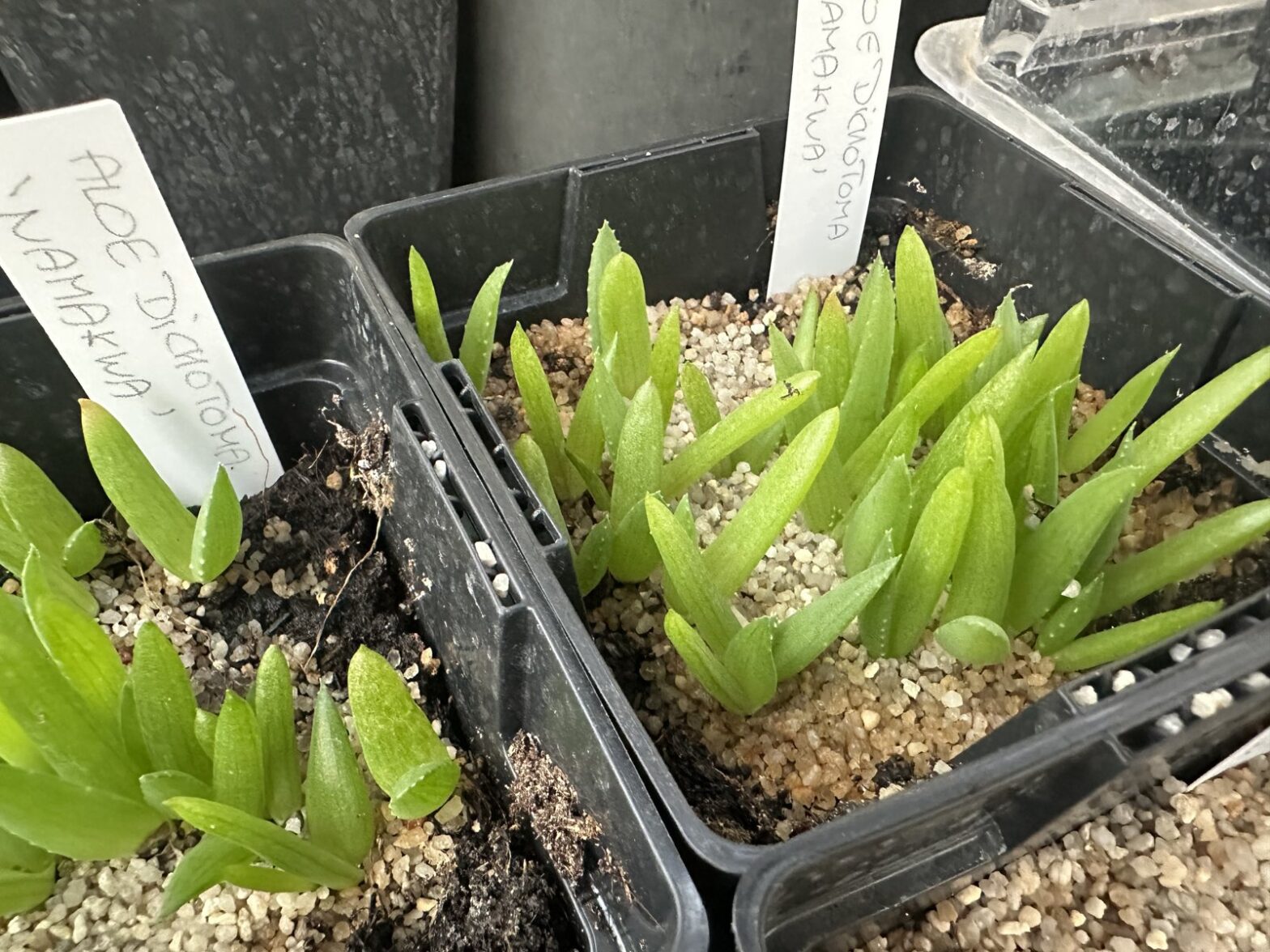
Cross-pollination, harvesting capsules, seed mix, temperature, germination and seedling care: a practical guide to raising aloes from seed.
Category: aloe
Cold Hardy Aloes: Which Species Survive Frost Outdoors?
Most aloes are frost-tender — their gel-filled leaves freeze, the cells burst, and the plant turns to mush. But a surprising number of species from the high-altitude grasslands, mountain slopes and winter-cold plateaus of southern Africa tolerate temperatures well below freezing and can be grown outdoors year-round in climates far colder than most gardeners realise.… Continue reading Cold Hardy Aloes: Which Species Survive Frost Outdoors?
Aloe not flowering
Aloes are flowering plants. In their natural habitats across southern and eastern Africa, Madagascar and the Arabian Peninsula, mature aloes bloom reliably every year, producing striking racemes of tubular flowers in shades of red, orange, yellow, coral and pink that attract sunbirds, bees and other pollinators. Yet most cultivated aloes — particularly those grown indoors… Continue reading Aloe not flowering
How to Propagate Aloes: Offsets, Cuttings, Seeds and Micropropagation
Aloes can be multiplied in four fundamentally different ways, each suited to a different situation: division of offsets (the easiest and most reliable method for home growers), stem and leaf cuttings (a useful fallback when offsets are unavailable), seed (the only way to produce new genetic individuals and the method of choice for species conservation… Continue reading How to Propagate Aloes: Offsets, Cuttings, Seeds and Micropropagation
Aloe Root Rot: Pathogens, Diagnosis, Treatment and Prevention
Root rot is the leading cause of death in cultivated aloes. It is not a single disease but a collective term for infections caused by several different soil-borne organisms — primarily the oomycetes (water moulds) Pythium and Phytophthora, and the true fungi Fusarium and Rhizoctonia — that attack and destroy the root system of a… Continue reading Aloe Root Rot: Pathogens, Diagnosis, Treatment and Prevention
Aloe Thrips (Hercinothrips dimidiatus): An Emerging Pest of Aloes in Europe — Identification, Damage and Control
Hercinothrips dimidiatus Hood is a tiny thrips of South African origin that has emerged in the last decade as a serious and spreading pest of cultivated aloes across southern Europe. First detected in Portugal in 2012 on Aloe arborescens, it has since been recorded in Italy (Sicily, 2021), France (Corsica, 2018), the Netherlands (in a… Continue reading Aloe Thrips (Hercinothrips dimidiatus): An Emerging Pest of Aloes in Europe — Identification, Damage and Control
Overwatered Aloe: How to Recognise the Signs, Rescue the Plant and Prevent It from Happening Again
Overwatering kills more aloe plants than drought, frost and pests combined. This is not an exaggeration — aloes evolved in the semi-arid savannas and rocky hillsides of southern and eastern Africa, where their roots experience weeks or months of completely dry soil between infrequent rain events. Their thick, gel-filled leaves are biological water tanks designed… Continue reading Overwatered Aloe: How to Recognise the Signs, Rescue the Plant and Prevent It from Happening Again
Aloe Mite (Aceria aloinis): How to Identify, Treat and Prevent the Most Destructive Alooid Pest
The aloe mite, Aceria aloinis Keifer, is a microscopic eriophyid mite that causes disfiguring gall-like growths on aloes and related succulents — a condition widely known among growers as “aloe cancer.” Unlike mealybugs, scale insects or spider mites, which are visible to the naked eye and attack the surface of the plant, aloe mites are… Continue reading Aloe Mite (Aceria aloinis): How to Identify, Treat and Prevent the Most Destructive Alooid Pest
Is Aloe vera Toxic to Cats and Dogs? What to Do Now
You have an Aloe vera on the windowsill and a cat that chews everything green. Or a puppy that investigates the world mouth-first. The question is inevitable: is Aloe vera toxic to pets? The short answer is yes — Aloe vera is listed as toxic to cats, dogs and horses by the ASPCA (American Society for the Prevention of Cruelty to Animals). But the… Continue reading Is Aloe vera Toxic to Cats and Dogs? What to Do Now
How to Repot Aloe vera: The Complete Step-by-Step Guide
Repotting is the single most useful thing you can do for an Aloe vera that has stopped growing, started tipping over or filled its pot with a tangle of roots and offsets. It is also the moment when more plants are killed than at any other time — not because repotting is difficult, but because people make… Continue reading How to Repot Aloe vera: The Complete Step-by-Step Guide