
Aloe vera is the most widely cultivated species in the genus Aloe, yet its wild origins remained uncertain until molecular phylogenetics confirmed the Arabian Peninsula — specifically the Hajar Mountains of Oman — as its native homeland. Prized for millennia for the translucent gel stored in its thick, succulent leaves, it has been carried along trade routes since antiquity and is now naturalized across every warm continent, from North Africa and the Canary Islands to the Caribbean and Southeast Asia. Despite this global ubiquity, Aloe vera is one of the least cold-tolerant members of its genus: its water-laden mesophyll, the very tissue that makes it medicinally valuable, renders it fatally vulnerable to freezing. This article examines the species in depth — its ecology, morphology, and taxonomy — and draws on grower reports from specialized forums to establish the precise temperature thresholds that determine success or failure under temperate climates.
Family: Asphodelaceae Subfamily: Asphodeloideae Genus: Aloe Accepted name (POWO): Aloe vera (L.) Burm.f., Flora Indica (1768) Principal synonyms: Aloe barbadensis Mill. (1768), Aloe vulgaris Lam. (1783), Aloe indica Royle (1839), Aloe perfoliata var. vera L. (1753) Common names: True Aloe, Barbados Aloe, Medicinal Aloe, Burn Plant, First-Aid Plant
Taxonomy and Nomenclature
Aloe vera was first described by Carl Linnaeus in 1753 as Aloe perfoliata var. vera in Species Plantarum. It was subsequently raised to species rank by Nicolaas Laurens Burman in 1768 in Flora Indica. Ten days later, Philip Miller independently described it as Aloe barbadensis in the Gardener’s Dictionary — a synonym that persists in older horticultural and pharmaceutical literature to this day. The epithet vera comes from the Latin verus, meaning “true,” while the genus name Aloe derives from the Arabic alloeh (“bitter and shiny substance”).
POWO currently lists 17 synonyms for Aloe vera, reflecting centuries of independent descriptions as the plant was carried along trade routes and mistaken for distinct species in each new territory. The spotted form sometimes labelled Aloe vera var. chinensis may be conspecific with Aloe massawana, a question that remains unresolved.
Molecular phylogenetic analyses (Grace et al., 2015) place Aloe vera within a clade of Arabian species closely related to Aloe perryi (endemic to Socotra, Yemen), Aloe forbesii, Aloe inermis, Aloe scobinifolia, and Aloe sinkatana. This evolutionary context is important: it confirms that the species evolved at the extreme northern limit of the natural range of aloes, in habitats characterized by severe aridity and wide diurnal temperature swings — conditions that explain much of its physiology and its surprisingly narrow cold tolerance.
Distribution and Ecology
Native Range
Aloe vera is native to the southeastern Arabian Peninsula, specifically the Hajar Mountains of northeastern Oman and the eastern United Arab Emirates. This attribution, long debated, was clarified by the phylogenetic study of Grace et al. (2015, BMC Evolutionary Biology), which placed the species unambiguously among related Arabian aloes at the northernmost natural limit of the genus. Earlier proposals that the species might originate from Sudan, the Canary Islands, or even the Iberian Peninsula were explained by the presence of naturalized populations introduced through ancient trade routes, mistaken for indigenous flora.
Truly wild populations of Aloe vera are remarkably scarce. The Hajar Mountains of Oman may harbor the only confirmed indigenous stands, making the species almost paradoxical: the most widely cultivated aloe in the world is among the rarest in the wild.
Naturalized Range
Millennia of human cultivation have spread Aloe vera across every warm continent. It has become naturalized in North Africa (Morocco, Algeria, Tunisia, Egypt), Sudan and neighboring Sahel countries, the Canary Islands, Cape Verde, Madeira, the Algarve region of Portugal, and southeastern Spain (notably the Murcia region). Introduced to China and southern Europe in the 17th century, it reached the Caribbean and the Americas with Spanish colonizers, becoming so prolific in Barbados and Curaçao that it was erroneously considered native there. Today, Aloe vera is commercially cultivated in over 70 countries and is listed as an invasive species in several tropical regions.
Ecology
In its native Arabian habitat, Aloe vera grows on rocky limestone slopes and wadi margins at altitudes between 200 and 1,500 m, in areas receiving less than 200 mm of annual rainfall. The climate is characterized by extreme diurnal temperature fluctuations (sometimes exceeding 25 °C between day and night), intense solar radiation, and extended dry seasons. Soils are skeletal, calcareous, and sharply drained.
The species employs Crassulacean Acid Metabolism (CAM photosynthesis) and forms arbuscular mycorrhizal associations that improve mineral uptake in nutrient-poor soils. Its thick, leathery, glaucous leaves — a hallmark of Arabian aloes — protect the water-storing mesophyll from both radiation damage and temperature extremes. These adaptations explain why Aloe vera thrives in arid heat but tolerates cold far less than many African aloes that evolved in highland environments with regular frost.
Morphological Description
Aloe vera is a stemless or very short-stemmed evergreen perennial succulent, typically reaching 60 to 100 cm in height (including the inflorescence) and spreading clonally through basal offsets (pups) to form dense colonies.
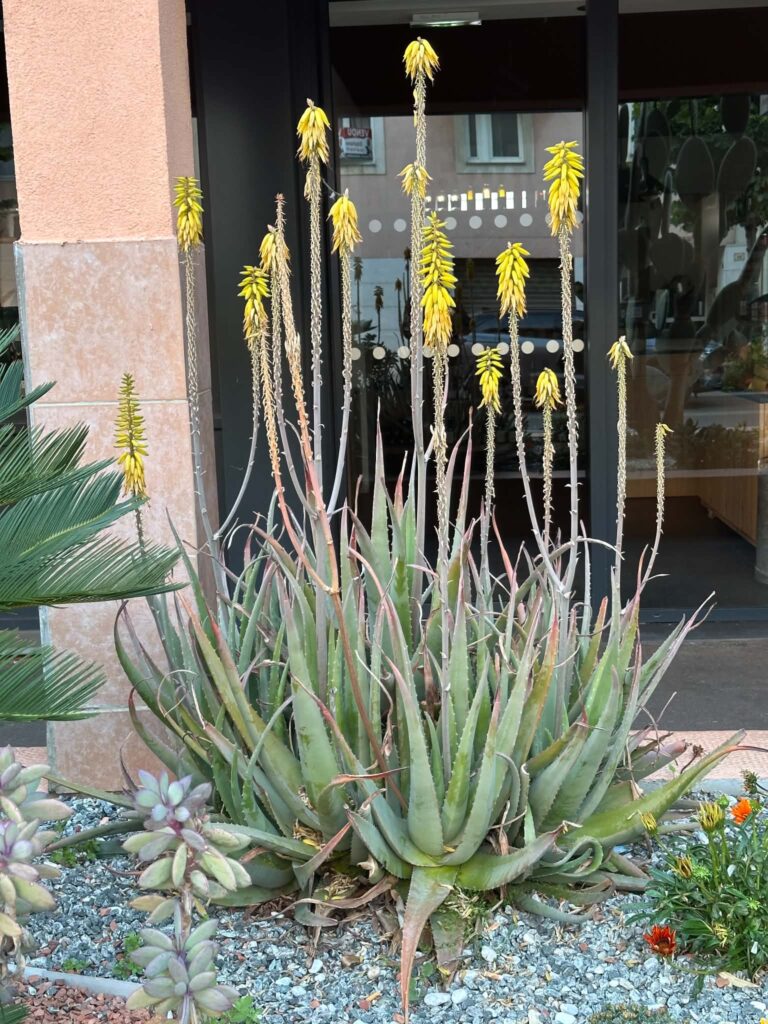
Rosette and leaves. The rosette consists of 12 to 20 thick, fleshy, lanceolate leaves arranged in a loose spiral. Individual leaves measure 30 to 60 cm long and 5 to 8 cm wide at the base, tapering to a pointed apex. The leaf color ranges from pale grey-green to bright green depending on light exposure and water status; some clones display scattered white flecks on both surfaces, particularly in juvenile plants. Leaf margins are armed with small, firm, pale teeth spaced 1 to 2 cm apart. The leaf epidermis is covered with a thick waxy cuticle.
In cross-section, three distinct tissue layers are visible: the outer green rind (chlorenchyma), a thin layer of yellow latex (containing aloin, a bitter anthraquinone glycoside), and the translucent inner gel (parenchyma), which is composed of approximately 95% water and contains the polysaccharide acemannan that accounts for the species’ commercial and medicinal value.
Inflorescence and flowers. Mature plants (typically five years or older) produce a simple or occasionally branched raceme on an erect scape rising 60 to 90 cm above the rosette. Flowers are pendulous, tubular, 2 to 3 cm long, and yellow to pale orange. In its native range, flowering occurs from late winter to early spring (February to April). Under cultivation in the Northern Hemisphere, flowering is triggered by a period of cool dormancy (approximately 10 to 13 °C) followed by warming spring temperatures. Plants rarely bloom indoors because they lack the necessary diurnal temperature cycling.
Fruit and seeds. The fruit is a dry, triangular capsule containing numerous flat, dark brown to black seeds, 3 to 5 mm in diameter. Germination rates under cultivation are moderate (50 to 70%) and seeds remain viable for one to two years if stored in cool, dry conditions.
Root system. The root system is shallow and fibrous, rarely extending deeper than 30 cm. This architecture favors rapid absorption of surface moisture after brief rain events — an adaptation to its arid origins.
Comparison with Two Commonly Confused Species
Aloe vera vs. Aloe officinalis Forssk.
Aloe officinalis (accepted by POWO, native to Saudi Arabia, Yemen, and Somalia) is the species most frequently confused with Aloe vera in the horticultural trade. Plants sold as “Aloe vera” with widely spaced, multicolored (orange to reddish) flowers and a tendency to form massive clumps of smaller rosettes are often Aloe officinalis rather than true Aloe vera.
| Character | Aloe vera | Aloe officinalis |
|---|---|---|
| Rosette size | 40–60 cm diameter at maturity | 25–40 cm, more compact |
| Leaf color | Grey-green to bright green, often glaucous | Darker green, less glaucous |
| Leaf spotting | White flecks variable, often absent in mature leaves | More consistently spotted |
| Inflorescence | Simple or rarely branched; flowers yellow, closely spaced on the raceme | Branched; flowers orange to bicolored, more widely spaced |
| Offsetting habit | Moderate; pups arise from the base | Prolific; forms dense clumps rapidly |
| Native range | Oman, UAE (Hajar Mountains) | Saudi Arabia, Yemen, Somalia |
The confusion matters for growers seeking the specific acemannan-rich gel of Aloe vera: Aloe officinalis produces a similar but less abundant gel with different phytochemical profiles.
Aloe vera vs. Aloe maculata All. (Soap Aloe)
Aloe maculata (formerly Aloe saponaria), native to South Africa, is the other species most routinely sold under the “Aloe vera” label, particularly in European garden centers. It is substantially hardier than Aloe vera and tolerates brief frosts to approximately –4 °C (USDA zone 9a).
| Character | Aloe vera | Aloe maculata |
|---|---|---|
| Leaf arrangement | Upright, lanceolate, loosely spiraled | Broader, more triangular, distinctly recurved |
| Leaf surface | Smooth to faintly spotted | Strongly and persistently spotted (white blotches in irregular bands) |
| Leaf margin teeth | Small, pale, closely spaced | Larger, darker (brown to reddish), more widely spaced |
| Flower color | Yellow (rarely pale orange) | Coral-red, orange, or bicolored (red-tipped yellow) |
| Inflorescence | Simple raceme, erect | Multi-branched, capitate (flat-topped clusters) |
| Cold hardiness | USDA 10–12 (minimum ~ +4 °C / 40 °F) | USDA 9–11 (tolerates brief –4 °C / 25 °F) |
| Stem | Essentially acaulescent | Short but distinct stem with age |
| Offsetting | Moderate | Very prolific |
The practical consequence: gardeners in USDA zones 9a–9b who plant what they believe is Aloe vera in the ground and see it survive winter frosts almost certainly have Aloe maculata or an Aloe maculata hybrid.
Optimal Growing Conditions
Light
Aloe vera requires bright light — a minimum of six hours of direct or bright indirect sunlight per day. In Mediterranean and subtropical climates (USDA zones 10–12), partial afternoon shade prevents sunburn during peak summer heat, especially for plants recently moved outdoors after indoor overwintering. Indoors, a south-facing or southwest-facing window is essential; supplemental LED grow lighting (full spectrum, 2,000–4,000 lux for 12 to 14 hours) improves winter vigor in high-latitude locations.
Temperature
The optimal growth temperature range is 18 to 29 °C (65 to 85 °F). Aloe vera enters dormancy below approximately 13 °C (55 °F) and suffers cold stress below 10 °C (50 °F). Cellular damage begins at approximately 4 °C (40 °F), and exposure to freezing temperatures (0 °C / 32 °F) causes irreversible cellular rupture in the water-saturated leaf mesophyll — the very trait that makes the species medicinally valuable is also its fatal vulnerability to cold.
Flowering requires a dormancy period of six to eight weeks at night temperatures around 10 to 13 °C, followed by a return to warmth above 18 °C — conditions that few indoor environments naturally provide.
Substrate
Aloe vera demands fast-draining, mineral-rich substrates with low organic content. A suitable mix consists of approximately 50% mineral aggregate (pumice, perlite, coarse sand, or fine gravel) and 50% standard potting compost, amended with a handful of horticultural charcoal per pot. The target pH is slightly alkaline: 7.0 to 8.5, reflecting the calcareous soils of its native Hajar Mountains. In containers, terracotta pots are preferred over plastic because they allow moisture to evaporate through the walls, reducing the risk of root rot.
Watering
The soak-and-dry method is essential. Water thoroughly until liquid drains from the pot, then allow the substrate to dry completely before watering again. In summer (active growth), this typically means watering every 7 to 14 days depending on pot size, temperature, and humidity. In winter (dormancy), reduce watering to once every three to six weeks. Overwatering — particularly in cool conditions — is the primary cause of death in cultivated Aloe vera.
Fertilization
Aloe vera has modest nutrient requirements. A balanced liquid fertilizer (NPK 10-10-10 or 10-40-10 for flowering) diluted to half strength, applied once monthly during the growing season (April to September in the Northern Hemisphere), is sufficient. Avoid fertilizing during winter dormancy.
Hardiness Zone
USDA zones 10 to 12 for reliable year-round outdoor cultivation without protection. In zone 9b (average annual minimum –1 to +4 °C), Aloe vera can survive in exceptionally well-drained, south-facing microclimates protected from winter rain, but this is marginal and losses are frequent during cold spells.
Success and Failure Under Temperate Climates: What the Growers Report
The question of growing Aloe vera outdoors in temperate climates has generated extensive discussion on specialized forums (Houzz, Hardy Tropicals UK, Agaveville, Quora gardening communities) and in regional horticultural literature. The consensus, supported by hundreds of grower reports, is clear-cut — but the details reveal important nuances.
The Critical Thresholds
Forum reports and horticultural references converge on the following temperature thresholds for Aloe vera:
- +10 °C (50 °F): Growth slows; the plant enters semi-dormancy. Below this threshold, metabolic activity drops sharply and root function declines, especially in wet substrates.
- +4 °C (40 °F): Cold stress begins. Leaves may darken, soften, or develop water-soaked translucent patches. In moist soil, root rot initiates rapidly at this temperature.
- 0 °C (32 °F): Lethal for unprotected plants. Ice crystal formation ruptures mesophyll cells; leaves collapse into translucent mush within hours. Even brief exposure (one to two hours) at this temperature causes severe, often fatal damage.
- –2 °C (28 °F): Virtually guaranteed plant death, even with frost cloth protection. Reports of survival at this temperature are exceedingly rare and typically involve plants that were already dry and sheltered against a thermal mass (south-facing stone wall).
Why Aloe vera Fails Where Other Aloes Succeed
Growers on Hardy Tropicals UK and Agaveville consistently report that species such as Aloe striatula (hardy to –7 °C), Aloe aristata (hardy to –10 °C), and Aloe polyphylla (hardy to –12 °C in dry conditions) survive UK and northern European winters that destroy Aloe vera without protection. The reason is evolutionary: these species evolved in the South African highlands (Eastern Cape, Lesotho, Drakensberg) where winter frosts are routine. Their leaves are smaller, denser, and contain proportionally less water, reducing ice crystal damage. Aloe vera, by contrast, evolved in a frost-free Arabian desert environment, and its large, gel-laden leaves are catastrophically vulnerable to freezing.
Several forum contributors note an additional factor: Aloe vera is exceptionally intolerant of the combination of cold and wet that characterizes temperate maritime winters (UK, northwestern France, Pacific Northwest). Even at temperatures above freezing, persistently wet soil at 5 to 8 °C triggers rapid root rot. In contrast, species like Aloe maculata tolerate occasional wet feet far better.
Documented Successes
- Southern California (USDA zone 10a–10b): Aloe vera thrives in the ground year-round with no protection, provided drainage is adequate. Growers on Agaveville report massive clumps after five to ten years.
- Southern Spain, Sicily, southern Portugal, Canary Islands: Naturalized populations confirm the species’ comfort in Mediterranean climates with winter minima above +5 °C.
- USDA zone 9b microclimates (southeastern US, Côte d’Azur, Ligurian Riviera): Success is possible but conditional — plants must be positioned against south-facing walls, in raised beds with mineral substrates, and ideally sheltered from winter rain by eaves or a temporary overhang. Even so, exceptional cold events (–3 to –5 °C, which occur every five to ten years in these zones) typically kill or severely damage unprotected plants.
- Indoor/outdoor seasonal rotation (zones 6–9): The most reliable strategy in temperate climates. Plants are moved outdoors from May to September and brought indoors before night temperatures fall below 10 °C. Growers in Seattle (zone 8b), the UK, and northern France consistently report success with this approach.
Documented Failures
- UK gardens, unprotected: Multiple Hardy Tropicals UK forum contributors report total loss of Aloe vera planted in the ground during average UK winters (minima –3 to –8 °C). Even under frost cloth, plants typically sustain lethal damage.
- Northern Florida, unprotected in the ground: Growers in Tallahassee and Jacksonville (zone 8b–9a) report losses during hard freezes that drop to –5 °C, despite the generally mild climate. The lesson: a single night of hard frost is sufficient to kill Aloe vera.
- North Texas (zone 8a), unprotected: Forum posts on Houzz confirm that Aloe vera cannot survive DFW-area winters in the ground, where temperatures regularly drop below –5 °C.
- Potted plants in unheated garages or cold frames: Multiple grower reports indicate that Aloe vera does not survive winter in unheated shelters where temperatures fall to 2 to 5 °C for extended periods, particularly if humidity is high.
Practical Recommendations for Temperate Growers
- Never plant Aloe vera in the ground in zones below 10a unless you accept it as a seasonal or expendable planting.
- Container culture is the safest approach in zones 8–9. Use terracotta pots with mineral-heavy substrate. Move plants indoors when night temperatures approach 10 °C.
- If you want a ground-planted aloe in zones 8b–9b, choose Aloe striatula, Aloe aristata, Aloe maculata, or Aloe arborescens instead. These species offer similar rosette forms with dramatically superior cold tolerance.
- Indoor overwintering conditions: Bright south-facing window, temperatures between 13 and 18 °C, watering reduced to once monthly, no fertilizer.
- Reacclimatize gradually in spring: When moving plants outdoors, expose them to direct sun progressively over two to three weeks to prevent sunburn on leaves that have adapted to lower indoor light levels.
Toxicity
Aloe vera gel (the inner transparent parenchyma) is widely regarded as safe for topical use and is a common ingredient in cosmetics, burn treatments, and skincare products. However, the yellow latex layer just beneath the rind contains aloin, a bitter anthraquinone compound that acts as a potent laxative and irritant. The US Food and Drug Administration banned aloin as an over-the-counter laxative ingredient in 2002 due to safety concerns.
Aloe vera is toxic to cats and dogs: ingestion of leaf material (including the gel) causes vomiting, diarrhea, lethargy, tremors, and — in severe cases — changes in urine color indicative of kidney stress. The ASPCA lists Aloe vera as toxic to cats, dogs, and horses.
Bibliography
Carter, S., Lavranos, J.J., Newton, L.E. & Walker, C.C. (2011). Aloes. The Definitive Guide. Kew Publishing, Royal Botanic Gardens, Kew. 720 pp.
Grace, O.M., Klopper, R.R., Figueiredo, E. & Smith, G.F. (2011). The Aloe Names Book. Strelitzia 28. South African National Biodiversity Institute, Pretoria. 232 pp.
Grace, O.M., Buerki, S., Symonds, M.R.E. et al. (2015). “Evolutionary history and leaf succulence as explanations for medicinal use in aloes and the global popularity of Aloe vera.” BMC Evolutionary Biology 15: 29. doi:10.1186/s12862-015-0291-7
Reynolds, G.W. (1950). The Aloes of South Africa. Aloes of South Africa Book Fund, Johannesburg. 520 pp.
Reynolds, G.W. (1966). The Aloes of Tropical Africa and Madagascar. The Aloes Book Fund, Mbabane. 537 pp.
Linnaeus, C. (1753). Species Plantarum 1: 320.
Burman, N.L. (1768). Flora Indica: 83.
Miller, P. (1768). The Gardeners Dictionary, ed. 8, no. 2.
Van Wyk, B.-E. & Smith, G.F. (2014). Guide to the Aloes of South Africa. 3rd ed. Briza Publications, Pretoria. 376 pp.
Authoritative Online Resources
- POWO — Plants of the World Online (Kew): Aloe vera
- GBIF — Global Biodiversity Information Facility: Aloe vera distribution data
- IUCN Red List: Aloe vera conservation assessment
- CITES Checklist: Aloe trade regulations
- Kew Science — Aloe research portal: Royal Botanic Gardens, Kew
- NC State Extension Gardener Plant Toolbox: Aloe vera cultivation profile
- ASPCA Toxic Plants Database: Aloe vera toxicity to pets
Aloe vera articles
- How to Grow and Care for Aloe vera
- Aloe vera Varieties: Identifying the Different Forms
- Aloe vera Gel: Harvesting, Preparation, and Uses
- Is Aloe vera Toxic to Cats and Dogs?
- Aloe vera Flower: How to Get Your Plant to Bloom
- How to Propagate Aloe vera from Offsets
- Aloe vera Turning Brown or Yellow: Causes and Solutions
- How to Repot Aloe vera