
Zamia furfuracea is a cycad from Mexico, endemic to the state of Veracruz, where it grows near the coast of the Gulf of Mexico, notably on coastal dunes. This species of the genus Zamia, sold in garden centres as the cardboard palm, has an underground stem and large, thick, stiff leaflets covered in rusty hairs when young. It is not a palm but a cone-bearing plant, and a very poisonous one, especially its red seeds. Listed as Endangered by the IUCN in the wild, it is grown outdoors in mild climates such as Florida, and elsewhere mostly in pots or as a house plant.
Key facts about Zamia furfuracea
- Accepted name: Zamia furfuracea L.f. (1789), accepted by The World List of Cycads (version 2026.08.15) and by GBIF; the World Checklist of Vascular Plants (WCVP), on which POWO is based, also accepts it (consulted through GBIF on 31 October 2026)
- Former names and synonyms: Zamia latifolia Lodd. ex Miq. (1849), Zamia muricata var. obtusifolia Miq. (1843), Zamia furfuracea var. trewii A.DC. (1868), Palmifolium furfuraceum (L.f.) Kuntze (1891)
- Family: Zamiaceae, order Cycadales
- Common names: cardboard palm, cardboard plant, cardboard cycad; also cardboard sago, Jamaican sago or Jamaica sago tree, Mexican cycad; “palma bola” in Spanish
- Natural range: Mexico, state of Veracruz, near the coast (0 to 50 m according to a 2014 inventory)
- IUCN status: Endangered (EN B1ab(v)), assessment by J.D. Bösenberg published in 2022
- CITES and other protection: CITES Appendix II; Annex B in the European Union; protected in Mexico under standard NOM-059-SEMARNAT-2010 (category differs between sources)
- Documented hardiness: USDA zones 9b to 11 according to the University of Florida (9a to 11b according to NC State Extension); leaves damaged at about −2 °C (28.4 °F) according to an Italian grower; a plant died at −4 °C (24.8 °F) in damp weather in Brittany (see Cold hardiness)
- Light and soil: sun to part shade; well-drained sandy or loamy soil, acid or alkaline; high drought tolerance and good salt tolerance (UF/IFAS)
- Habit and adult size: underground stem, often clumping; 0.6 to 1.5 m (2 to 5 ft) tall and 1.5 to 2.5 m (5 to 8 ft) across in cultivation (UF/IFAS)
- In the UK, US and Australia: Cambridge (accession of 1987), Belfast (Tropical Ravine glasshouse) and six other British gardens; Montgomery (35 accessions), Fairchild and some 25 other American gardens; outdoor beds at Royal Botanic Gardens Victoria, Melbourne, and five other Australian gardens
- Toxicity: poisonous to people and animals, especially the seeds (see Toxicity and precautions)
How to recognise Zamia furfuracea
By its stiff leaves in a rosette, whose leaflets are broad, thick and obovate (widening towards the tip), with a cardboard-like feel that gives the plant its English names. The young leaves are covered in rusty hairs, the origin of the name furfuracea.
The original description, published in 1789 in the Hortus Kewensis, defines it by wedge-shaped, straight, hairless leaflets, toothed from the middle to the tip and scurfy (as if covered with bran) underneath, and by a prickly petiole. The horticultural fact sheets of the University of Florida (UF/IFAS) and of North Carolina State University Extension give the following guide for cultivated plants:
- rounded habit, often clumping, 0.6 to 1.5 m (2 to 5 ft) tall and 1.5 to 2.5 m (5 to 8 ft) across, slow-growing;
- pinnate leaves arranged in a spiral, with 6 to 12 pairs of stiff, downy leaflets 7.5 to 20 cm (3 to 8 in) long and 2.5 to 5 cm (1 to 2 in) wide, entire or toothed in the upper third;
- separate male and female plants; the rusty-brown female cone forms in the centre of the plant and holds many red seeds.
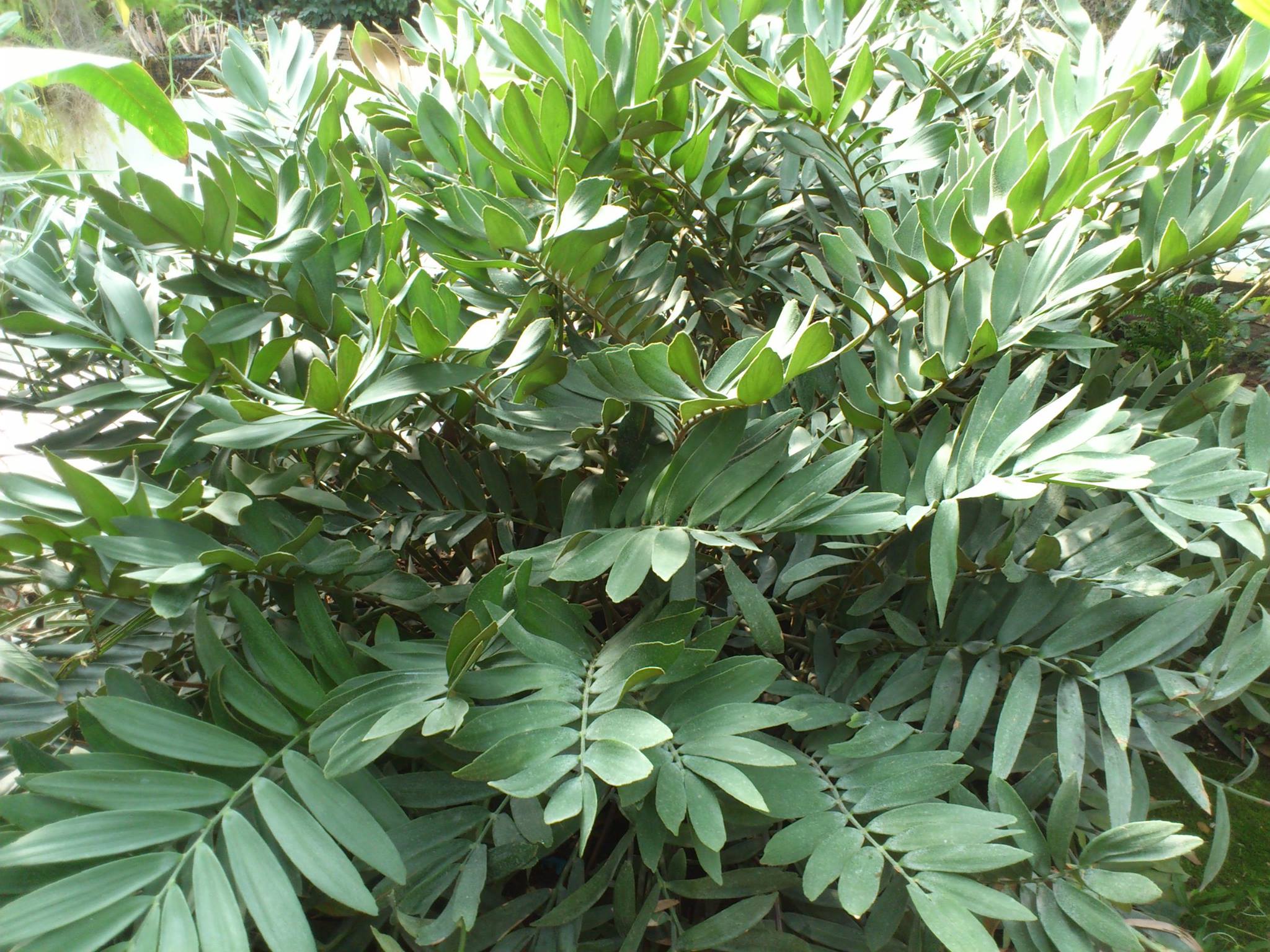
The chromosome number is 2n = 18, according to a 2022 cytogenetic study of a plant from the botanic garden of Masaryk University in Brno (Vozárová and colleagues, 2022). Forms with narrower leaflets exist in cultivation: NC State Extension’s fact sheet illustrates them.
Hybrids
No named horticultural hybrid has been published, but hybridisation is an old question for this species. According to Pérez-Farrera and colleagues (2012), who summarise earlier work not consulted here, Vovides (1988) studied an inland form of Zamia furfuracea that was intermediate in six morphological and eleven anatomical characters between Zamia loddigesii and the coastal dune form, and considered it a possible introgressive hybrid between the two. Norstog (1987) obtained fertile hybrids in cultivation between a male Zamia furfuracea and a female Zamia spartea, and Schutzman (2004) saw Norstog’s plant as an introgressive hybrid with the dune form. These hypotheses concern wild populations; no published source says what share of the plants sold might derive from them.
Possible confusion
With Zamia integrifolia and Zamia pumila
NC State Extension notes that Zamia furfuracea is often confused with Zamia integrifolia, the coontie of Florida, the other Zamia common in cultivation. The leaflets separate them easily: broad, thick and downy in Zamia furfuracea, narrow, smooth and glossy in Zamia integrifolia. The confusion also affects growers’ reports: on the French Fous de palmiers forum, a 2015 post about a Zamia planted in the ground near Marseille does not make clear which of the two species was involved.
The confusion with Zamia pumila is first of all historical. When Linnaeus described Zamia pumila in 1763, he cited plates by Plukenet that the younger Linnaeus referred in 1789 to Zamia furfuracea; and the 1789 Hortus Kewensis gave at the same time the name Zamia integrifolia to the Florida plant that Linnaeus had called Zamia pumila. According to Eckenwalder (1980), Smith (1961) even concluded that the name Zamia pumila should have applied to the Mexican species. These names long circulated in place of one another; today Zamia pumila is a species of the Greater Antilles (Cuba, Hispaniola, Puerto Rico) and Zamia integrifolia that of Florida, both with narrow leaflets (The World List of Cycads).
With Zamia loddigesii
Zamia loddigesii, widespread on the Atlantic slope of Mexico, has narrower, thinner leaflets, without the thick down of Zamia furfuracea. The World List of Cycads lists among the synonyms of Zamia furfuracea the name Zamia latifolia, which Schuster (1932) treated as a variety of Zamia loddigesii (Zamia loddigesii var. latifolia): the two species have therefore already been mixed up in nomenclature. The intermediate forms mentioned under Hybrids make identification of plants from inland Veracruz harder still.
With Cycas revoluta
In garden centres the two plants are sometimes sold side by side, and some English names (“sago”) are shared with Cycas revoluta, the sago palm. The leaves of Cycas revoluta carry very many narrow leaflets, each with a midrib, whereas those of Zamia furfuracea have a few pairs of broad leaflets without a midrib.
Taxonomy
Zamia furfuracea was published in 1789 by William Aiton in the Hortus Kewensis (volume 3, page 477), under the name of the younger Linnaeus (L.f.), who had written the description. The text says it came from the West Indies and had been grown since 1691 in the royal garden at Hampton Court; it cites as references plates by Plukenet, by Hermann (Paradisus Batavus, 1698) and by Trew, and gives it the English name “Broad-leav’d Zamia”. The West Indian origin is a mistake: the species is known in the wild only from Veracruz (The World List of Cycads). In the absence of a herbarium specimen, Stevenson and Sabato designated plate 210 of Hermann’s Paradisus Batavus as the lectotype in 1986 (The World List of Cycads).
The World List of Cycads accepts as synonyms Zamia muricata var. obtusifolia Miq. (1843), Zamia latifolia Lodd. ex Miq. (1849) and its combinations, and Zamia furfuracea var. trewii A.DC. (1868). Other names sometimes given as synonyms are not on that list: Zamia vestita Van Houtte and Zamia crassifolia B.S.Williams ex T.Moore & Mast. do exist in IPNI, but their placement could not be checked at source; Zamia ottonis Miq. is a quite different name, referred to a Cuban species; and no name Zamia maritima is recorded in IPNI. IPNI also records a Chinese variety published in 2021, Zamia furfuracea var. curvativivillosa T.B.Chao & Zhi X.Chen, which The World List of Cycads does not mention. The author citation is L.f., not “L.f. ex Aiton”, according to The World List of Cycads and IPNI.
No molecular phylogeny consulted specifies the place of the species within the genus. In 2018, a study of the chloroplast genome of Zamia fischeri grouped that plant with another Zamia, Zamia furfuracea (Lei and colleagues, 2018).
Etymology and history
The epithet comes from the Latin furfuraceus, “scurfy”, referring to the reddish-brown hairs on the young leaves (Haynes, 2022, as quoted by The World List of Cycads). According to the Hortus Kewensis, the plant was grown in England as early as 1691.
It has become a model for the study of cycad pollination. As early as 1986, Norstog, Stevenson and Niklas showed the role of a weevil in its pollination, and several recent studies were carried out on plants at Montgomery Botanical Center, in Florida (Salzman and colleagues, 2020; Valencia-Montoya and colleagues, 2025).
Common names
The English names refer to the stiff leaflets with the feel of cardboard. The University of Florida gives cardboard plant, cardboard cycad and cardboard palm; NC State Extension adds cardboard sago, Jamaican sago and Mexican cycad; the Royal Horticultural Society lists cardboard palm and Jamaica sago tree; Species+ gives “cardboard palm” in English and “palma bola” in Spanish. The 1789 Hortus Kewensis called it “Broad-leav’d Zamia”. These names can mislead: the plant is not a palm, “sago” also refers to Cycas revoluta, and “Jamaican” does not match its Mexican origin.
In the wild
Zamia furfuracea is endemic to Veracruz (The World List of Cycads). The inventory of Mexican Zamiaceae by Nicolalde-Morejón and colleagues (2014) places it between 0 and 50 m, in the Gulf of Mexico biogeographical region. A 2025 study of the extinction risk of Veracruz cycads describes it as a species of coastal dunes and records four localities, an extent of occurrence of 1,998 km², a habitat loss of 56 % and 84 % of its range outside protected areas, across ten municipalities (Gómez Díaz, 2025, after Favian-Vega and colleagues, 2022). No more detailed primary description of its habitat could be read.
Its pollination is one of the best studied among cycads. It depends on an obligate mutualism with a small weevil, Rhopalotria furfuracea (formerly Rhopalotria mollis), which completes its whole development in the male cones; without it, the plant sets no seed (Salzman and colleagues, 2020, after Norstog and colleagues, 1986). The cones heat up each day at pollination time and give off scents that first attract and then repel the insects, a “push-pull” mechanism that moves them from male to female cones (Salzman and colleagues, 2020). The weevils are also guided by the higher humidity around the cones (Salzman and colleagues, 2023) and, according to a study published in Science in 2025, by the infrared radiation given off by the heated cones: their antennae carry infrared-sensitive neurons tuned to the temperature of their host plant (Valencia-Montoya and colleagues, 2025).
The amount of warming varies between sources: Salzman and colleagues (2020), citing earlier measurements, give a peak of 2.5 °C (4.5 °F) above ambient air for male cones and 0.8 °C (1.4 °F) for female cones, whereas the Harvard Gazette, presenting the 2025 study, writes that Zamia furfuracea can heat its cones by 46 °F (about 25.6 °C) above the surrounding air. The abstract of the 2025 study gives no figure.
Conservation status and regulation
Zamia furfuracea is listed as Endangered (EN) on the IUCN Red List, on the basis of J.D. Bösenberg’s assessment published in 2022 (dated 2020), under criteria B1ab(v): a small extent of occurrence and a continuing decline in the number of mature individuals (The World List of Cycads; category confirmed by the Red List data relayed by GBIF, consulted on 31 October 2026). The previous assessment was by J. Chemnick and T. Gregory (2010). Gómez Díaz (2025) ranks it among the three most threatened Zamia of Veracruz, with Zamia vazquezii and Zamia inermis, and proposes moving them to CITES Appendix I. The Friends of Belfast Botanic Gardens note that most of the severe decline is due to the removal of plants for ornamental use, and that the species is now more common in cultivation than in the wild.
In Mexico the species appears in standard NOM-059-SEMARNAT-2010, but the sources disagree on its category: “subject to special protection” (Pr) in the table of Nicolalde-Morejón and colleagues (2014), “in danger of extinction” (P) in that of Gómez Díaz (2025). The official text was not consulted.
Like every Zamia except Zamia restrepoi, the species is listed in CITES Appendix II, where the genus has appeared since 4 February 1977; Species+ has a separate entry for it. Annotation #4 (the version adopted at CoP20, in force since 5 March 2026) excludes from CITES seeds and pollen, as well as seedlings and tissue cultures obtained in vitro and transported in sterile containers; international trade in the plants requires an export permit. In the European Union the species falls under Annex B of Regulation (EC) No 338/97, whose current annexes are set by Regulation (EU) 2026/1383, applicable since 29 June 2026. In Florida, the University of Florida rates its invasive potential as “caution”: it may be planted, but should be managed to prevent its escape from gardens.
Databases consulted on 19 and 24 October 2026 (Species+, GBIF, The World List of Cycads, IPNI, Crossref). This summary does not replace the official texts: check the regulations in force before any purchase, and choose nursery-raised plants grown from seed.
Growing Zamia furfuracea
Zamia furfuracea is easy to grow in a pot and indoors, and in the ground only in frost-free or nearly frost-free climates. The fact sheets of the University of Florida (UF/IFAS) and NC State Extension sum up its needs:
- Light: full sun to part shade (UF/IFAS adds that it grows in sun or shade); indoors, a very bright position.
- Soil: well drained; the plant tolerates sandy, loamy, acid or alkaline soils and is rated as having good salt tolerance.
- Watering: moderate; the plant is drought-tolerant once established; let the compost dry between waterings, in a pot with several drainage holes.
- Growth: slow, which makes it a good container plant; UF/IFAS also recommends it for mass planting, as a specimen or in borders, planted 90 to 150 cm (36 to 60 in) apart.
The Californian nursery Jungle Music, in an undated article, describes it as commonly seen in American nurseries because its seed is readily available, it “can tolerate a freeze”, it stays fairly small and it can be grown in sun in many areas; it notes that plants in full sun are more compact, with shorter leaves, whereas in filtered light the leaves can reach about 1.5 m (5 ft), and that its coastal origin gives it a remarkable tolerance of salt spray. The French specialist nursery Cycadales.eu (2023) places the species among the Zamia of Mexico and northern Central America, of moderate difficulty.
Outdoor and in-ground cultivation
In the United States, the University of Florida recommends it for USDA zones 9b to 11, with planting possible all year round there; NC State Extension gives zones 9a to 11b and says that in North Carolina it must be brought indoors for the winter. These are the institutions’ own ratings. In Australia, the census of the Royal Botanic Gardens Victoria lists Zamia furfuracea in outdoor beds at Melbourne Gardens, in a temperate climate (census of October 2026). In the Mediterranean, the best result found is a plant that has lived for more than twenty years in the ground, in full sun, in heavy soil, in Palermo (see Cold hardiness). In Britain, no outdoor planting has been documented.
Container cultivation
In the UK and other cool climates, it is grown in a pot, as a house plant or in a conservatory, and kept frost-free in winter. UF/IFAS notes that it adapts easily to indoor conditions. Use a free-draining compost and a pot with drainage holes, water moderately, let the compost dry between waterings and water less in winter: too much water in cool conditions is the first cause of rot. A pot can stand outside in summer and come in before the first frosts.
In cultivation in the UK, US and Australia
In short: widely held in botanic gardens in all three countries; outdoors only in mild climates.
- United Kingdom: the Cambridge University Botanic Garden catalogue lists an accession of 1987; the Friends of Belfast Botanic Gardens show the species in the Tropical Ravine glasshouse; Chelsea Physic Garden, Oxford Botanic Garden, RHS Garden Wisley, Paignton Zoo, the National Botanic Garden of Wales and Birmingham Botanical Gardens declare it to BGCI. No outdoor planting is documented.
- United States: Montgomery Botanical Center, in Coral Gables (Florida), lists 35 accessions in its online catalogue, from 1992 to 2001 according to the garden’s numbering (11 from 1998 and 20 from 2001); Fairchild Tropical Botanic Garden lists it in its Garden Explorer; the Huntington, San Diego Zoo, Naples Botanical Garden, UC Berkeley and about two dozen other American gardens declare it to BGCI, including gardens in Chicago, Denver and Minnesota, whose winters mean the plants can only be kept under glass.
- Australia: Royal Botanic Gardens Victoria (outdoor beds at Melbourne Gardens, census of October 2026); the Royal Botanic Garden Sydney, Brisbane Botanic Gardens Mount Coot-tha, James Cook University (Townsville), the Royal Tasmanian Botanical Gardens (Hobart) and the University of Melbourne System Garden declare it to BGCI.
A BGCI declaration shows that a garden held the plant at some point, not that it is alive today. The British nursery Trebrown gives it a USDA zone 10b rating, its own commercial classification.
Propagation
Zamia furfuracea is propagated by seed and, according to UF/IFAS and NC State Extension, by division of clumps. According to UF/IFAS, the seed germinates fairly well several months after being cleaned and sown. Without the pollinating weevil, hand pollination is needed to obtain seed, with a male and a female plant. A grower in Montpellier lost many seedlings in a glasshouse that never fell below 15 °C (59 °F), and blamed the watering (Fous de palmiers forum, 2010): seedlings fear excess water.
Pests and diseases
According to the University of Florida, the main pest is Florida red scale (Chrysomphalus aonidum), which can prove fatal if left unchecked; no disease is of major concern. In cultivation, too much water in cool weather causes rot of the underground stem and roots. NC State Extension lists the plant as deer-resistant.
Cold hardiness
Zamia furfuracea is not very hardy: its foliage suffers at the first frosts and the plant can die in moderate, wet cold. The University of Florida recommends it for USDA zones 9b to 11, NC State Extension for zones 9a to 11b. Jungle Music estimates that it is somewhat freeze-tolerant, “probably down to about 27 °F” (about −2.8 °C); this is a nursery’s estimate, not a measurement.
Mediterranean and European experience
These reports come from France and Italy; they are useful to readers in comparable climates, such as coastal California or southern Australia, but give no exact equivalent.
- A grower in Concarneau (Finistère, Brittany, France) reports on the Fous de palmiers forum that his Zamia furfuracea, grown in the garden, died in mid-December 2007 after a low of −4 °C (24.8 °F) in damp weather; the Météo-France station at Melgven, a few kilometres away, recorded −4.0 °C (24.8 °F) on 16 December 2007.
- In 2010, on the same forum, a member whose location is not given reports losing two plants, one to frost and the other to excess air humidity; a grower in the Deux-Sèvres (western France) replies that he had the same experience, and a grower in Montpellier thinks cold was the cause, perhaps made worse by humidity.
- A grower in Palermo (Sicily, Italy) reports on the Tropicamente forum that a plant has lived for more than twenty years in the ground, in full sun, in very heavy soil that has never been dug (2010); another member wrote in 2009 that the species grows well in the ground at Palermo botanic garden, without damage.
- A grower in Naples (Campania, Italy) reports on the Tropicamente forum that during winter 2008–2009 his two large plants in pots, mulched and under a double layer of fleece, had many leaves scorched, whereas Dioon spinulosum treated in the same way showed only a little reddening.
- A grower in Rome (Lazio, Italy) reports on the Fous de palmiers forum (July 2010) that a plant in the ground without protection for two years once nearly died; a Tropicamente member whose location is not given says he lost two plants in the ground in their fourth winter.
- A grower in Ravenna (Emilia-Romagna, Italy) places the start of leaf damage at about −2.2 °C (28.0 °F) and brings his plant in for the winter (Tropicamente forum, 2009–2010).
No result of a planting of Zamia furfuracea has been published by the Jardin zoologique tropical at La Londe-les-Maures, in the Var; for comparison, a Zamia integrifolia survived −6 °C (21 °F) there in February 2012, with damage to its leaves. The 2015 post from near Marseille mentioned under Possible confusion may concern Zamia integrifolia, and that plant had not been through a frost.
United Kingdom, United States and Australia
No dated outdoor report with a measured temperature could be read for these countries. In the United States, the institutional ratings above (zones 9b to 11, or 9a to 11b) are the most reliable guide; in North Carolina the plant is brought in for the winter. In Britain, where no outdoor planting is documented, it should be treated as a frost-tender plant. In Australia, the Melbourne outdoor beds show that it can be grown in the open in a mild temperate climate, but the census gives no planting date or winter result.
A forum participant quoted two books in 2009, one giving leaf destruction from −3 °C (26.6 °F) (The Cycads, Whitelock), the other cases of survival at −9 °C (15.8 °F) (Cycads of the World, Jones); these figures could not be checked in the books and should not be used as thresholds. Taken together, the reports suggest leaf damage at about −2 to −3 °C (28.4 to 26.6 °F) and possible death from −4 °C (24.8 °F) in wet soil: this is a synthesis of isolated reports, not a measurement.
Toxicity and precautions
Zamia furfuracea is poisonous to people and animals. Like other Zamia, it contains toxic glycosides (cycasin, macrozamin), from which methylazoxymethanol is derived, according to pharmacological studies cited by The Gymnosperm Database. For this species, the ASPCA, the American veterinary poison control centre, lists it as toxic to dogs, cats and horses and names cycasin, BMAA (a neurotoxic amino acid) and an unidentified neurotoxin in cattle as its toxic principles; the signs described range from vomiting and bloody diarrhoea to liver damage and death. NC State Extension states that the seeds are the poisonous part, that one or two seeds can be fatal, and lists among the symptoms in people vomiting (sometimes bloody), headache, stomach pain, jaundice, bruising and liver failure.
Keep the plant out of reach of children and pets, remove ripe female cones where animals can reach them, and wear gloves to handle the seeds. If any part is swallowed, contact a poison centre, a doctor or a vet straight away (in the US, the ASPCA Animal Poison Control Center; in the UK, your vet or NHS 111; in Australia, the Poisons Information Centre).
Traditional uses
No traditional use specific to Zamia furfuracea is documented. Today it is grown as an ornamental.
Frequently asked questions
Is the cardboard palm a palm?
No. It is a cycad of the family Zamiaceae, a seed plant with naked seeds that reproduces by cones. The English name comes from its thick leaflets with the feel of cardboard.
Can I grow a cardboard palm outside in the UK?
Not reliably. It is rated for USDA zones 9b to 11 in Florida, its foliage suffers from about −2 to −3 °C (28.4 to 26.6 °F), and a plant died at −4 °C (24.8 °F) in damp weather in Brittany. Grow it in a pot, stand it outside in summer if you wish, and bring it indoors before the first frosts.
How do I care for a cardboard palm indoors?
Give it a very bright position, a free-draining compost and a pot with drainage holes. Water moderately, let the compost dry between waterings and reduce watering in winter. UF/IFAS notes that it adapts easily to indoor conditions; growth is slow.
How can I tell it from Zamia integrifolia?
By the leaflets: broad, thick, downy and obovate in Zamia furfuracea, narrow, smooth and glossy in Zamia integrifolia. NC State Extension notes that the two are often confused.
Is the cardboard palm poisonous to dogs and cats?
Yes. The ASPCA lists it as toxic to dogs, cats and horses, and the seeds are the most dangerous part; NC State Extension states that one or two seeds can be fatal. If any is swallowed, contact a vet or a poison centre at once.
How do I propagate it?
From cleaned seed, or by dividing a clump. Seed forms only with a male and a female plant, and hand pollination where the pollinating weevil is absent.
Is it endangered in the wild?
Yes. The IUCN lists it as Endangered (2022): it lives only on a small part of the Veracruz coast, where much of its habitat has been destroyed.
Further reading on Succulentes
- Watering Cycads: Common Mistakes and How to Avoid Them
- Is Sago Palm Toxic to Dogs, Cats & Children? What to Know
- Cycads in Italian Botanic Gardens: Naples, Palermo, Florence and La Mortola
Sources
Reference sites
- The World List of Cycads (version 2026.08.15), Zamia furfuracea: https://cycadlist.org/scientific_name/468 — author, publication, lectotype (Hermann, pl. 210), range (Veracruz), IUCN status (EN B1ab(v)), synonyms, etymology. Checklist of the IUCN Cycad Specialist Group, reliable; consulted on 19 and 24 October 2026.
- GBIF, World Checklist of Vascular Plants (Zamia furfuracea): https://api.gbif.org/v1/species/207875042 — accepted name in the World Checklist of Vascular Plants (basis of POWO), published in Hortus Kew. 3: 477 (1789). Kew data distributed by GBIF, reliable; consulted on 31 October 2026.
- GBIF (API), Zamia furfuracea: https://api.gbif.org/v1/species/5284125/iucnRedListCategory — current IUCN Red List category (EN). IUCN data distributed by GBIF; consulted on 31 October 2026.
- Hortus Kewensis, vol. 3 (1789), Internet Archive: https://archive.org/details/mobot31753000624111 — original description (p. 477), stated origin, cultivation at Hampton Court in 1691, old English name. Primary source.
- IPNI, Zamia furfuracea: https://www.ipni.org/n/270522-2 — publication (Hort. Kew. 3: 477, 1789), varieties and related names (Zamia vestita, Zamia crassifolia, Zamia ottonis). Reference nomenclatural index; consulted on 19 October 2026.
- Species+ (UNEP-WCMC), Zamia furfuracea: https://speciesplus.net/species#/taxon_concepts/25376/legal — CITES Appendix II, EU Annex B, English and Spanish common names. Official database; consulted on 19 October 2026.
- UF/IFAS Extension, Zamia furfuracea, Cardboard Plant, Cardboard Cycad (FPS-618): https://ask.ifas.ufl.edu/publication/FP618 — common names, USDA zones 9B to 11, dimensions, soils, drought and salt tolerance, uses, indoor growing, propagation, Florida red scale, invasive potential. University fact sheet, reliable; consulted on 24 October 2026.
- NC State Extension, Zamia furfuracea: https://plants.ces.ncsu.edu/plants/zamia-furfuracea/ — common names, confusion with Zamia integrifolia, zones 9a to 11b, wintering indoors in North Carolina, container growing, leaflets, deer resistance, toxicity and symptoms. University fact sheet, reliable; consulted on 24 October 2026.
- Royal Horticultural Society, Zamia furfuracea: https://www.rhs.org.uk/plants/20381/zamia-furfuracea/details — common names (cardboard palm, Jamaica sago tree); no hardiness rating given. Horticultural society; consulted on 24 October 2026.
- ASPCA Animal Poison Control, Cardboard Cycad: https://www.aspca.org/pet-care/aspca-poison-control/toxic-and-non-toxic-plants/cardboard-cycad — toxicity to dogs, cats and horses, toxic principles. Veterinary poison centre, reliable.
- The Gymnosperm Database, Zamia: https://www.conifers.org/za/Zamia.php — glycosides (cycasin, macrozamin) and methylazoxymethanol in Zamia. Reference database; genus-level data.
- Jungle Music Palms and Cycads (Encinitas, California), Zamia Cycads, the species: https://junglemusic.net/Zamia/Zamia_An_Exotic_Type_Of_Cycad.html — availability in American nurseries, habit in sun and shade, salt-spray tolerance, cold estimate (“probably down to about 27 °F”). Specialist nursery; undated article (page modified in February 2026), consulted on 24 October 2026.
- Cycadales.eu, Comment cultiver les Zamia en climat tempéré (6 January 2023, updated 27 May 2023, in French): https://cycadales.eu/comment-cultiver-les-zamia-en-climat-tempere/ — cultivation group of the species and its difficulty. Specialist nursery: experience-based advice for a group of species.
- Friends of Belfast Botanic Gardens, Zamia: https://fobbg.co.uk/plant-collections/cycads/zamia/ — Zamia furfuracea in the Tropical Ravine, decline in the wild due to removal of plants. Botanic garden friends’ association; consulted on 24 October 2026.
- BGCI PlantSearch, Zamia furfuracea: https://plantsearch.bgci.org/ — two entries (L.f. and L.f. ex Aiton), 55 and 28 gardens, including those named in the text. Global database of garden lists; a declaration is not proof of a living plant today; consulted on 24 October 2026.
- Montgomery Botanical Center, online plant catalogue (BG-BASE, CYCADS dataset): https://websites.rbge.org.uk/cgi-bin/nph-readbtree.pl/dataset=CYCADS/filename=n132_cyc/firstval=1?ETI=zamia+furfuracea* — 35 accessions (1992 to 2001) and six of Zamia aff. furfuracea. Catalogue kept by the garden; consulted on 24 October 2026.
- Trebrown Nurseries, Zamia furfuracea: https://www.trebrown.com/plant_info.php?species=Zamia+furfuracea — common name Cardboard Palm, USDA zone 10b rating. British nursery, commercial classification; consulted on 24 October 2026.
- Harvard Gazette, First male gets heated up, then female… (December 2025): https://news.harvard.edu/gazette/story/2025/12/first-male-gets-heated-up-then-female-and-then-you-know/ — presentation of the 2025 infrared study, cone warming. University news article; figure to be treated with caution.
- Fous de palmiers forum (France): https://www.fousdepalmiers.fr/html/forum/viewtopic.php?p=47744 (Concarneau, 2007); https://www.fousdepalmiers.fr/html/forum/viewtopic.php?p=97088 (Rome, 2010); https://www.fousdepalmiers.fr/html/forum/viewtopic.php?p=97117, https://www.fousdepalmiers.fr/html/forum/viewtopic.php?p=97119 and https://www.fousdepalmiers.fr/html/forum/viewtopic.php?p=97120 (winter and seedling losses, 2010); https://www.fousdepalmiers.fr/html/forum/viewtopic.php?p=388862 (near Marseille, 2015, species uncertain); https://www.fousdepalmiers.fr/html/forum/viewtopic.php?p=58928 (book quotations, 2009). Dated reports, cited without names.
- Tropicamente forum (Italy): https://www.tropicamente.it/forums/topic/nuove-arrivate-3/ (Palermo, 2010); https://www.tropicamente.it/forums/topic/zamia-furfuracea-e-dion-spinulosum/ (Palermo, Rome, Ravenna, 2009–2012); https://www.tropicamente.it/forums/topic/rusticita-dioon-spinulosum/ (Naples, 2008–2009). Dated reports, cited without names.
Bibliography
- Aiton, W. (1789). Hortus Kewensis 3: 477. [Original description of Zamia furfuracea, by the younger Linnaeus; copy on Internet Archive.]
- Stevenson, D.W. & Sabato, S. (1986). Typification of names in Zamia L. and Aulacophyllum Regel (Zamiaceae). Taxon 35: 134–144. [Lectotype designation; cited after The World List of Cycads.]
- Eckenwalder, J.E. (1980). Taxonomy of the West Indian cycads. Journal of the Arnold Arboretum 61(4): 701–722. https://doi.org/10.5962/bhl.part.8542 [History of the names Zamia pumila and Zamia integrifolia, Smith’s (1961) view.]
- Norstog, K.J., Stevenson, D.W. & Niklas, K.J. (1986). The role of beetles in the pollination of Zamia furfuracea L. fil. (Zamiaceae). Biotropica 18: 300–306. [Cited after Salzman et al. (2020).]
- Pérez-Farrera, M.Á. et al. (2012). Zamia grijalvensis sp. nov. (Zamiaceae, Cycadales) from Chiapas, Mexico with notes on hybridization and karyology. Nordic Journal of Botany 30(5): 565–570. https://doi.org/10.1111/j.1756-1051.2012.01453.x [Summary of the work of Vovides (1988), Norstog (1987) and Schutzman (2004) on hybridisation.]
- Nicolalde-Morejón, F., González-Astorga, J., Vergara-Silva, F., Stevenson, D.W., Rojas-Soto, O. & Medina-Villarreal, A. (2014). Biodiversidad de Zamiaceae en México. Revista Mexicana de Biodiversidad 85 (suppl.): S114–S125. https://doi.org/10.7550/rmb.38114 [Altitude, biogeographical region, NOM-059 category (Pr).]
- Lei, J.-Y., Hinsinger, D.D. & Jiang, G.-F. (2018). Characterization of the complete chloroplast genome of endangered cycads Zamia fischeri Miq. ex Lem. Mitochondrial DNA Part B 3(2): 1059–1061. https://doi.org/10.1080/23802359.2018.1508387
- Salzman, S., Crook, D., Crall, J.D., Hopkins, R. & Pierce, N.E. (2020). An ancient push-pull pollination mechanism in cycads. Science Advances 6: eaay6169. https://doi.org/10.1126/sciadv.aay6169 [Pollination by Rhopalotria furfuracea, cone warming.]
- Salzman, S., Dahake, A., Kandalaft, W., Valencia-Montoya, W.A. et al. (2023). Cone humidity is a strong attractant in an obligate cycad pollination system. Current Biology 33. https://doi.org/10.1016/j.cub.2023.03.021 [Role of humidity.]
- Valencia-Montoya, W.A., Liénard, M.A., Rosser, N., Calonje, M. et al. (2025). Infrared radiation is an ancient pollination signal. Science. https://doi.org/10.1126/science.adz1728 [Infrared and pollination.]
- Vozárová, R. et al. (2022). Mega-sized pericentromeric blocks of simple telomeric repeats and their variants reveal patterns of chromosome evolution in ancient Cycadales genomes. The Plant Journal. https://doi.org/10.1111/tpj.15969 [2n = 18 in Zamia furfuracea.]
- Gómez Díaz, J.A. (2025). Assessing the extinction risk of Veracruz cycads. Cambridge Prisms: Extinction. https://doi.org/10.1017/ext.2025.5 [Localities, extent of occurrence, habitat loss, NOM-059 category (P), proposal for Appendix I.]
- Bösenberg, J.D. (2022). Zamia furfuracea. The IUCN Red List of Threatened Species 2022: e.T213252394A69839756. https://doi.org/10.2305/IUCN.UK.2022-1.RLTS.T213252394A69839756.en [Endangered assessment.]
- Haynes, J.L. (2022). Etymological compendium of cycad names. Phytotaxa 550(1): 1–31. https://doi.org/10.11646/phytotaxa.550.1.1 [Etymology as quoted by The World List of Cycads.]
- Calonje, M., Stevenson, D.W. & Osborne, R. (2026). The World List of Cycads, version 2026.08.15. Montgomery Botanical Center, Coral Gables. https://doi.org/10.5281/zenodo.21958524 [Reference checklist.]