
In a genus dominated by green and grey-green foliage, Yucca pallida stands apart. This small, stemless Texan endemic is instantly recognizable by its remarkable leaf color — a soft, chalky blue-grey that looks as though a watercolorist washed a silvery glaze over each rosette. Native to the Blackland Prairies of north-central Texas, where it once dotted the tallgrass sea alongside bluestems and Indian grass, this species of the genus Yucca is among the most ornamentally desirable of all compact yuccas — and one of the least known outside its home state. The combination of blue-toned foliage, low stature, shade tolerance, and the ability to colonize heavy clay soils makes Yucca pallida a plant that answers needs no other yucca can fill. If you are searching for a drought-proof, deer-resistant, architectural accent with genuine color impact, the pale-leaf yucca deserves serious consideration.
Quick Facts
| Scientific name | Yucca pallida McKelvey |
| Family | Asparagaceae (subfamily Agavoideae) |
| Origin | East-central Texas (Blackland Prairies and adjacent Edwards Plateau margins) |
| Adult size | Rosettes 20–50 cm tall × 40–80 cm wide; flower stalk 0.6–1.3 m |
| Hardiness | −18 °C (0 °F) / USDA zones 6b–10 |
| IUCN | Not formally assessed; not listed under CITES |
| Cultivation difficulty | 1/5 |
Taxonomy and Nomenclature
Yucca pallida was described by Susan Delano McKelvey in 1947 in her monumental work Yuccas of the Southwestern United States (volume 2, page 57, plates 13 and 14). The species had previously been included within Yucca rupicola, and it was McKelvey who recognized the distinctive pale-leaved populations of the Blackland Prairies as a separate species. The specific epithet pallida is Latin for “pale,” referring to the characteristic glaucous (bluish-white) leaf color — the most immediately obvious feature separating it from the bright olive-green foliage of Yucca rupicola.
Classification. Within the genus Yucca, the species belongs to section Chaenocarpa (capsular-fruited yuccas) and series Rupicolae (Hochstätter). DNA evidence presented by Clary (1997) confirms a particularly close phylogenetic relationship between Yucca pallida and Yucca rupicola — the two are sister species that hybridize freely where their ranges meet on the eastern margin of the Edwards Plateau.
Family and subfamily. Asparagaceae, subfamily Agavoideae (APG IV, 2016). Older literature may cite Agavaceae.
Synonyms
- Yucca rupicola var. edentata Trel. (1911, publ. 1912) — basionym of the variety below
- Yucca pallida var. edentata (Trel.) Cory (1952)
McKelvey (1938–1947) suggested that Yucca pallida var. edentata — plants with entirely smooth, toothless margins — might represent hybrids between Yucca pallida and Yucca arkansana. This variety is no longer widely recognized.
Common Names
English: pale yucca, pale-leaf yucca. Occasionally also listed as “twist-leaf yucca” in some databases (a name more properly applied to Yucca rupicola). No established common names exist in other languages.
Infraspecific Taxa
The variety edentata (Trel.) Cory was formerly recognized for plants with smooth leaf margins. It is no longer accepted by POWO or the FNA. The species is treated as monotypic.
Morphological Description
Habit and Caudex
Yucca pallida is a small, acaulescent (stemless) perennial that forms loose, spreading colonies through branching subterranean caudices. Colonies are typically more extensive than those of Yucca rupicola, containing 10 to 30 rosettes per colony — sometimes considerably more in undisturbed populations. Each rosette bears fewer than 100 leaves. There is no above-ground trunk. As with other members of series Rupicolae, each individual rosette is monocarpic, but the colony is persistent and long-lived.
Leaves
The leaves are the most striking and diagnostic feature. They are lanceolate, straight (not twisted), flat except for becoming slightly concave near the apex, and widest above the middle — a subtle but useful character distinguishing them from those of Yucca rupicola (widest at the middle). Leaves measure 20–50 cm long and 1–4.5 cm wide.
The defining characteristic is the glaucous coloring: a distinctive pale blue-grey to chalky sage-green that is unique among the Edwards Plateau yuccas and immediately catches the eye in any planting. The texture is flexible — similar to Yucca rupicola but distinctly different from the rigid leaves of Yucca reverchonii. The margins are finely denticulate (minutely toothed) or sometimes wavy, bordered by a narrow yellow stripe. No filaments are present. The leaf tip terminates in a small spine, but the overall flexibility and softness of the foliage make this one of the safest yuccas to place near pathways or children’s areas.
Inflorescence and Flowers
The inflorescence is a panicle, often distally racemose (the upper portion bearing flowers directly on the main axis rather than on branches), arising from the center of the rosette on a scapelike peduncle 0.6–1.3 m tall and less than 2.5 cm in diameter. The peduncle is glaucous (matching the foliage), and one distinctive field observation is that the emerging stalk initially appears reddish before fading to green and blue-green. The panicle bears wide-spreading branchlets 1.5–2.3 cm long. Total inflorescence height ranges from 70 to 120 cm.
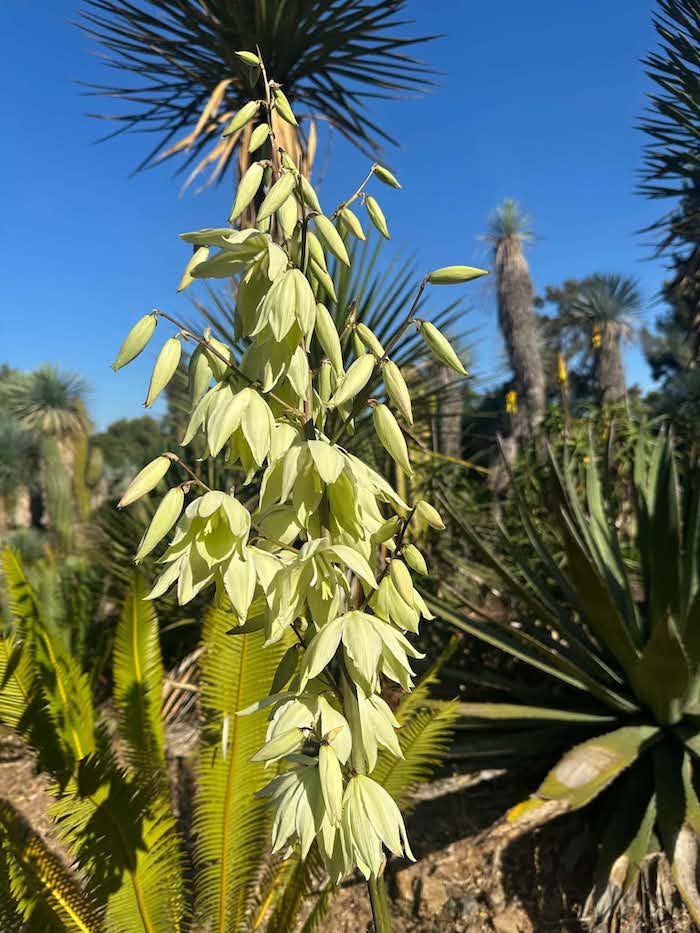
Individual flowers are pendant, campanulate (bell-shaped), fragrant, and showy. The six tepals are distinct, greenish white, elliptic to ovate, 5–6.5 cm long and 2–3.2 cm wide. Filaments measure 1.8–3.2 cm; the pistil is 3.2–4 cm long; the style is white, 13–20 mm, with lobed stigmas. Flowering occurs in spring, typically May to June in Texas.
Pollination depends on the obligate mutualism with yucca moths (Tegeticula spp.). The yucca giant skipper butterfly (Megathymus yuccae) also uses Yucca pallida as a larval host plant.
Fruits and Seeds
The fruit is an erect, dry, dehiscent capsule. Dehiscence is septicidal. Detailed measurements are not given separately from the related species in the FNA treatment, but capsule size is broadly comparable to that of Yucca rupicola (4–6 cm long). Seeds are thin, dull black.
Similar Species and Frequent Confusions
Yucca pallida is most commonly confused with Yucca rupicola — and for understandable reasons, since the two were historically treated as a single species. The confusion extends into the commercial trade, where blue-leaved plants sold as “Yucca rupicola” are frequently Yucca pallida or hybrids between the two.
Yucca rupicola Scheele — Twisted-leaf Yucca
The sister species and most frequent source of confusion. Yucca rupicola shares the acaulescent, clumping habit and flexible foliage but differs in its olive-green (not glaucous blue-grey) leaf color, pronounced leaf twist (absent in Yucca pallida), narrower leaves (1.7–4 cm, widest at the middle vs. 1–4.5 cm, widest above the middle), and orange to reddish-brown (not yellow) leaf margins. Where the two species’ ranges overlap, they hybridize freely, producing attractive intermediate forms with partially twisted, blue-green leaves — plants that are sometimes sold as Yucca pallida × rupicola.
Yucca arkansana Trel. — Arkansas Yucca
Another small, acaulescent species from the central Texas region. Yucca arkansana differs in its filamentous (not denticulate) leaf margins, narrower leaves, and generally greener foliage. McKelvey suggested that smooth-margined Yucca pallida plants (var. edentata) might represent hybrids with Yucca arkansana.
Yucca rostrata Engelm. ex Trel. — Beaked Yucca
Sometimes confused at the nursery point-of-sale because of the shared blue foliage tone. However, Yucca rostrata is a fundamentally different plant: trunked (eventually reaching 3–5 m), with very narrow leaves (less than 1.5 cm wide) arranged in a dense spherical head. The two species are not closely related within the genus.
Comparative Table
| Character | Yucca pallida | Yucca rupicola | Yucca arkansana |
|---|---|---|---|
| Leaf color | Pale blue-grey to chalky sage | Olive-green to pale green | Dull green |
| Leaf twist | None | Strong, increasing with age | None or slight |
| Leaf width | 1–4.5 cm (widest above middle) | 1.7–4 cm (widest at middle) | 1–2.5 cm |
| Leaf margin | Denticulate or wavy, yellow | Denticulate, orange/brown | Filamentous (white threads) |
| Colony size | 10–30+ rosettes | 2–15 rosettes | Variable, often solitary |
| Habitat | Blackland Prairies, clay soils | Edwards Plateau, limestone | Sandy or gravelly soils |
Distribution and Natural Habitat
Yucca pallida is endemic to the Blackland Prairies of east-central Texas, with its range extending onto the adjacent eastern margins of the Edwards Plateau and the Cross Timbers ecoregion. Some references also mention northern Mexico, but POWO restricts the native range to Texas. The Blackland Prairie is a distinctive ecoregion stretching from the Red River in the north southward to San Antonio, characterized by deep, dark, calcareous clay soils (Houston Black clay series), gentle topography, and a tallgrass prairie flora that has been largely destroyed by agriculture.
Within this range, Yucca pallida grows on open prairies, limestone outcrops, rocky slopes, and the clay soils of remnant grasslands. The species notably tolerates heavy clay — a remarkable adaptation among yuccas, most of which require sharply drained, sandy or rocky substrates. This clay tolerance is a key ecological and horticultural distinction from Yucca rupicola.
Associated species include tallgrass prairie dominants such as Schizachyrium scoparium (little bluestem), Sorghastrum nutans (Indian grass), Panicum virgatum (switchgrass), and forbs including Salvia spp., Penstemon spp., and Silphium spp. Where the Blackland Prairie meets the eastern Edwards Plateau, Yucca pallida comes into contact with Yucca rupicola, and extensive natural hybrid swarms occur in the zone of sympatry.
Conservation
Yucca pallida has not been formally assessed by the IUCN Red List and is not listed under CITES.
The conservation situation of Yucca pallida is closely tied to the fate of the Texas Blackland Prairies — one of the most endangered ecosystems in North America. Fewer than 1% of the original tallgrass prairie remains intact; the rest has been converted to agriculture, rangeland, or urban development (particularly the explosive growth of the Dallas–Fort Worth, Austin, and San Antonio metropolitan areas). While Yucca pallida persists along county roadsides, railroad rights-of-way, and in remnant limestone outcrops, its habitat is fragmenting rapidly. The species can be found in some protected areas, and its use in native-plant landscaping projects provides a supplementary buffer. The progressive loss of yucca moth pollinators, as documented for the related Yucca rupicola, likely also affects Yucca pallida populations.
Cultivation
| Parameter | Value |
|---|---|
| Hardiness | −18 °C (0 °F) / USDA zones 6b–10 |
| Light | Full sun to partial shade |
| Soil | Well-drained; tolerates clay, limestone, sand, loam |
| Watering | Low; drought-tolerant once established |
| Adult size | 20–50 cm (H) × 40–80 cm (W), excluding flower stalk |
| Growth rate | Moderate |
| Difficulty | 1/5 |
Light
Yucca pallida thrives in full sun but is notably shade-tolerant — it can be grown in the shade garden for textural interest, though it will bloom less profusely than plants in full sun. This shade tolerance, shared with its sister species Yucca rupicola, is unusual in the genus and makes Yucca pallida an invaluable plant for dry, shaded positions under deciduous trees or along the north side of buildings.
Soil and Drainage
This is where Yucca pallida genuinely differs from most yuccas: it tolerates heavy clay soils. In the wild, it grows on the deep, dark, calcareous clays of the Blackland Prairie — soils that would rot most yuccas within a season. Drainage is still important (standing water is never acceptable), but the species is far more forgiving of heavier substrates than any other member of series Rupicolae. In cultivation, it performs equally well in clay loam, sandy loam, limestone rubble, and standard garden soil. The pH preference is neutral to alkaline.
Watering
Less water is better. Once established, Yucca pallida requires minimal supplemental irrigation. The Blackland Prairie receives 760–1,000 mm of annual rainfall — considerably more than the semi-arid Edwards Plateau — so this species is inherently adapted to somewhat more moisture than its relatives. It will not, however, tolerate waterlogged conditions. In containers, allow the substrate to dry between waterings.
Cold Hardiness — Documented Experiences
Cold hardiness is estimated at approximately −18 °C (0 °F), corresponding to USDA zone 6b. This figure is supported by experience from the Texas Panhandle, where the species has been successfully grown for over eight years with winter lows reaching −18 °C in well-drained soil. Plant Delights Nursery in North Carolina, a leading yucca trialing nursery, offers the hybrid Yucca ‘Silver Anniversary’ (Yucca filamentosa × Yucca pallida) as hardy to zone 5b (−26 °C / −15 °F), suggesting that the Yucca pallida parent contributes good cold tolerance.
Key factors for cold survival: The entirely subterranean caudex provides excellent frost protection. The species’ tolerance of clay soils, which retain more moisture than sand or gravel, suggests a greater inherent resistance to wet-cold conditions than many other yuccas. Nevertheless, the standard advice applies: avoid winter irrigation, ensure that the crown does not sit in pooled water, and provide a dry mineral mulch in borderline zones.
Container Growing
The low stature, spreading habit, and blue foliage make Yucca pallida an exceptional container plant. Use a wide, shallow terracotta or concrete container with good drainage. A standard gritty mix (50% pumice or perlite, 30% potting soil, 20% sand) works well, though this species is less demanding about substrate composition than most yuccas. In cold-winter areas, overwinter containers in an unheated greenhouse or cold frame.
Growth Rate
Yucca pallida has a moderate growth rate — faster to colonize than Yucca rupicola or Yucca reverchonii. Colonies of 10–30 rosettes can develop within 5–10 years from a single offset, creating an attractive spreading groundcover of blue rosettes.
What to Know Before Buying
Availability. Yucca pallida is more widely available than Yucca reverchonii but still uncommon in mainstream garden centers. It is regularly offered by specialist native-plant nurseries in Texas (High Country Gardens, Yucca Do Nursery) and by a growing number of online succulent and xeriscape suppliers. Plant Delights Nursery offers the excellent hybrid Yucca ‘Silver Anniversary’ (Yucca filamentosa × Yucca pallida) for gardeners wanting a tougher, faster-spreading plant with blue-tinted foliage.
Seeds vs. plants. Seeds are occasionally available through specialist exchanges. Germination follows the standard yucca protocol: 24-hour warm-water soak, sow in gritty mineral mix, maintain 20–25 °C. Seedling growth is slow. Purchasing a well-rooted offset in a 1-liter pot is the most efficient route to a flowering colony.
Pitfalls to avoid. The single most common problem in the trade is confusion with Yucca rupicola. True Yucca pallida has flat, straight (not twisted), pale blue-grey leaves with yellow (not orange or reddish-brown) margins. If the leaves twist and the color is olive-green, the plant is Yucca rupicola. If the leaves are partially twisted and the color is intermediate blue-green, it may be a natural hybrid. Both species and their hybrids are excellent garden plants, but accurate identification matters for collectors and for content that aims to be botanically precise.
Propagation
Seeds
Sow fresh seeds in a well-drained mineral mix. Soak seeds for 24 hours in warm water before sowing. Maintain a temperature of 20–25 °C and keep the substrate barely moist. Germination is slow and irregular. Pot seedlings individually once they have 2–3 true leaves.
Offsets
The most practical method. Yucca pallida produces offsets freely from its branching subterranean caudex. Detach offsets with a clean, sharp knife when they have developed their own root system. Allow the cut surface to callus for 2–3 days in a dry, shaded spot before planting into a gritty substrate. Water sparingly until establishment is confirmed by new leaf growth.
Division
Mature colonies can be divided in early spring by excavating and separating individual rosettes with a section of caudex. Given the large colony size this species can achieve (10–30+ rosettes), division is both practical and productive.
Pests and Diseases
Yucca pallida is exceptionally trouble-free — arguably the easiest species in the entire genus to grow. Most problems are cultural (overwatering, poor drainage in non-clay soils) rather than biological.
Root and crown rot (Fusarium, Phytophthora): Less common with this species than with most yuccas, thanks to its natural tolerance of heavier, moister soils. Still, standing water around the crown should always be avoided.
Mealybugs (Pseudococcus spp.): Occasionally found in leaf bases. Treat with rubbing alcohol on a cotton swab for light infestations.
Agave snout weevil (Scyphophorus acupunctatus): Not a primary host, but worth monitoring in gardens where this pest is active on nearby agavoids.
Yucca giant skipper (Megathymus yuccae): The larvae of this butterfly bore into the caudex of Yucca pallida. In its native Texas range, this is a natural part of the ecosystem rather than a pest problem. In gardens outside the native range, the insect is absent.
Deer: Foliage is deer-resistant. Flowers are browsed by deer where populations are dense.
Landscape Use
Yucca pallida fills landscape niches that no other yucca can match, thanks to the convergence of blue foliage, shade tolerance, clay tolerance, and compact size.
Blue accent in prairie gardens: The signature use. Plant Yucca pallida among native grasses — Schizachyrium scoparium, Bouteloua curtipendula, Muhlenbergia capillaris — for an authentic Texas Blackland Prairie aesthetic, with the blue rosettes providing year-round structural contrast.
Dry shade: One of the very few blue-leaved evergreen plants that performs well in dry, shaded conditions. Use under deciduous trees, on shaded slopes, or on the north side of walls.
Clay soil gardens: Where most yuccas fail, Yucca pallida thrives. If your soil is heavy clay and you want a yucca, this is the species to choose — no raised beds, imported gravel, or soil amendments required.
Groundcover and mass planting: The vigorous offset production and moderate growth rate allow Yucca pallida to form attractive spreading colonies of blue rosettes. Plant on 50–60 cm centers for a groundcover effect on slopes, embankments, or large rock gardens.
Container gardens: The blue foliage is a striking complement to terracotta pots and pairs beautifully with orange, purple, and silver-leaved companion plants.
Hybridization potential: The natural hybrid Yucca pallida × Yucca rupicola produces plants with partially twisted, blue-green leaves — an attractive combination of both parents’ best features. The cultivar ‘Silver Anniversary’ (Yucca filamentosa × Yucca pallida) is increasingly popular in the southeastern US and combines dusty blue foliage with exceptional cold hardiness.
Frequently Asked Questions
Is Yucca pallida the same as Yucca rupicola?
No. The two are closely related sister species that were historically treated as one, but they are now universally recognized as distinct, confirmed by DNA analysis (Clary, 1997). The most obvious difference is leaf color: pale blue-grey in Yucca pallida versus olive-green in Yucca rupicola. The leaves of Yucca pallida are straight (not twisted), and the species grows on the Blackland Prairies rather than the Edwards Plateau. Where the two species’ ranges overlap, they hybridize freely.
Can Yucca pallida grow in clay soil?
Yes — this is one of the key distinctions from other yuccas. In the wild, Yucca pallida grows on the heavy, dark calcareous clays of the Texas Blackland Prairie. In cultivation, it performs well in clay loam and even moderately heavy clay, provided the soil does not remain waterlogged. This clay tolerance makes it uniquely valuable among yuccas for gardens on heavy soils.
Does Yucca pallida tolerate shade?
Yes. Like its sister species Yucca rupicola, Yucca pallida is shade-tolerant and can be grown in partial shade or dappled light. Flowering will be less profuse in shade than in full sun, but the foliage remains attractive. Few other yuccas offer this combination of blue foliage and shade tolerance.
How does Yucca pallida differ from Yucca rostrata?
Despite the superficially similar blue foliage, the two species are very different plants. Yucca rostrata is a trunked species that eventually reaches 3–5 m tall, with very narrow leaves (under 1.5 cm wide) forming a dense spherical head. Yucca pallida is entirely stemless, with broader, softer leaves and a low, spreading, colony-forming habit. They are not closely related within the genus.
What is Yucca ‘Silver Anniversary’?
A hybrid between Yucca filamentosa and Yucca pallida, introduced by Plant Delights Nursery (PDN/JLBG). It produces a fast-growing clump of dusty blue foliage approximately 60 cm tall and 120 cm wide, and is hardy to USDA zone 5b at minimum. It combines the cold hardiness and vigorous offset production of Yucca filamentosa with the blue leaf color of Yucca pallida.
Reference Databases and Online Resources
- POWO — Yucca pallida
- Flora of North America — Yucca pallida
- Tropicos — Missouri Botanical Garden
- iNaturalist — Yucca pallida
- Lady Bird Johnson Wildflower Center
- GBIF — Yucca pallida
Bibliography
- McKelvey, S.D. (1947). Yucca pallida. In: Yuccas of the Southwestern United States, vol. 2: 57, plates 13–14. Arnold Arboretum, Harvard University.
- McKelvey, S.D. (1938–1947). Yuccas of the Southwestern United States. 2 volumes. Jamaica Plain.
- Trelease, W. (1911, publ. 1912). Yucca rupicola var. edentata. Report (Annual) Missouri Botanical Garden 22: 102.
- Webber, J.M. (1953). Yuccas of the Southwest. USDA Agriculture Monograph No. 17. Washington, D.C.
- Hess, W.J. & Robbins, R.L. (2002). Yucca. In: Flora of North America Editorial Committee (eds.), Flora of North America North of Mexico, vol. 26: 423–439. Oxford University Press.
- Clary, K.H. (1997). Phylogeny, character evolution, and biogeography of Yucca L. (Agavaceae) as inferred from plant morphology and sequences of the internal transcribed spacer (ITS) region of the nuclear ribosomal DNA. Ph.D. dissertation, University of Texas at Austin.
- Molon, G. (1914). Le Yucche. Ulrico Hoepli Editore, Milano. 247 pp.
- Wasowski, S. & Wasowski, A. (1991, 2002). Native Texas Plants: Landscaping Region by Region. Gulf Publishing / Taylor Trade Publishing.