Seed is the standard way to propagate nolinas, the beargrasses of the American Southwest and Mexico. Trunk-forming species such as Nolina nelsonii and Nolina longifolia cannot be reliably propagated from cuttings, and wild-dug plants transplant poorly. The good news is that Nolina seed usually germinates without much fuss. The real challenges lie elsewhere: getting viable seed in the first place, then nursing young plants through their first years, when they grow slowly and are easily lost to overwatering.
This guide takes you from ripe capsules to plants in the ground. The figures quoted come from published studies on a handful of species and are given with the species concerned, because not all nolinas behave alike.
What you need to know about nolina seed
Male and female plants
Nolinas are generally dioecious: one plant bears male flowers, another female flowers, and flowers with both sexes functional turn up only occasionally. A lone nolina in a garden will not set viable seed. You need a male and a female of the same species, flowering at the same time and close enough for insects to carry pollen between them. Since the sexes cannot be told apart until the plants flower, anyone hoping to harvest their own seed should plant several seed-grown specimens.
Papery capsules, small seeds
The fruit is a thin, papery, three-lobed capsule that normally holds three seeds. In Nolina microcarpa the capsule measures 4–6 mm long by 6–8 mm wide (about ¼ in) and the seeds 2–3.5 mm across. Nolina parviflora seeds are ovoid, roughly 3.4 × 2.6 mm, with close to 60,000 seeds to the kilogram (about 27,000 per pound).
Good storage life
Nolina seed does not lose viability within months. A Mexican seed monograph reports that Nolina parviflora seed keeps for several years in a sealed jar in cool, dry conditions, and that refrigeration extends its life further. A lot of Nolina interrata collected in 1990 and held in a California botanic garden seed bank still germinated at 90% when sown in 2014. That assumes well-dried seed stored properly, not seed left for months in a warm, humid greenhouse.
Getting seed
From a specialist seed supplier. Choose suppliers that state the harvest year and provenance. Seed sold as “Nolina recurvata” will give you a ponytail palm, Beaucarnea recurvata, which belongs to a separate genus.
From your own plants. After late-spring flowering, the capsules on a pollinated female ripen over the summer. Harvest them when they are light brown, very dry and papery, and ready to drop on their own. Finish drying indoors, rub the capsules between your palms and winnow off the chaff. Discard flat, shrivelled or empty seeds: in a conservation project on Nolina interrata, most of the field-collected seed turned out to be malformed and inviable.
When to sow
- Late April to June, unheated, under cover or outdoors in mild climates. Seedlings emerge quickly and have the whole summer to establish.
- Late January to March, in a greenhouse or cold frame, if needed on a heat mat set to 20–25 °C (68–77 °F). The Native Plant Society of Texas recommends this late-winter sowing for Nolina texana.
Avoid sowing in midsummer in a hot room: above 30 °C (86 °F), germination drops sharply.
Should you soak the seed?
It depends on the species. Nolina parviflora seed has no dormancy and needs no pre-treatment. Nolina cespitifera, by contrast, has a seed coat that slows water uptake: in a Mexican study, the best result (about 49% germination) came after an 8-minute dip in 3% sodium hypochlorite.
For home growers, the simplest approach is a 12–24 hour soak in room-temperature water, 20–25 °C (68–77 °F). Do not use hot water, nor lukewarm water at 30 °C (86 °F) or above. The nursery that propagated Nolina interrata also soaked its seed for 24 hours before sowing. A soak does no harm to species without dormancy and softens the seed coat of the others.
Mix and containers
Mix. Use a clean, free-draining medium: equal parts sifted seed compost and perlite, or compost and fine pumice. The Nolina interrata nursery used a 50/50 peat–perlite mix, having found that young plants were very sensitive to excess moisture. Sterilising the compost in the oven reduces the risk of damping off.
Containers. From germination onwards, the seedling sends down a long taproot. Use pots at least 15 cm (6 in) deep, tall “long tom” pots or tree tubes rather than shallow seed trays, and sow one or two seeds per pot to avoid tricky pricking out.
Sowing step by step
- Fill the pots to 1 cm (½ in) below the rim and water from below, then let them drain.
- Place the seeds on the surface.
- Cover with 5 mm to 1 cm (¼–½ in) of fine mix or grit. The Nolina parviflora monograph recommends 1 cm, and seed of that species germinates as well or better in the dark.
- Label (species, source, date) and cover with a clear lid, airing daily.
Temperature and light
Do not overheat. In Nolina parviflora, germination reached about 85% at 20 °C (68 °F) and 88% at 25 °C (77 °F) in darkness, but fell below 16% at 30 °C (86 °F). For Nolina cespitifera, the optimum is around 25 °C. Aim for 20–25 °C (68–77 °F) and watch propagators standing in the sun, which overheat quickly. Bright light without direct sun is enough during germination; afterwards, seedlings need plenty of light, with light shade in their first season.
Germination
Expect seedlings in two to four weeks in most cases. In Nolina cespitifera, the first seeds sprouted within 5–10 days at 26 °C (79 °F); Nolina interrata seed sown in mid-December had germinated by January. Emergence is often staggered, so do not give up on a pot before six to eight weeks.
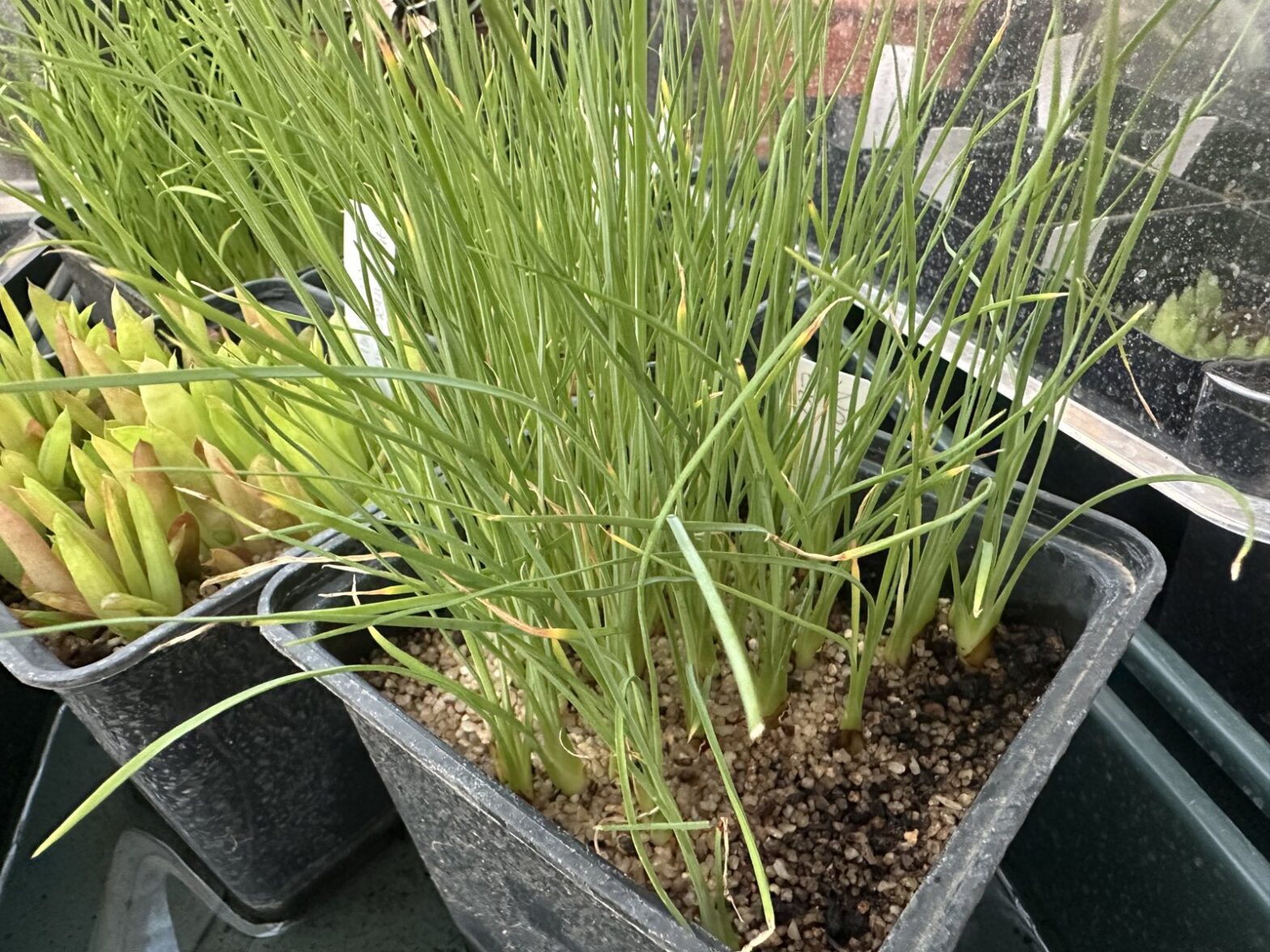
The seed first pushes out an elongated, arched structure about 10 mm (⅜ in) long; the first leaf appears at the bend of the arch, which sometimes lifts the seed above the surface. This is normal. The seedling then looks like a fine blade of grass.
Seedling care
Watering. Remove the cover gradually once seedlings appear, then let the surface dry between waterings. In Nolina interrata, root rot killed about half the seedlings after germination, and the nursery then grew the young plants on the dry side.
Potting on and feeding. If you sowed in a tray, transplant at the two- or three-leaf stage without breaking the taproot; for Nolina texana, the Native Plant Society of Texas suggests 4–6 inch pots and light shade in the first season. A quarter-strength liquid feed once a month during the growing season is enough. Watch for aphids.
The first years and planting out
Nolinas are slow starters: it takes several years to get a decorative rosette, and longer for an arborescent species to form a trunk. Keep seedlings dry and frost-free over their first winter, in a cold frame or a bright, unheated greenhouse. Published hardiness ratings, including USDA zones, apply to established adult plants; seedlings are considerably more tender, and no reliable figures exist for them.
Plant out in spring, using two- to three-year-old plants raised in deep pots, in full sun and very free-draining soil. When Nolina interrata was reintroduced in California, all two-year-old plants survived their first ten months in the ground, against 70% of one-year-olds. Choose the spot carefully, since established nolinas resent being moved, and water through the first summer.
Species most often grown from seed
- Nolina nelsonii: the blue nolina from Tamaulipas, a trunk-forming species propagated almost exclusively from seed.
- Nolina longifolia: the large nolina of Mediterranean gardens, which POWO treats as Nolina parviflora, the species with the best-studied germination.
- Nolina matapensis: a tree nolina from Sonora and Chihuahua, for mild-winter climates.
- Nolina texana and Nolina microcarpa: stemless beargrasses, among the hardiest; nurseries rate high-elevation forms to USDA zone 5. They can also be divided.
- Nolina hibernica: the former Nolina ‘La Siberica’, from the mountains of north-eastern Mexico.
For range, habit and hardiness of each species, see our page on the genus Nolina. Yuccas are sown along similar lines: see growing yuccas from seed.
Sidebar: sowing Beaucarnea and Dasylirion
Ponytail palms (Beaucarnea) and sotols (Dasylirion), close relatives of nolinas, are sown the same way, with two differences:
- Remove the fruit wall. Their seeds sit inside a dry, three-winged fruit that holds back germination: in Dasylirion lucidum, 22% germinated with the fruit on against 94% without; in Beaucarnea recurvata, 37% against 60%. Otherwise, soak for 24 hours in room-temperature water.
- Keep Beaucarnea warm. Beaucarnea gracilis germinated at 88–90% between 25 and 30 °C (77–86 °F), but hardly at all at a constant 20 °C (68 °F).
Common mistakes
- Expecting seed from a single nolina with no male nearby.
- Sowing above 30 °C (86 °F).
- Using shallow trays where the taproot hits the bottom.
- Keeping the mix soggy after germination.
- Planting out too young, or moving an established nolina.
Quick reference
| Step | Recommendation |
|---|---|
| Harvest | Light brown, dry, papery capsules ready to drop |
| Storage | Sealed jar, cool and dry |
| Timing | Late April to June, or late January to March under heated cover |
| Soak | 12–24 h in room-temperature water, 20–25 °C (68–77 °F) |
| Mix | Equal parts fine compost and perlite |
| Containers | At least 15 cm (6 in) deep |
| Depth | 5 mm to 1 cm (¼–½ in) |
| Temperature | 20–25 °C (68–77 °F), never above 30 °C (86 °F) |
| Emergence | Usually 2–4 weeks |
| After germination | Let the surface dry between waterings |
| Planting out | In spring, 2- to 3-year-old plants |
Frequently asked questions
How long do nolina seeds take to germinate?
Usually two to four weeks at 20–25 °C (68–77 °F). Wait six to eight weeks before writing a pot off, and check that the temperature has not exceeded 30 °C (86 °F).
Why does my beargrass produce empty capsules?
Because its flowers were not pollinated. A female plant needs a male of the same species flowering at the same time.
How long does nolina seed stay viable?
Several years if well dried and kept in a sealed jar somewhere cool; refrigeration extends its life.
Can I sow nolina directly in the garden?
In mild climates it can work: at the Domaine du Rayol on the French Riviera, the large nolinas sometimes self-seed. Pots remain the safer option, since you control moisture and can protect seedlings in winter.
Sources
- Reyes Bautista, Z. & Rodríguez Trejo, D. A. Monograph Nolina parviflora, Semillas de especies forestales series (RNGR).
- Castillo-Quiroz, D. et al. (2018). Tratamientos químicos y biológicos para estimular la germinación en semillas de Nolina cespitifera. Polibotánica 45.
- Conservation Biology Institute (2016). Dehesa Nolina and Variegated Dudleya Augmentation, SANDAG report.
- USDA Forest Service, Fire Effects Information System, Nolina microcarpa.
- Native Plant Society of Texas, Nolina texana.
- RNGR monographs Beaucarnea gracilis and Dasylirion lucidum, based on Rodríguez Trejo et al. (2019), Entreciencias 7(20).