
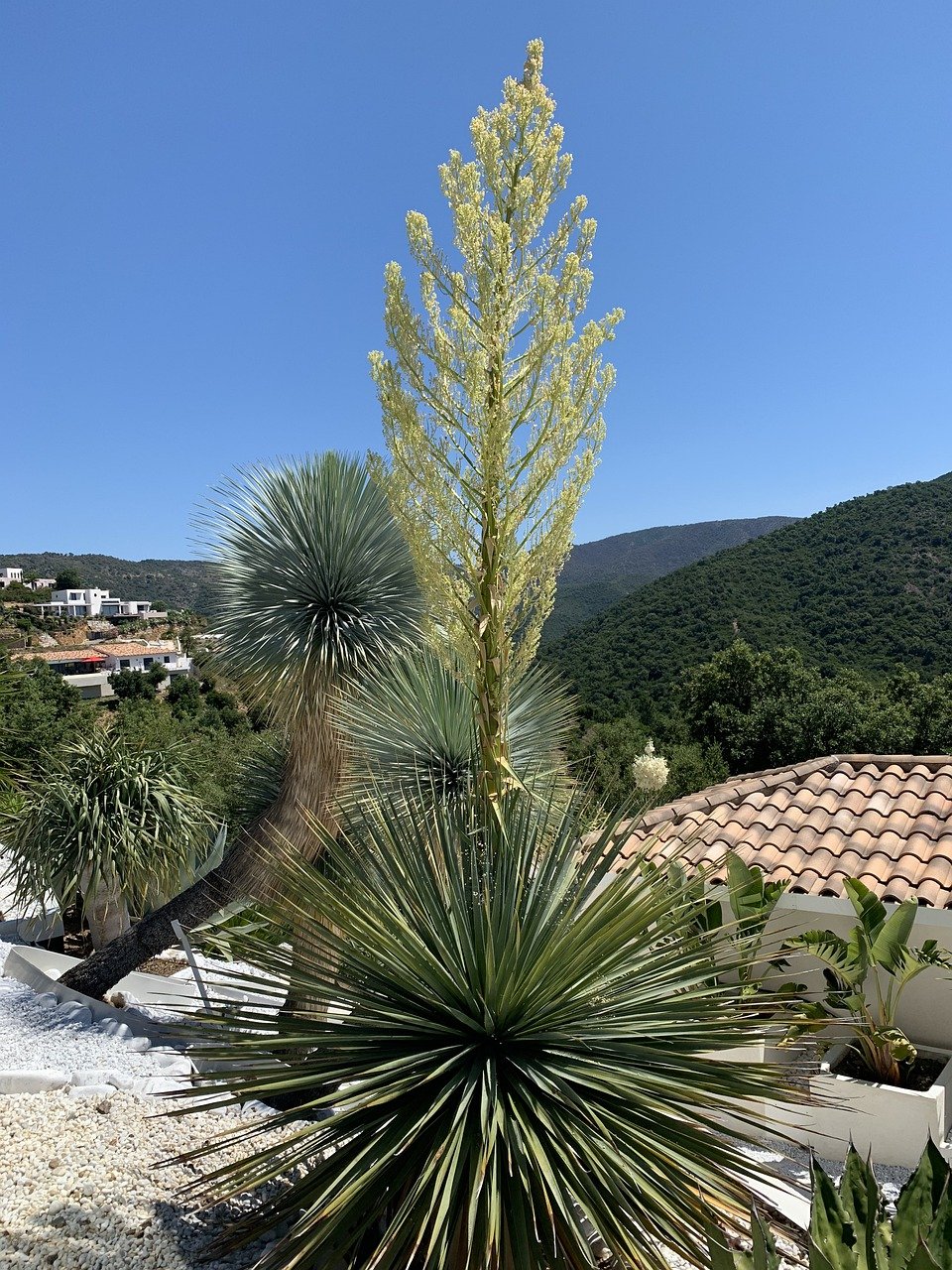
Nolina nelsonii is the blue jewel of the genus — an arborescent beargrass from the mountains of Tamaulipas whose dense, spherical crown of silvery blue-green leaves, carried atop a stout trunk, creates one of the most striking architectural silhouettes in the entire nolinoid world. Often compared to a giant ponytail palm, but far hardier and with stiffer, more intensely coloured foliage, Nolina nelsonii has become the most sought-after species in the genus for collectors and landscape designers alike.
But this popularity carries a shadow. The overwhelming majority of large, trunked specimens sold in Europe originate from wild-collected plants stripped from the mountains of Tamaulipas — a practice that is ecologically damaging and ethically indefensible. Succulentes.net strongly encourages gardeners to purchase only nursery-propagated, seed-grown plants, and to reject wild-collected specimens regardless of size or price.
Taxonomy and nomenclature
First described in the US National Arboretum archives in 1906. Family Asparagaceae, subfamily Nolinoideae. The species is considered closely related to the Californian Nolina parryi. POWO gives the native range as Mexico (Tamaulipas).
Common names
Blue nolina, Nelson’s beargrass, Nelson’s blue beargrass, Soyate (English and Spanish).
Morphological description
Habit
Nolina nelsonii is a slow-growing, arborescent, evergreen succulent. It develops a stout, usually solitary trunk that can reach 2–3 m in cultivation and several metres more in the wild, topped by a dense, beautifully rounded rosette approximately 1.5–2 m in diameter. The trunk is typically clothed in a dense “petticoat” of persistent dead leaves. The overall mature height in cultivation is 2.5–3 m (8–10 ft); in the wild, taller specimens exist. Plant Delights Nursery describes plants reaching 10–12 ft (3–3.7 m) at maturity in their North Carolina climate.
Leaves
Leaves are the species’ defining ornamental feature: rigid but not dangerously sharp, pointed, approximately 90 cm long and 2.5 cm wide, silvery blue-green to glaucous blue, with finely serrated margins. The colour is exceptional — a striking, cool blue-grey that catches the light and stands out dramatically against green garden foliage. Plant Delights describes them as having “fine written all over it.”
Inflorescence, flowering and monocarpy
Nolina nelsonii is dioecious (separate male and female plants) and monocarpic at the rosette level. After reaching maturity — which can take 18+ years in cultivation (Plant Delights) or 29 years as documented at the University of Washington Botanic Gardens — the rosette produces a tall flower stalk (1–2 m above the foliage) bearing thousands of tiny white flowers. After flowering, the main rosette dies.
However, lateral trunks typically emerge from below the dying rosette to continue the plant’s life. The Palm Centre (UK) notes: “After blooming, the plant’s main trunk dies and multiple lateral trunks emerge to take its place.” This makes the species functionally polycarpic at the clump level — the plant persists through successive generations of trunks, though the original stem is lost.
Distribution and natural habitat
Endemic to the Mexican state of Tamaulipas, growing in desert and montane regions at elevations up to approximately 2,700 m (9,000 ft). The habitat ranges from arid desert scrub to the margins of montane vegetation on rocky, calcareous slopes. The continental climate features hot summers, cold winters with frost, and wide daily temperature swings.
Cultivation guide
| Hardiness | −12 °C / 10 °F (USDA zone 8a) |
| Light | Full sun (essential) |
| Soil | Very well-drained; poor, rocky, gravelly preferred |
| Water | Very low once established; zero in winter |
| Growth rate | Slow (18–29 years to maturity) |
| Flowering | Monocarpic at rosette level; lateral trunks replace the original |
Light requirements
Full sun, without exception. Intense light ensures compact, well-coloured rosettes and optimal cold hardiness. The species thrives in exposed, wind-swept positions and tolerates extreme reflected heat.
Soil and drainage
Drainage is paramount. Promesse de Fleurs emphasises that the species “seems even hardier and easier to perpetuate when planted in poor, rocky soil, or composed of a good portion of gravel that allows perfect drainage.” In heavy soil, plant on a raised mound or in a purpose-built gravel garden. Neutral to alkaline pH is natural but the species is tolerant. The Palm Centre confirms that “excellent drainage is absolutely key for the plant to withstand colder temperatures.”
Watering
Zero supplementary water once established, even in Mediterranean climates with dry summers. During the establishment phase (first 2–3 years), occasional deep watering supports root development. In containers, water sparingly in summer and not at all in winter.
Cold hardiness
The data converges on approximately −12 °C (10 °F) as the reliable limit for established specimens in well-drained soil:
- Promesse de Fleurs: “around −12 °C if of short duration and the plant is established in suitable soil.”
- The Palm Centre (UK): “already survived down to −12 °C in some UK gardens: but excellent drainage is absolutely key.”
- The Cactus King: “hardy below 0 °F” (below −18 °C) — likely an optimistic claim for the most established specimens.
- Plantlust / Cistus Nursery: rates as USDA zone 8.
Young plants are significantly more frost-sensitive. Protect for the first 2–3 winters with fleece or a rain shelter.
| USDA zone | Growing mode | Winter protection |
|---|---|---|
| 9–11 | In-ground, no issues | None |
| 8b | In-ground | Frost cloth for extended cold; impeccable drainage |
| 8a | In-ground, sheltered position | Wall shelter, gravel mulch, fleece for severe events; young plants protected |
| 7b and below | Container or borderline in-ground | Overwinter under cover or provide serious protection |
Landscape use
Nolina nelsonii is an architectural focal point of the highest order. Its blue-grey crown, stout trunk and dramatic scale make it outstanding as a specimen in gravel gardens, dry borders, Mediterranean landscapes and exotic plantings. Promesse de Fleurs suggests combining it with Puya caerulea, Agave americana, Cylindropuntia imbricata, Yucca brevifolia, hardy cacti and Canary Island vipers bugloss. It is deer-resistant.
The wild-collection problem
Large, trunked specimens of Nolina nelsonii command high prices in European nurseries — and the vast majority of these originate from wild-collected plants uprooted from the mountains of Tamaulipas. This practice depletes natural populations, damages fragile montane ecosystems and is ethically unacceptable. Seed-grown plants, while slower to reach impressive sizes, are the only responsible option. Several specialist nurseries (Cistus Nursery, Yucca Do Nursery, rarepalmseeds.com) offer seed-grown stock. A seed-grown Nolina nelsonii that you have watched develop from a seedling to a blue-crowned tree over two decades is immeasurably more satisfying than a wild-stripped trunk of unknown provenance.
Propagation
Seed: the primary and recommended method. Germinate at 20–25 °C; emergence in 2–4 weeks from fresh seed. Growth is slow — expect 5+ years before an ornamental rosette forms, and 15–20+ years for a visible trunk. The University of Washington’s specimen took 29 years from seed (Yucca Do Nursery, 1993) to first flowering in 2022.
Offsets: lateral shoots may develop after the main rosette flowers and dies. These can be separated and replanted.
Pests and diseases
Root rot: the only serious threat. Prevention: drainage. No other significant pests or diseases in landscape settings. The Palm Centre notes that the species “has low irrigation needs, and even in a container requires little to no water in the colder months.” Deer and rabbit resistant.
References
POWO (2026). Nolina nelsonii. Plants of the World Online, Kew.
University of Washington Botanic Gardens (2022). August 2022 Plant Profile: Nolina nelsonii.