
Macrozamia miquelii is a cycad from central-eastern Queensland, in eastern Australia, that forms dense stands in the open eucalypt forests of the Rockhampton region, between Mount Larcom and Byfield. A species of the genus Macrozamia, it was first described by Ferdinand von Mueller in 1862 as Encephalartos miquelii, a name still found in older texts. It is a medium-sized plant with a trunk that is almost always underground and flat, fairly glossy leaves. For a long time its name covered several related Queensland species, separated in 2001: many plants and seeds sold under this name therefore do not necessarily belong to the species in the strict sense. The IUCN lists it as Least Concern.
Key facts about Macrozamia miquelii
- Accepted name: Macrozamia miquelii (F.Muell.) A.DC. (1868), accepted by The World List of Cycads (version 2026.08.15), the Australian Plant Census, GBIF and Species+
- Former names and synonyms: Encephalartos miquelii F.Muell. (1862, basionym); Macrozamia tridentata var. miquelii (F.Muell.) J.Schust. (1932); Macrozamia tridentata var. oblongifolia Regel (1876); Macrozamia mackenziei W.Bull (1877); Encephalartos spiralis var. major Miq. (1863)
- Family: Zamiaceae, order Cycadales; section Macrozamia, “Macrozamia miquelii group” (Jones et al., 2001)
- Common names: “Wild Pineapple”, “Zamia” and “Zamia Palm” (Australian Plant Census)
- Natural range: Australia, central-eastern Queensland (Port Curtis district, from Mount Larcom to north of Byfield), at 10 to 540 m, according to the 2001 revision; the older Flora of Australia keeps a wider range reaching north-eastern New South Wales
- IUCN status: Least Concern (LC), assessment by J.D. Bösenberg dated August 2020 and published in 2022
- CITES and other protection: CITES Appendix II (annotation #4); Annex B in the European Union; no listing under Australian threatened-species law (Atlas of Living Australia)
- Documented hardiness: no reliable measurement; in Italy, at Ravenna, a young potted plant sheltered from rain and wind came through −3 °C (26.6 °F) (see Cold hardiness)
- Light and soil: in the wild, open forest or eucalypt woodland, on stony soils or deep sand
- Habit and adult size: trunk usually underground, sometimes emergent up to 50 cm tall and 45 cm across; 20 to 80 leaves 0.5 to 2.3 m long
- In the UK, US and Australia: declared to BGCI by 41 institutions, including Kew, RHS Garden Wisley, Glasgow, Paignton Zoo and Montgomery Botanical Center; grown at the Royal Botanic Garden Sydney since 1977 and at Royal Botanic Gardens Victoria
- Toxicity: the whole plant is toxic, above all the seed kernel (see Toxicity and precautions)
How to recognise Macrozamia miquelii
Macrozamia miquelii forms a clump of flat, dark green leaves above a trunk that is almost always buried; the leaflets at the base of the leaf are progressively reduced to spines. The most recent description is that of the revision by David Jones, Paul Forster and Ish Sharma (2001), who redescribed the species in the strict sense.
- Trunk: usually underground, sometimes emergent, upright, columnar or barrel-shaped, up to 50 cm long and 45 cm across, unbranched.
- Leaves: 20 to 80 in a dense crown, 0.5 to 2.3 m long, dark green, dull to slightly glossy, flat in section and arching; young leaves light green; petiole 20 to 40 cm, woolly at the base.
- Leaflets: 80 to 180 per leaf, inserted at about 40°, 15 to 50 cm long and 6 to 12 mm wide, thick, with stomata on the underside only and a whitish callous base; the lowest 6 to 16 pairs are reduced to rigid spines.
- Male cones: 1 to 5, cylindrical to spindle-shaped, 12 to 28 cm long and 3.8 to 6.5 cm across, green.
- Female cones: 1 to 3, cylindrical to barrel-shaped, 25 to 40 cm long and 10 to 15 cm across, green; apical spines of the sporophylls up to 4.5 cm.
- Seeds: oblong to ovoid, 2 to 3 cm long and 1.5 to 2 cm wide, with a yellowish, pale orange or red fleshy coat.
The measurements of the Flora of Australia (Hill, 1998), based on a broader concept of the species, differ slightly: trunk 0 to 40 cm, 30 to 80 leaves 0.8 to 2.1 m long, 80 to 160 leaflets, seeds 25 to 35 mm with an orange-red coat. Jones and his colleagues themselves note many discrepancies in measurements with that treatment.
Hybrids
No hybrid of Macrozamia miquelii is documented. Johnson (1959) knew of none, and the 2001 revision reports none.
Possible confusion
Confusion comes mainly from the related species of the “Macrozamia miquelii group”, long lumped under this name, and from Macrozamia communis in the trade.
With the species of the Macrozamia miquelii group
According to Jones et al. (2001), the group comprises seven species of eastern Queensland: Macrozamia cardiacensis, Macrozamia douglasii, Macrozamia longispina, Macrozamia macleayi, Macrozamia miquelii, Macrozamia mountperriensis and Macrozamia serpentina. Their key separates Macrozamia miquelii by its 6 to 16 pairs of leaflets reduced to spines, its thick, dull to slightly glossy leaves and its female cones 10 to 15 cm across. Macrozamia macleayi, its closest relative on allozyme evidence, has glossier, thinner leaves and narrower female cones (7 to 10 cm); Macrozamia douglasii, from K’gari (Fraser Island) and Cooloola, has only one to four pairs of leaflets reduced to spines; Macrozamia serpentina is smaller in every part.
Before 2001, Macrozamia miquelii also covered populations now placed in these species: the text by Len Butt on the PACSOA wiki thus cites plants from Fraser Island, Mount Perry, Gympie and Upper Brookfield near Brisbane, and calls it “the most variable of all the Macrozamias”. These localities now belong, at least in part, to Macrozamia douglasii, Macrozamia mountperriensis or Macrozamia macleayi; the PACSOA does not assign each population.
With Macrozamia communis
Macrozamia communis, from New South Wales, looks very similar. Johnson (1959) separated them as follows: in Macrozamia miquelii, thin, flexible, glossy leaflets, often crowded, short and narrow sporophyll spines (2 to 5 mm at the base), and seeds 2.5 to 3.5 cm long; in Macrozamia communis, thicker, rigid, dull leaflets, often spaced, long and broad sporophyll spines (5 to 12 mm), and seeds 3 to 4.5 cm long. The two species do not meet in the wild. In cultivation, labels get mixed up: on the Italian Tropicamente forum, a grower reported in 2009 that plants raised from seed sold as Macrozamia miquelii had been identified by other enthusiasts as Macrozamia communis.
Names not to be confused
Ceratozamia miqueliana, also named after Miquel, is a Mexican cycad of quite another genus. Cycas miquelii Warb. (1900) is, for The World List of Cycads, a synonym of Cycas revoluta, and Zamia miquelii W.Bull (1876) a doubtful name. No name “Macrozamia miqueliana” exists in that list. Finally, Lepidozamia, another Queensland genus long placed in Macrozamia, differs, according to Johnson’s key (1959), in its leaflets inserted along the midline of the upper side of the rachis, its successive crowns of leaves separated by a broad series of cataphylls, and its almost stalkless cones with spineless sporophylls.
Taxonomy
Macrozamia miquelii is an accepted species. Mueller described it in 1862 in Encephalartos (Fragmenta Phytographiae Australiae 3: 38), and Alphonse de Candolle transferred it to Macrozamia in 1868 (Prodromus 16(2): 535).
Mueller’s description mixed two species: Charles Moore’s collection from the Richmond River belonged to the species later described as Macrozamia fawcettii, while those of Thozet, near Rockhampton, and of Walter Hill, at Moreton Bay, matched the present species. Johnson (1959) chose Thozet’s Rockhampton collection, kept in Melbourne (MEL), as the lectotype. Paul Forster (1999) proposed conserving the name with that type, since Mueller himself had indicated another application; the nomenclature committee rejected the proposal, considering that Mueller’s annotation did not amount to a lectotypification (Jones et al., 2001). The World List of Cycads accepts the Melbourne lectotype.
Johnson (1959) took a very broad view of the species: he included Macrozamia douglasii, Macrozamia mountperriensis and Macrozamia cylindrica, finding no discontinuity between these populations. The Flora of Australia (Hill, 1998) already recognised five species of the group, including new species described by Forster and Jones (1998), and Jones, Forster and Sharma (2001) revised the whole group, reinstated Macrozamia macleayi and described Macrozamia serpentina, restricting Macrozamia miquelii to the Port Curtis district. The online Flora of Australia (revised in April 2026) still keeps a broad concept, from Rockhampton to the Richmond River, while noting that the treatment needs revision. The World List of Cycads now records the species only from Queensland. Authors also differ on the name Encephalartos douglasii F.Muell.: The World List of Cycads places it, as an invalid name of 1882, under Macrozamia miquelii, whereas Jones et al. (2001) treat it as a synonym of Macrozamia douglasii. The chromosome number is 2n = 18.
Etymology and history
The epithet honours Friedrich Anton Wilhelm Miquel (1811–1871), Dutch botanist and pioneer of the study of cycads, who had created the genus Macrozamia in 1842 (Flora of Australia; Haynes, 2022, as given by The World List of Cycads). The species was grown very early in Europe under many horticultural names, among them Macrozamia mackenziei, published in 1877 in the catalogue of the nurseryman William Bull and in the Gardeners’ Chronicle; Johnson (1959) already spoke of a “plethora of names in all imaginable ranks”.
Common names
The Australian Plant Census gives “Wild Pineapple”, “Zamia” and “Zamia Palm”, names also applied to other Queensland Macrozamia. The Royal Botanic Garden Sydney uses “Burrawang, Banga” in its Garden Explorer and Royal Botanic Gardens Victoria “Burrawang Nut” in its census; “burrawang” is above all the name of Macrozamia communis. The name “Miquel’s Cycad”, sometimes quoted, is not documented in any reference source.
In the wild
According to Jones et al. (2001), Macrozamia miquelii in the strict sense lives in the Port Curtis district, from Mount Larcom to north of Byfield, at 10 to 540 m, in open forest or eucalypt woodland dominated, depending on the site, by Corymbia citriodora and Eucalyptus crebra or by Corymbia intermedia and Eucalyptus umbra. It often grows on stony soil (the trachyte of the Peaks), but on deep sand at Byfield. The authors call it widespread and abundant, with several populations in protected areas, including Byfield and Mount Archer national parks.
The male cones shed pollen in October and November; they are visited by thrips of the Cycadothrips chadwicki complex, and the ripe seeds fall in March and April (Jones et al., 2001). A study by Terry et al. (2021) showed that the species is pollinated by a cryptic species of that complex, the most genetically distinct of all, attracted by a scent compound unknown elsewhere, prenyl crotonate, released by the male cones and by receptive female cones.
Seed dispersal is very limited. In central Queensland, Hall and Walter (2013) followed 840 marked seeds: 70 to 100% stayed within a metre of the parent plant, and the longest distance recorded was 5 m. The common brushtail possum (Trichosurus vulpecula) was the only animal that moved seeds; densities reached 1,000 to 5,000 plants per hectare. The authors see this as a sign of dispersal once ensured by large animals now rare or extinct, hence the formation of dense groves.
Conservation status and regulation
Macrozamia miquelii is listed as Least Concern (LC) on the IUCN Red List. The assessment by J.D. Bösenberg is dated 21 August 2020 and was published in 2022; an earlier assessment, by K.D. Hill, was published in 2010 (The World List of Cycads, GBIF and Crossref, checked on 26 October 2026). Jones et al. (2001) described the species as widespread and abundant, and the Atlas of Living Australia shows no national or state threatened-species listing for it.
Like all Zamiaceae, it is listed in CITES Appendix II, with annotation #4 (listing in force on 5 March 2026), and in Annex B of the European Union wildlife trade regulations (Species+, checked on 26 October 2026). Buy plants or seeds of documented origin, and check the regulations in force.
Growing Macrozamia miquelii
Few reliable cultivation data exist for the species in the strict sense, because many plants sold under this name come from seed of unrecorded origin. The text on the PACSOA wiki, written before the 2001 revision, describes it as very easy to grow, in sun or shade, making a plant about 0.5 m tall and 1 m across. In the wild, it grows on stony slopes as well as on deep sand, which argues for a free-draining soil.
Outdoor and in-ground cultivation
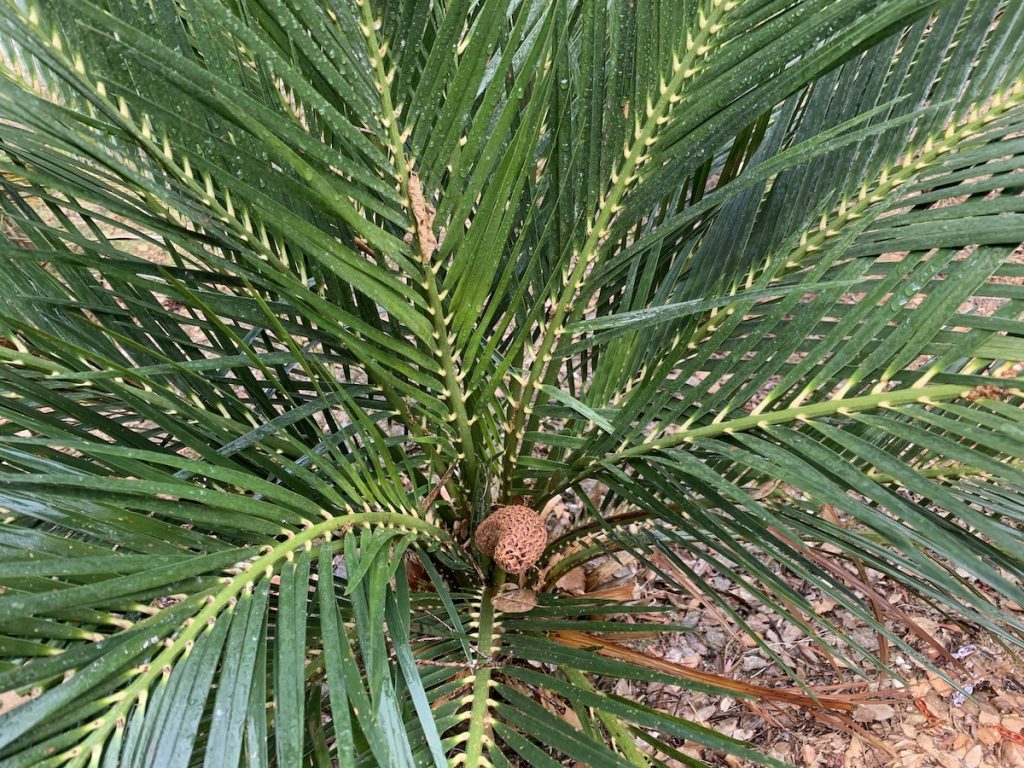
- Mediterranean experience: the Jardin zoologique tropical in La Londe-les-Maures, in the Var (southern France), grows a plant presumed to be Macrozamia miquelii, the one pictured on this page. According to the garden, it is very difficult to identify, and the identification rests on observation of the cones; the garden has published no other observations on this plant.
- Growth: on the Italian Tropicamente forum, a grower reported in 2008 that his seed-raised Macrozamia miquelii grew much better at two years old than a Macrozamia communis sown six years earlier.
- Soil: free-draining; in the wild the species grows on stony slopes and on deep sand.
Container cultivation
In a pot, provide a deep container for the taproot and a very free-draining mix, and keep the plant frost-free in winter wherever frosts occur.
In cultivation in the UK, US and Australia
- Australia: the Royal Botanic Garden Sydney lists three plants in its Garden Explorer, two of wild origin from accessions of 1977 and 1990, in bed 102i, and one acquired in 2024 (updated 1 October 2026). The census of Royal Botanic Gardens Victoria, downloaded on 19 October 2026, records four plants: two planted at Cranbourne on 7 August 2012 and two at Melbourne, one of them of wild origin in the cycad collection. The Australian Botanic Garden Mount Annan, the Australian National Botanic Gardens, the Botanic Garden of South Australia and Burrendong Botanic Garden also declare it to BGCI.
- United States: Montgomery Botanical Center (Coral Gables, Florida) holds three accessions in its online catalogue, two of them from 2003. Twelve other institutions declare it to BGCI, among them Fairchild Tropical Botanic Garden, Marie Selby Botanical Gardens, Moore Farms Botanical Garden, Mercer Arboretum, the Lincoln Park Conservatory in Chicago, the New York Botanical Garden, the Huntington, Descanso Gardens, the San Diego Zoo, the Cal State Fullerton Arboretum, the University of California Botanical Garden at Berkeley and Honolulu Botanical Gardens.
- United Kingdom: the Royal Botanic Gardens, Kew, RHS Garden Wisley, Glasgow Botanic Gardens and Paignton Zoo declare it to BGCI.
Forty-one institutions in all declare the species to BGCI (checked on 26 October 2026), the others in fourteen countries, from Belgium to South Africa. A BGCI listing records a declaration by the garden, not necessarily a living plant on display today, and many plants labelled Macrozamia miquelii may come from the broad concept used before 2001. No English-language grower’s report with a date, a place and a temperature has been found.
Propagation
The species is propagated by seed; it does not produce useful offsets. According to the PACSOA text, the seeds germinate easily, but growth in the first years is slow. On the Fous de palmiers forum, a grower near Lyon (France) noted in 2008 that one seed bought under this name germinated in eight days and the others in about five weeks. The true identity of seeds in the trade remains uncertain (see Possible confusion).
Pests and diseases
No publication specific to the species deals with its pests in cultivation. As in other Macrozamia, scale insects and rots in wet soil are the problems most often mentioned by growers. A fungus, Discosia macrozamiae, was described in 2018 on Macrozamia miquelii in Australia (Crous et al., 2018); its importance for the plant is not known.
Cold hardiness
No reliable data establish the cold hardiness of Macrozamia miquelii. In its range, the Port Curtis district, with a coastal subtropical climate, frosts are rare; no temperature data for the species’ sites are documented in a verifiable source. No source gives a USDA zone for it.
Mediterranean and European experience
- Italy: at Ravenna, a young Macrozamia miquelii in a pot, left outside but sheltered from rain and wind, came through −3 °C (26.6 °F), according to a post of July 2009 on the Tropicamente forum; the same grower reported in 2010 that his plants of this species had died, without giving the cause. In Campania, another enthusiast reported losing almost all the Macrozamia miquelii he grew outdoors during the winter of 2010–2011, with −3 °C (26.6 °F) at his home; those plants had been identified by other growers as Macrozamia communis, so the report cannot be attributed to the species with certainty.
- Italy, under glass: the Naples Botanic Garden grew the species in a glasshouse in 1984 (journal Delpinoa).
- France: no dated in-ground cultivation report is documented. On the Fous de palmiers forum, the species appears mainly in sowing lists (2007–2010); a grower announced hardiness trials on young plants in February 2010, without published results. In 2014, a member relayed a hardiness ranking by an Australian grower, who placed the species of the Queensland coast among the least hardy of the genus and considered that the hardiness of Macrozamia miquelii depends on the origin of the plants; no temperature is given.
United Kingdom, United States and Australia
No dated cultivation result with a temperature has been published. The figures found online (“−6 °C (21.2 °F) for a brief frost”, zone 9b, “more frost-sensitive than Macrozamia communis”) rest on no published trial.
Toxicity and precautions
Yes, Macrozamia miquelii is toxic, like all cycads. Macrozamia contain toxic glycosides (cycasin, macrozamin), from which methylazoxymethanol is derived, a toxin of the liver and nervous system; the seeds are the most dangerous part. The data published for this species are precise: Hall and Walter (2014) measured 0.34% cycasin (fresh weight) in the seed endosperm and found none in the fleshy coat; according to Ladd et al. (1993), as cited by Asmussen (2011), the kernel contains about 3.9% macrozamin, one of the highest levels among the Macrozamia analysed; Yagi (2004) found only cycasin in its leaves. In Australia, Macrozamia cause livestock poisoning: damage to the liver and gut from the seeds, and loss of control of the hind legs in cattle that eat the leaves (Healy, 1967). No case specific to this species is documented.
Wear gloves to clean seeds and keep plants and seeds out of reach of children and animals. In case of ingestion, call a poison centre, a doctor or a vet without delay.
Traditional uses
The seeds of Macrozamia miquelii were a food for Aboriginal people in Queensland, after detoxification. According to Asmussen’s review (2011), Thozet described in 1866, near Rockhampton, seeds first roasted in their shells, then cracked; the kernels, placed in bags, were leached for six to eight days in a stream or pool. An elder from Kilcoy, Gaiarbau, described the same method in the Wide Bay region, where the species concerned may also have been Macrozamia douglasii or Macrozamia pauli-guilielmi. These preparations rest on traditional know-how: never eat cycad seeds.
Frequently asked questions
Where does Macrozamia miquelii grow in the wild?
In central-eastern Queensland, Australia. Since the 2001 revision, the species in the strict sense is restricted to the Port Curtis district, from Mount Larcom to north of Byfield. The populations further south, once filed under this name, belong to other species of the same group.
How can it be told from Macrozamia communis?
Mainly by the leaflets and the cones. Macrozamia miquelii has thinner, more flexible leaflets, short and narrow sporophyll spines and smaller seeds; Macrozamia communis has thick, rigid, dull leaflets. Origin settles it: Queensland for one, New South Wales for the other.
Is it frost-hardy?
Nobody knows. No dated in-ground trial has been published in Europe; the only reliable report, from Italy, concerns a young potted plant, sheltered, that came through −3 °C (26.6 °F). Grow it in a pot and keep it frost-free in winter until its hardiness is better known.
Are seeds sold under this name reliable?
Not always. The name long covered a whole group of Queensland species, and growers have found that seedlings sold as Macrozamia miquelii were Macrozamia communis. Ask for the geographical origin of the seed.
Is it related to Ceratozamia miqueliana or Cycas miquelii?
No. These names also honour Miquel, but refer to plants of other genera: a Mexican cycad for the first, a synonym of Cycas revoluta for the second.
Is it poisonous?
Yes, like all cycads, above all the seed kernel, which contains cycasin and macrozamin. According to a 2014 study the orange fleshy coat contains no cycasin, but the whole seed remains dangerous; call a poison centre in case of ingestion.
Is it endangered?
No. The IUCN lists it as Least Concern (assessment published in 2022), and it is described as widespread and abundant, partly within national parks. Its trade falls under CITES Appendix II.
Further reading on Succulentes
- How to Grow Cycads from Seed: Germination, Seedling Care and Propagation Setup
- Is Sago Palm Toxic to Dogs, Cats & Children? What to Know
Sources
Reference sites
- The World List of Cycads (version 2026.08.15), Macrozamia miquelii: https://cycadlist.org/scientific_name/404 — publication (1868), basionym, synonyms, range (Queensland), IUCN status (LC), etymology, references; related names (Cycas miquelii, Zamia miquelii, Ceratozamia miqueliana). The reference list of the IUCN Cycad Specialist Group; checked on 26 October 2026.
- The World List of Cycads, copy of Jones, Forster & Sharma (2001): https://cycadlist.org/storage/references/open/965683a3-a414-4c2e-9cf7-796b4fa133ff.pdf — revision of the group, description, range, habitat, phenology, typification, key. Peer-reviewed paper; full text.
- Flora of Australia online, Macrozamia miquelii: https://profiles.ala.org.au/opus/foa/profile/Macrozamia%20miquelii — description (broad concept), range, taxonomic notes (revised 2026). The national flora.
- Atlas of Living Australia, Macrozamia miquelii: https://bie.ala.org.au/species/https://id.biodiversity.org.au/taxon/apni/51448893 — English names from the Australian Plant Census, synonyms, no conservation listing. National database; checked on 26 October 2026.
- PACSOA Wiki, Macrozamia miquelii: https://www.pacsoa.org.au/wiki/index.php/Macrozamia_miquelii — text by Len Butt (before 2001): localities, variability, easy cultivation, pale orange seeds. Specialist society; broad concept of the species.
- Species+ (UNEP-WCMC), Macrozamia miquelii: https://speciesplus.net/species#/taxon_concepts/17682/legal — CITES Appendix II, EU Annex B, synonyms. Official database; checked on 26 October 2026.
- Royal Botanic Garden Sydney, Garden Explorer, Macrozamia miquelii: https://rbgsydney.gardenexplorer.org/taxon-3281.aspx — three plants, accessions of 1977, 1990 and 2024. Garden’s own catalogue, updated 1 October 2026.
- Royal Botanic Gardens Victoria, Living Collection Census: https://data.rbg.vic.gov.au/rbgcensus/ — four plants at Melbourne and Cranbourne (Zamiaceae list downloaded on 19 October 2026).
- Montgomery Botanical Center, living collection (BG-BASE catalogue): https://websites.rbge.org.uk/cgi-bin/nph-readbtree.pl/dataset=CYCADS/filename=n132_cyc/firstval=1?ETI=macrozamia%2A — three accessions; checked on 26 October 2026.
- BGCI PlantSearch: https://plantsearch.bgci.org/ — 41 institutions declaring the species; checked on 26 October 2026.
- Tropicamente forum (Italy): https://www.tropicamente.it/forums/topic/le-foglie-nuove-delle-cycadacee/ (Ravenna, 2009); https://www.tropicamente.it/forums/topic/nuove-arrivate-2/ (2010); https://www.tropicamente.it/forums/topic/macrozamia-miquelii/ (identification, 2009); https://www.tropicamente.it/forums/topic/a-proposito-delle-beccariophoenix-a-e-m/ (Campania, 2011); https://www.tropicamente.it/forums/topic/macrozamia-miquelii-e-le-altre/ (sowing, 2008). Growers’ forum; indicative only.
- Fous de palmiers forum (France): https://www.fousdepalmiers.fr/html/forum/viewtopic.php?p=24899 (sowing, 2008); https://www.fousdepalmiers.fr/html/forum/viewtopic.php?p=82004 (trials, 2010); https://www.fousdepalmiers.fr/html/forum/viewtopic.php?p=323061 (hardiness ranking relayed, 2014). Growers’ forum; indicative only.
Bibliography
- Mueller, F. von (1862). Encephalartos miquelii. Fragmenta Phytographiae Australiae 3: 38. [Original description; as summarised by Johnson (1959) and Jones et al. (2001).]
- Candolle, A. de (1868). Cycadaceae. Prodromus Systematis Naturalis Regni Vegetabilis 16(2): 522–548. [Transfer to Macrozamia (p. 535); reference from The World List of Cycads.]
- Johnson, L.A.S. (1959). The families of cycads and the Zamiaceae of Australia. Proceedings of the Linnean Society of New South Wales 84: 64–117. [Typification (Thozet lectotype), broad concept, key with Macrozamia communis; full text.]
- Hill, K.D. (1998). Cycadophyta. In: McCarthy, P.M. (ed.), Flora of Australia 48: 597–661. CSIRO Publishing, Melbourne. [Online version revised in 2026.]
- Jones, D.L., Forster, P.I. & Sharma, I.K. (2001). Revision of the Macrozamia miquelii (F.Muell.) A.DC. (Zamiaceae section Macrozamia) group. Austrobaileya 6(1): 67–94. doi:10.5962/p.299651 [Reference revision; full text.]
- Hall, J.A. & Walter, G.H. (2013). Seed dispersal of the Australian cycad Macrozamia miquelii (Zamiaceae): are cycads megafauna-dispersed “grove forming” plants? American Journal of Botany 100(6): 1127–1136. doi:10.3732/ajb.1200115 [Seed dispersal; abstract.]
- Hall, J.A. & Walter, G.H. (2014). Relative seed and fruit toxicity of the Australian cycads Macrozamia miquelii and Cycas ophiolitica. Journal of Chemical Ecology 40: 860–868. doi:10.1007/s10886-014-0490-5 [Cycasin in the endosperm, absent from the fleshy coat; abstract.]
- Terry, L.I., Moore, C.J., Roemer, R.B., Brookes, D.R. & Walter, G.H. (2021). Unique chemistry associated with diversification in a tightly coupled cycad-thrips obligate pollination mutualism. Phytochemistry 186: 112715. doi:10.1016/j.phytochem.2021.112715 [Pollination by a cryptic Cycadothrips, prenyl crotonate; abstract.]
- Yagi, F. (2004). Azoxyglycoside content and β-glycosidase activities in leaves of various cycads. Phytochemistry 65: 3243–3247. doi:10.1016/j.phytochem.2004.09.013 [Cycasin in the leaves; abstract.]
- Crous, P.W. et al. (2018). Fungal Planet description sheets: 716–784. Persoonia 40: 239–392. doi:10.3767/persoonia.2018.40.10 [Discosia macrozamiae; abstract.]
- Asmussen, B. (2011). “There is likewise a nut…” A comparative ethnobotany of Aboriginal processing methods and consumption of Australian Bowenia, Cycas, Macrozamia and Lepidozamia species. Technical Reports of the Australian Museum, Online 23(10): 147–163. doi:10.3853/j.1835-4211.23.2011.1575 [Seed preparation, macrozamin content; full text.]
- Healy, P.J. (1967). Macrozamia poisoning. Reprinted by Flock & Herd: https://flockandherd.net.au/archive/transcribed/1967/reader/macrozamia-poisoning.html [Livestock poisoning by the genus.]
- Bösenberg, J.D. (2022). Macrozamia miquelii. The IUCN Red List of Threatened Species 2022: e.T42012A48868886. doi:10.2305/IUCN.UK.2022-1.RLTS.T42012A48868886.en [Least Concern; assessment dated 21 August 2020, from Crossref.]
- Haynes, J.L. (2022). Etymological compendium of cycad names. Phytotaxa 550(1): 1–31. doi:10.11646/phytotaxa.550.1.1 [Etymology, as given by The World List of Cycads.]
- Calonje, M., Stevenson, D.W. & Osborne, R. (2026). The World List of Cycads, version 2026.08.15. Montgomery Botanical Center, Coral Gables. doi:10.5281/zenodo.21958524 [Reference list.]