On the granite hills of eastern Zimbabwe and western Mozambique — from Mount Selinda in the south to Mount Darwin in the north, across the Mapande Range and into the river valleys of the Odzi, Garezi, and Pungwe — a green, medium-sized Encephalartos grows on rocky slopes and in forested river gorges. Encephalartos manikensis is the most widespread, most secure, and most commonly cultivated member of its namesake complex: the manikensis complex, a group of five robust, green-leaved, spiny-leafleted cycads from the Zimbabwe–Mozambique borderlands. It is the species you can see in the main streets of Harare — the most commonly grown cycad in Zimbabwe, an urban tree as much as a wild one. It is the species that produces female cones that occasionally reach nearly one metre in length — freakishly large structures that dwarf the plant bearing them. And it is the species whose male cones are so massive that LLIFLE observes: “they can’t easily be told from female cones.”
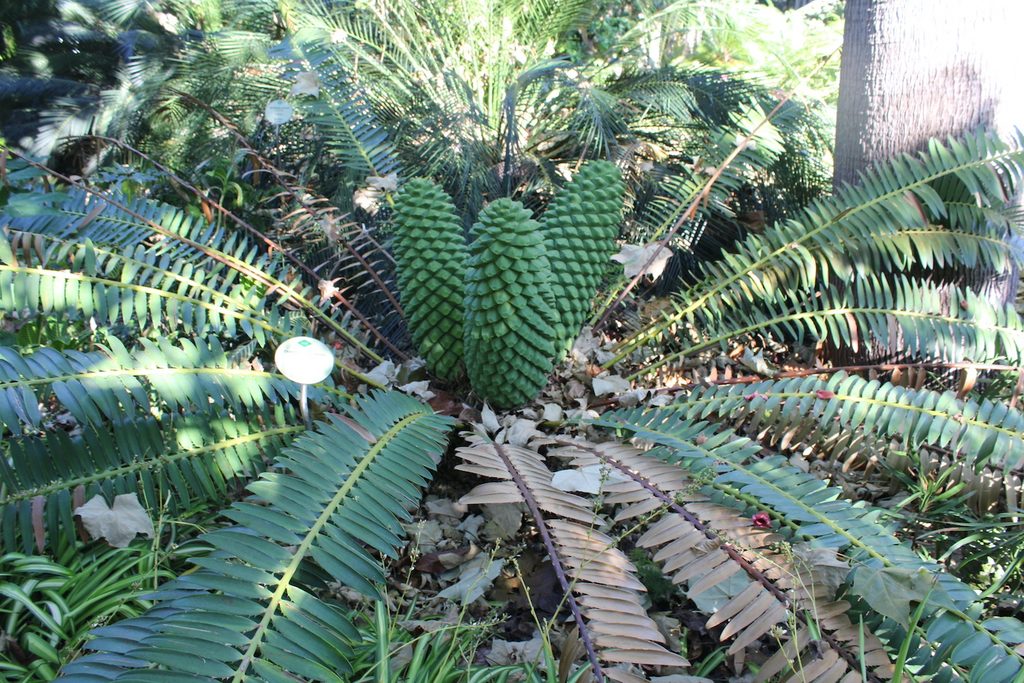
But the Gorongo cycad’s real significance lies not in what it is, but in what surrounds it — or rather, what used to surround it. Encephalartos manikensis is the anchor species of a complex that is disintegrating. Of its four sister species: chimanimaniensis is probably extinct in the wild, Encephalartos pterogonus was declared extinct and partially reintroduced, Encephalartos munchii survives as a tiny relic on one mountain, and concinnus persists in small, fragmented populations in southern Zimbabwe. Encephalartos manikensis itself — the patriarch, the generalist, the one with the widest range and the largest populations — is Near Threatened. It is the last standing pillar of a taxonomic edifice that once encompassed five species across two countries. Whether the complex survives as anything more than manikensis alone depends on decisions being made now, in Mozambique and Zimbabwe, about mountains and inselbergs that most people have never heard of.
Taxonomy and nomenclature
Encephalartos manikensis (Gilliland) Gilliland has an unusual taxonomic history: it was described twice by the same author, in consecutive years, at different ranks. In 1938, the South African botanist Hamish Boyd Gilliland published it as a variety of the Kenyan/Malawian species Encephalartos gratus: E. gratus var. manikensis Gilliland. Africa Cycads notes the discovery was made in 1937. The following year (1939), Gilliland raised the variety to species rank: Encephalartos manikensis (Gilliland) Gilliland, in the Proceedings and Transactions of the Rhodesia Scientific Association (volume 37: 133–134).
The epithet manikensis refers to the Manica Province of Mozambique (and the adjacent Manica districts of eastern Zimbabwe), where the species was discovered. Haynes (2022) confirms this etymology. The type locality is the Nyamkwarara (Numkwarara) Valley near Mount Gorongo — hence one of the species’ common names, the Gorongo cycad.
The relationship with Encephalartos gratus from Malawi and northern Mozambique is significant. Gilliland originally considered manikensis a geographic variant of gratus — a southern form of a broadly distributed central African species. LLIFLE notes that manikensis “is allied to Encephalartos gratus, but is easily distinguishable principally by the lack of pubescence on the mature cone-scales.” The two species share the same general architecture (medium trunk, green glossy leaves, spiny leaflets) but differ in cone-scale texture: gratus has hairy (puberulent) mature cone-scales, manikensis has smooth (glabrous) ones.
The manikensis complex was created in 1969 when R.A. Dyer and Inez Verdoorn published their landmark paper “Encephalartos manikensis and its near allies” in Kirkia (7(1): 147–158), segregating the broadly defined manikensis into five species based primarily on pollen cone morphology:
E. manikensis sensu stricto: thick, flat, uncurved, unwinged cone scales. Distribution: Zimbabwe and Mozambique (widest range).
E. chimanimaniensis: curving cone scales. Distribution: Chimanimani Mountains, eastern Zimbabwe (probably extinct).
E. concinnus: smaller cones (30–50 × 7–10 cm). Distribution: southern Zimbabwe.
E. munchii: bluish-green leaves and cones, 3–6 leaflet spines. Distribution: Zembe Mountain, Mozambique.
E. pterogonus: winged cone-scale projections. Distribution: Mount Mruwere, Mozambique.
The validity of this segregation remains debated. PACSOA summarises the problem: “There are a number of separate populations, most of which have distinctive features, but they aren’t consistent enough to warrant being separated out into new species.” LLIFLE agrees: “some botanists argue that there could be as many as five species.” The issue is one of taxonomic philosophy: are consistent but subtle differences in cone-scale shape, measured across geographically isolated populations, sufficient to justify species-level separation? Or are they merely the expected variation within a single, geographically widespread, morphologically plastic species?
The practical consequences of this debate are significant for conservation. If all five are a single species, then the large, relatively secure Mozambican populations of manikensis provide a genetic reservoir for the entire complex — the loss of the chimanimaniensis or pterogonus populations, while regrettable, does not represent the extinction of a unique evolutionary lineage. If they are genuinely distinct species, each mountaintop population is an irreplaceable unit of biodiversity, and its loss is permanent.
Common names: Gorongo cycad, Gorongowe cycad, Rhodesian cycad, Manica cycad (English).
Morphological description
Habit and caudex: Encephalartos manikensis is a medium-sized, stout, evergreen cycad. The trunk is erect, initially single, reaching up to 1.5 m in height and approximately 30 cm in diameter. Africa Cycads gives a broader range: “trunk height of one to two meters” with stems potentially reaching “two to three meters, though this would take a very long time.” The species suckers from the base, forming clumps.
Leaves: The fronds are 100–200 cm long (Wikipedia gives 1–2 m; Africa Cycads gives a typical length of “about two meters”), dark green, glossy, and arranged in a crown at the stem apex. The leaves emerge light green and darken as they mature. The petiole is short (5–6 cm). Each leaf comprises approximately 60 pairs of lanceolate leaflets, which may have 1–2 spines on both upper and lower margins, and are attached at approximately 180° on the rachis — creating the flat leaf cross-section characteristic of the complex. Basal leaflets taper to thorns.
Reproductive structures — the giant cones: The cones of manikensis are the complex’s most dramatic feature. Male cones are 1–4 per plant, erect, cylindrical-ovoid, light green, 25–65 cm long and 15–22 cm wide. The scales are thick — thicker than those of concinnus, lacking the curving of chimanimaniensis and the wings of pterogonus. LLIFLE provides the remarkable observation: “Male cones in this species are so big they can’t easily be told from female cones” — an unusual character, since in most Encephalartos species, the male cones are significantly narrower than the female.
Female cones are 1–2, ovoid, 30–45 cm long and 20–25 cm wide. But these are typical dimensions. LLIFLE adds: “The size of the female cones can vary greatly and occasionally very large cones, almost 1 m in length, are produced.” A female cone approaching one metre is an extraordinary structure — larger than the cones of species with much bigger trunks and broader leaves. Whether these giant cones are a response to particularly favourable growing conditions, a genetic variant in certain populations, or a phenomenon specific to cultivation is not documented.
Seeds are broadly ellipsoid, 25–35 mm long, scarlet, darkening with age.
Distribution and natural habitat
Encephalartos manikensis has the widest distribution of any species in the complex — and one of the wider distributions in the eastern African section of the genus. LLIFLE provides a detailed locality list:
Zimbabwe: From Mount Selinda in the south, northward through the Chipinge area, near Mount Nyanyadzi, along the Odzi and Garezi rivers, to Mount Gorongo, and further north to Mount Darwin (Pfura/Fura).
Mozambique: Near Garuso, Mount Bandula, Mount Chicamba, near Vanduzi, and Mount Chinhazanza (Chinyayadze/Chinyazange) near the Pungwe River. LLIFLE notes: “Most of the plants are found in the highlands of the Mapande Range.”
The altitude range is 600–1400 m — a wide span that includes lowveld granite koppies (similar to the dyerianus habitat) and montane grassland (approaching the chimanimaniensis habitat). The habitat is grassy slopes on granite hills, usually in full sun, among large rocks in exposed open conditions, and also in river valleys associated with forests. The substrate is granite — acidic, sandy, well-drained. The species is found “on grassy slopes on granite hills, usually in full sun, amongst large rocks in exposed open conditions and also in river valleys in places associated with forests” (LLIFLE).
The population is estimated at fewer than 10,000 mature individuals. LLIFLE: “Some subpopulations are still quite large, especially in Mozambique.” The Mozambican populations are less well surveyed but may represent the species’ demographic stronghold — larger, more intact, and less heavily poached than the Zimbabwean populations, partly because of the greater difficulty of access.
Conservation — the relative survivor
Encephalartos manikensis is assessed as Near Threatened (NT) on the IUCN Red List. This is among the more secure statuses within the genus — a reflection of the species’ wider distribution, multiple subpopulations, and the persistence of large colonies in Mozambique. But Near Threatened is not safe. The primary threats are: illegal collection for the ornamental trade (manikensis is popular, available, and well known to collectors); afforestation (commercial forestry plantations replacing natural habitat); and agriculture (clearing of granite-hillside habitat for crops).
The species’ relative security — compared with its CR and extinct relatives — creates a perverse risk: because manikensis is “only” Near Threatened, it may receive less conservation attention and fewer resources than its more dramatic cousins. But manikensis is the last large, viable, genetically diverse population in the complex. If it declines significantly — through continued poaching, through habitat loss, through the cumulative effect of decades of slow attrition — then the entire complex loses its genetic reservoir. Protecting manikensis is not just about one species; it is about maintaining the evolutionary potential of the complex as a whole.
The Gorongo cycad on the streets of Harare
LLIFLE provides a striking cultural detail: Encephalartos manikensis “is the cycad most commonly grown in Zimbabwe and can be seen in many gardens and in the main street of Harare, the capital and most populous city of Zimbabwe.” This is unusual — most Encephalartos species are collector plants, confined to specialist gardens and botanical collections. Manikensis has crossed the boundary from specialist to mainstream, from botanical curiosity to street tree.
The reasons are straightforward: it is locally available (Zimbabwe is within its natural range), it is fast-growing (LLIFLE: “one of the fastest growing cycads”), it is adaptable (tolerating a range of soils, light levels, and watering regimes), and it is attractive (glossy green foliage, stout architectural trunk, impressive cones). In Harare’s subtropical climate — warm, seasonally wet, with mild winters — manikensis thrives as a landscape plant, and its presence on public streets normalises the cycad as part of the urban environment rather than an exotic rarity.
This cultural integration has a conservation dimension. A species that people see daily, in their streets and gardens, is a species that people care about. The Harare street trees are ambassadors for the genus — silent arguments for the value of cycads, visible to thousands of people who would never visit Mount Gorongo or the Mapande Range.
Cold hardiness
The 600–1400 m altitude range spans a significant climatic gradient. Higher-altitude populations (1200–1400 m) experience moderate frost; lower-altitude populations (600–800 m) are essentially frost-free.
Practical cold hardiness estimate: USDA Zone 9b–10a (−1 to −4 °C) for higher-altitude forms; Zone 10a–10b for lowland forms. LLIFLE classifies the species as “frost sensitive (USDA zones 10–12)” but notes that it is “well represented in botanical gardens and private collections worldwide where the tropical cycads can be grown.” Light frost is tolerated; sustained freezing is not.
Caveat: The wide altitudinal range suggests that cold tolerance varies between populations. Higher-altitude forms from Mount Gorongo or the Mapande Range may tolerate more frost than lowland river-valley forms. A single isolated success with one provenance does not predict the behaviour of another. When acquiring manikensis for cultivation in marginal climates, provenance information matters.
Cultivation — the easy one
Difficulty: 1/5. LLIFLE: “one of the fastest growing cycads and responds well to cultivation.” Africa Cycads: “As a group, all are green, fast growing and never get huge.” This is the easiest species in the complex and one of the easiest in the genus.
Light: Full sun. The open granite-hillside habitat was fully exposed. The species tolerates light shade but produces its best form — tightest crown, most cones — in full sun.
Soil: Well-drained, granite-derived, slightly acidic. The species tolerates a range of soil types: “It grows in all sorts of soil type, but prefers well-drained, gritty soil with plenty of water, especially in dry weather” (Africa Cycads). Avoid waterlogging.
Watering: Moist during the growing season, drier in winter. LLIFLE: “In cultivation prefers moist soil with good drainage for optimal growth. But it is eventually drought resistant.” Avoid high-pressure irrigation — the water force damages leaves and stems.
Growth rate: Fast — among the fastest in the genus. Seedlings develop into attractive garden plants with 1 m long leaves within 4–5 years. Mature plants can hold multiple simultaneous whorls of leaves.
Suckering: Abundant. The species “tends to sucker well” (LLIFLE, Africa Cycads), forming multi-stemmed clumps that are both ornamental and a source of vegetative propagation material.
Transplanting: Easy. Unlike munchii (virtually impossible to transplant as a mature plant) and lanatus (notoriously difficult), manikensis tolerates disturbance well.
Container culture: Excellent when young. The moderate eventual size (trunk to 1.5–2 m) and fast growth make manikensis a satisfying container specimen. Transfer to the ground when the plant outgrows its container.
Propagation: Seed. Among the easiest in the genus to germinate. Seedlings need shade initially but establish quickly. Hand pollination is necessary in cultivation for reliable seed production.
Comparison — manikensis as anchor of the complex
| Character | E. manikensis | E. pterogonus | E. munchii | E. chimanimaniensis |
|---|---|---|---|---|
| Distribution | Zimbabwe + Mozambique (widest) | Mt Mruwere, Mozambique | Zembe Mt, Mozambique | Chimanimani Mts (extinct?) |
| Population | <10,000 (largest) | ~700 (reintroduced) | Tiny relic | 0 (field surveys negative) |
| Cone scale | Thick, flat, unwinged | Winged projections | Standard; bluish-green | Curving edges |
| Leaf colour | Dark green, glossy | Mid-green, shiny | Soapy green; blue flush | Bright green, glossy |
| Female cone max | ~1 m (exceptional) | 30–40 cm | Not documented | 35–40 cm |
| Trunk | To 1.5–2 m × 30 cm | To 1.5 m × 40 cm | To 1 m × 35 cm | To 1.8 m × 45 cm |
| Growth rate | Fast (fastest in complex) | Fast | Fast | Unknown |
| Transplant | Easy | Easy | Virtually impossible | Unknown |
| Cultural presence | Harare street tree | Rare in cultivation | Rare in cultivation | Extremely rare |
| IUCN status | NT | CR | CR | CR (possibly extinct) |
The Mapande Range — a genetic reservoir under pressure
The Mapande Range in Mozambique holds the largest surviving populations of Encephalartos manikensis. These populations are the demographic and genetic core of the species — and, arguably, of the entire manikensis complex. If the segregate species (chimanimaniensis, pterogonus, munchii, concinnus) are indeed part of a single polymorphic entity, then the Mapande populations contain the ancestral genetic variation from which the mountaintop variants diverged. If the segregates are distinct species, the Mapande populations are still the genetic reservoir of the largest and most widespread member of the complex — the species most likely to survive the current extinction crisis.
The Mapande Range is not well protected. Unlike the Chimanimani Mountains (which have a National Park and a UNESCO Biosphere Reserve), the Mapande highlands have no formal conservation status. The cycad populations exist on unprotected granite hills, vulnerable to the same poaching, afforestation, and agricultural encroachment that threaten cycads across the region. The Mozambican populations’ relative security is a function of inaccessibility and low population density, not of active protection.
A comprehensive botanical survey of the Mapande Range — documenting the size, structure, and genetic diversity of the manikensis populations, and determining whether any of the variation corresponds to the mountaintop segregates described by Dyer and Verdoorn — is one of the most important outstanding tasks in central African cycad conservation. The answers would clarify both the taxonomy of the complex and the conservation priorities within it. Until that survey is conducted, we are managing a group of species whose boundaries, populations, and genetic structure are only partially understood — making decisions about conservation with incomplete knowledge, on mountains we have barely visited, for plants we have barely counted.
Authority websites
POWO — Plants of the World Online: https://powo.science.kew.org/taxon/urn:lsid:ipni.org:names:797483-1
IUCN Red List: https://www.iucnredlist.org/species/41898/10577152
World List of Cycads: https://cycadlist.org
Bibliography
Gilliland, H.B. (1938). Encephalartos gratus var. manikensis. [Original description as variety]
Gilliland, H.B. (1939). Encephalartos manikensis. Proceedings and Transactions of the Rhodesia Scientific Association 37: 133–134. [Raised to species]
Dyer, R.A. & Verdoorn, I.C. (1969). Encephalartos manikensis and its near allies. Kirkia 7(1): 147–158. [Complex segregation; JSTOR stable/23501059]
Whitelock, L.M. (2002). The Cycads. Timber Press, Portland. 374 pp.
Donaldson, J.S. (ed.) (2003). Cycads: Status Survey and Conservation Action Plan. IUCN/SSC Cycad Specialist Group, IUCN, Gland.
Donaldson, J.S. (2010). Encephalartos manikensis. The IUCN Red List of Threatened Species.
Haynes, J.L. (2022). Etymological compendium of cycad names. Phytotaxa 550(1): 1–31.