If Encephalartos horridus is the compact, ferocious blue cycad, then Encephalartos lehmannii is its taller, more graceful cousin — a species that combines the same silvery-blue colouration with longer, more elegant fronds and a developing trunk that gives mature specimens a stately, architectural presence. It is one of the most widely cultivated blue Encephalartos and, for gardeners in Mediterranean and warm-temperate climates, one of the most rewarding.
Taxonomy and nomenclature
Encephalartos lehmannii Lehm. was described by Lehmann in 1834. The epithet is self-referential — Lehmann named the species after himself, a practice that was common in 19th-century botany but is now considered poor form. The type material originated from the Eastern Cape of South Africa.

Encephalartos lehmannii is part of the Eastern Cape blue cycad complex, closely related to Encephalartos horridus, Encephalartos trispinosus, and Encephalartos arenarius. Natural hybridisation among these species is well documented, and intermediate forms are common both in the wild and in nursery stock.
Common names: Karoo cycad, Lehmann’s cycad (English); Karroobroodboom (Afrikaans).
Morphological description
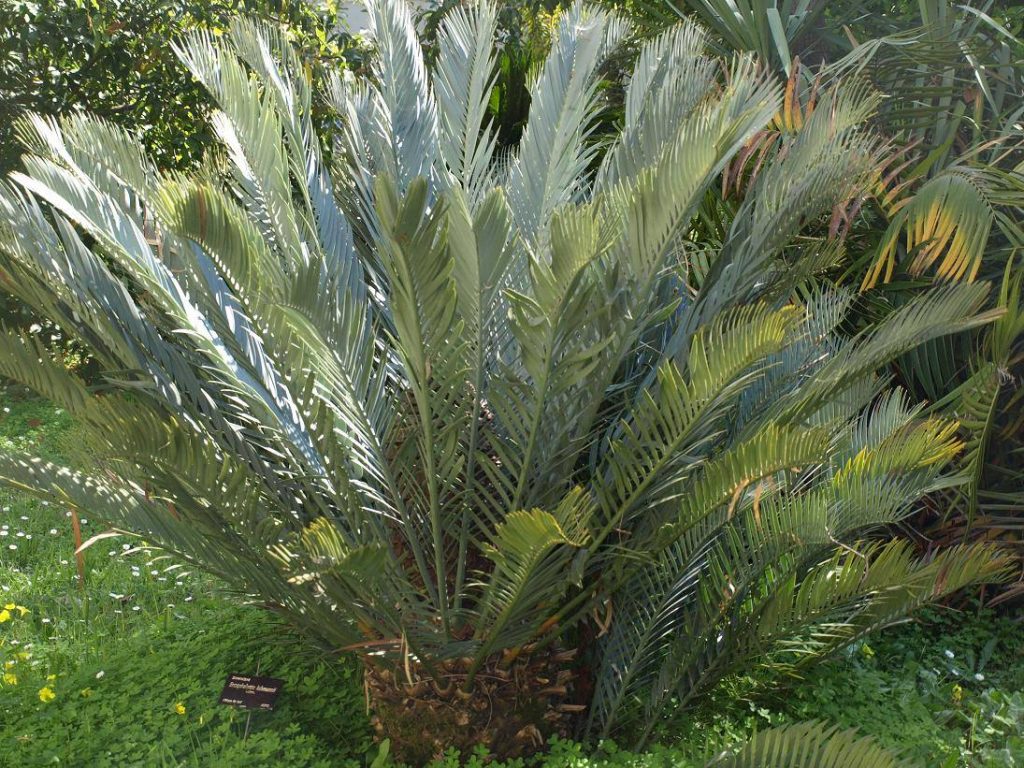
Habit and caudex: Encephalartos lehmannii develops a more substantial trunk than Encephalartos horridus. The stem is erect, typically reaching 1–2 m in height (occasionally to 3 m in very old specimens) and 25–35 cm in diameter. It is usually single-trunked but may branch after damage. Suckering from the base occurs but is less prolific than in Encephalartos horridus. The crown bears 8–15 fronds in a graceful, spreading rosette.
Leaves: Fronds are 1–1.5 m long — significantly longer than Encephalartos horridus. The colour is silver-blue to grey-blue, with the same waxy bloom that characterises the Eastern Cape blue complex. Leaflets are broader and less ferociously armed than in Encephalartos horridus: each leaflet has 1–3 lobes, but the lobes are wider (1–2 cm) and less spine-like, giving the frond a less aggressive, more refined appearance. The leaflets are arranged in a flat plane along the rachis — not three-dimensionally twisted as in some species — giving each frond a clean, graphic silhouette.

Reproductive structures: Male cones are cylindrical, 25–40 cm long, greenish-yellow. Female cones are ovoid, 30–50 cm, producing bright red seeds. Mature plants may produce multiple cones simultaneously — a spectacular display on a blue-grey background.
Distribution and natural habitat
Encephalartos lehmannii is endemic to the Eastern Cape, with a distribution centred on the Great Fish River valley and the margins of the Karoo — an arid to semi-arid inland region. The range extends roughly from the Grahamstown (Makhanda) area westward to the Graaff-Reinet district, at elevations of 200–800 m.
The habitat is dry, rocky hillsides in Karoo and valley bushveld — open, sun-baked terrain with sparse woody vegetation. The climate is semi-arid: annual rainfall of 250–400 mm (the driest habitat of any commonly cultivated Encephalartos), hot summers (30–40 °C), and cool to cold winters (daytime 10–18 °C, nights occasionally dropping to −5/−7 °C in frost hollows at higher elevations). The Karoo margin is one of the harshest environments occupied by any cycad — and Encephalartos lehmannii thrives in it.
Conservation status
Encephalartos lehmannii is listed as Near Threatened (NT) on the IUCN Red List — a less critical status than Encephalartos horridus, reflecting its wider distribution and larger total population. However, illegal collection remains a significant threat, and some local populations have been severely depleted. The species is listed on CITES Appendix I and is fully protected under South African law.
Cultivation guide
Difficulty: 2/5 — easy and forgiving.
Light: Full sun. Like Encephalartos horridus, the blue colour develops best in maximum light. Tolerates partial shade but the foliage greens up.
Soil: Very fast-draining. This species comes from one of the driest cycad habitats in the world — replicate that with a highly mineral substrate. A mix of coarse gravel, crusite, and minimal organic matter works well. Neutral to slightly alkaline pH (6.5–7.5) is tolerated — the Karoo soils are often calcareous.
Watering: Minimal. Encephalartos lehmannii is one of the most drought-tolerant cycads in cultivation. Water sparingly in summer, very sparingly in winter. In Mediterranean gardens, established in-ground plants may need no supplemental irrigation at all once their root systems are established. Less water is better — always.
Cold hardiness: Among the most cold-tolerant Encephalartos. The Karoo margin habitat experiences regular winter frost to −5/−7 °C. In cultivation, reliable in USDA Zone 9a (−4 to −7 °C) in dry conditions. Brief exposure to −8/−10 °C has been survived in exceptionally well-drained positions. The key is dry cold — winter wet combined with cold is far more damaging than dry frost alone.
Container culture: Excellent, though it eventually develops a trunk that requires a large container. A specimen in a wide, shallow terracotta pot with a mineral substrate, in full sun, develops the intense blue-silver colouration that makes this species a collector’s prize.
Propagation
Seed: Standard Encephalartos protocol. Remove the red sarcotesta, soak 24 hours, plant in very free-draining medium at 25–30 °C. Germination: 3–12 months. Slow-growing seedlings.
Offsets: Produced occasionally. Detach, callus 1–2 weeks, root in warm, dry conditions.
Authority websites
POWO — Plants of the World Online: https://powo.science.kew.org/…
IUCN Red List: https://www.iucnredlist.org/species/41899/10580513
PlantZAfrica (SANBI): http://pza.sanbi.org/encephalartos-lehmannii
World List of Cycads: https://cycadlist.org
Bibliography
Lehmann, J.G.C. (1834). Novarum et minus cognitarum stirpium pugillus sextus. Hamburg. [Original description]
Goode, D. (2001). Cycads of Africa. Struik Publishers, Cape Town. 352 pp.
Jones, D.L. (2002). Cycads of the World. 2nd ed. Smithsonian Institution Press, Washington. 456 pp.
Donaldson, J.S. (ed.) (2003). Cycads: Status Survey and Conservation Action Plan. IUCN/SSC Cycad Specialist Group, IUCN, Gland.