
Dioon edule is a cycad from eastern Mexico, where it grows on the slopes of the Sierra Madre Oriental and near the Gulf of Mexico coast, from Hidalgo and Querétaro to Tamaulipas and Veracruz. The type species of the genus Dioon, it forms a stout, often short trunk crowned with stiff leaves set with crowded leaflets. Its seeds, known as chamal, have fed communities in north-eastern Mexico for centuries, after lengthy detoxification. In cultivation it is the most widely grown Dioon and one of the most cold-tolerant: in France, plants in the ground have come through winters at −7 to −9 °C (19.4 to 15.8 °F), but winter wet is often fatal to them. The University of Florida calls it the chestnut dioon. The plants of the northern part of its former range, long classified as Dioon edule var. angustifolium, form a species in their own right, Dioon angustifolium, recognised again in 2003.
Key facts about Dioon edule
- Accepted name: Dioon edule Lindl. (1843), published under the spelling Dion edule; accepted by The World List of Cycads (version 2026.08.15), GBIF and Kew’s World Checklist of Vascular Plants, the database behind POWO (June 2026 version, published on GBIF)
- Former names and synonyms: Zamia maelenii Miq. (1844), Platyzamia rigida Zucc. (1846), Dioon imbricatum Miq. (1847), Dioon strobilaceum Lem. ex A.DC. (1868), Dioon edule var. lanuginosum Wittm. (1899); Dioon edule var. angustifolium now refers to Dioon angustifolium (see Taxonomy)
- Family: Zamiaceae, order Cycadales
- Common names: chestnut dioon (University of Florida); in Mexico chamal, chamalito, quiotamal, tiotamal, palma de dolores, palma de Santa Teresita, palma de la virgen; dameu in the Xi’iuy language
- Natural range: Mexico (Hidalgo, Querétaro, San Luis Potosí, Tamaulipas, Veracruz), from sea level to about 1,550 m (5,100 ft)
- IUCN status: Near Threatened (NT A2cd), assessment by J. Chemnick and T. Gregory dated July 2020 and published in 2022
- CITES and other protection: CITES Appendix II (annotation #4); Annex B in the European Union; “in danger of extinction” (category P) in Mexico under the standard NOM-059-SEMARNAT-2010
- Documented hardiness: in France, survival in the ground at −7 °C (19.4 °F) under passive protection (Paris suburbs, 2009–2010), at −8 to −10 °C (17.6 to 14 °F) under fleece (Nîmes, February 2012) and at −9 °C (15.8 °F) (Gard, 2011–2012; Tarn, 2025–2026); leaves scorched at −6 to −7 °C (21.2 to 19.4 °F) without protection (Agen); losses from winter wet at only −4 °C (24.8 °F) (Nantes); USDA zones 8 to 11 according to the University of Florida (see Cold hardiness)
- Light and soil: full sun to partial shade, well-drained soil; tolerates drought and salt (University of Florida)
- Habit and adult size: plants 1 to 3 m tall, sometimes 5 m; trunk 22 to 30 cm (9 to 12 in) across; leaves 55 to 150 cm long (2020 revision)
- In the UK, US and Australia: Kew, Edinburgh and Cambridge (under glass); Missouri Botanical Garden (two plants from the 1904 World’s Fair), Montgomery Botanical Center and Fairchild Tropical Botanic Garden (Florida); Royal Botanic Gardens Victoria (outdoor beds at Melbourne) and Royal Botanic Garden Sydney; declared to BGCI by some fifty American gardens
- Toxicity: raw seeds toxic, as in all cycads (see Toxicity and precautions)
How to recognise Dioon edule
Dioon edule is recognised by its stiff, flat, upright leaves, set with numerous narrow leaflets, sharp-tipped but with smooth margins in adult plants, and by its large woolly female cones. The revision of the genus published in 2020 by Hernández-Tapia, Jiménez-Ramírez and Vovides separates it from other Dioon by its entire-margined leaflets, little or not at all overlapping, and by the shape of its female cone scales.
The revision gives the following description:
- Habit: plants 1 to 3 m tall, sometimes up to 5 m; trunk upright to reclining, 22 to 30 cm across, branching in old plants.
- Leaves: 5 to 40 per crown, 55 to 150 cm long, with brownish-white hairs that are lost with age; petiole 10 to 32 cm, woolly at the base.
- Leaflets: 60 to 140 pairs, linear-lanceolate, 0.4 to 1.5 cm wide, those in the middle 4 to 14 cm long; margin entire, 9 to 12 veins.
- Male cones: cylindrical, about 35 cm long and 4 to 8.5 cm across.
- Female cones: ovoid to cylindrical, 14 to 35 cm long and 10 to 20 cm across, on a short stalk, very woolly.
- Seeds: ovoid, 1 to 3 cm long, with a fleshy coat (sarcotesta) that is bright yellow to orange-yellow.
Wild plants often stay low. Charles J. Chamberlain, who studied it in the early twentieth century at Chavarrillo, near Xalapa, writes that its stocky trunk rarely exceeds 1.2 to 1.5 m. The species varies a great deal between populations, in size, leaf length and the colour of the new flushes, which the University of Florida describes as blue-green, sometimes pale blue or reddish when they emerge. Seedling leaves often carry small spines that disappear in adult plants.
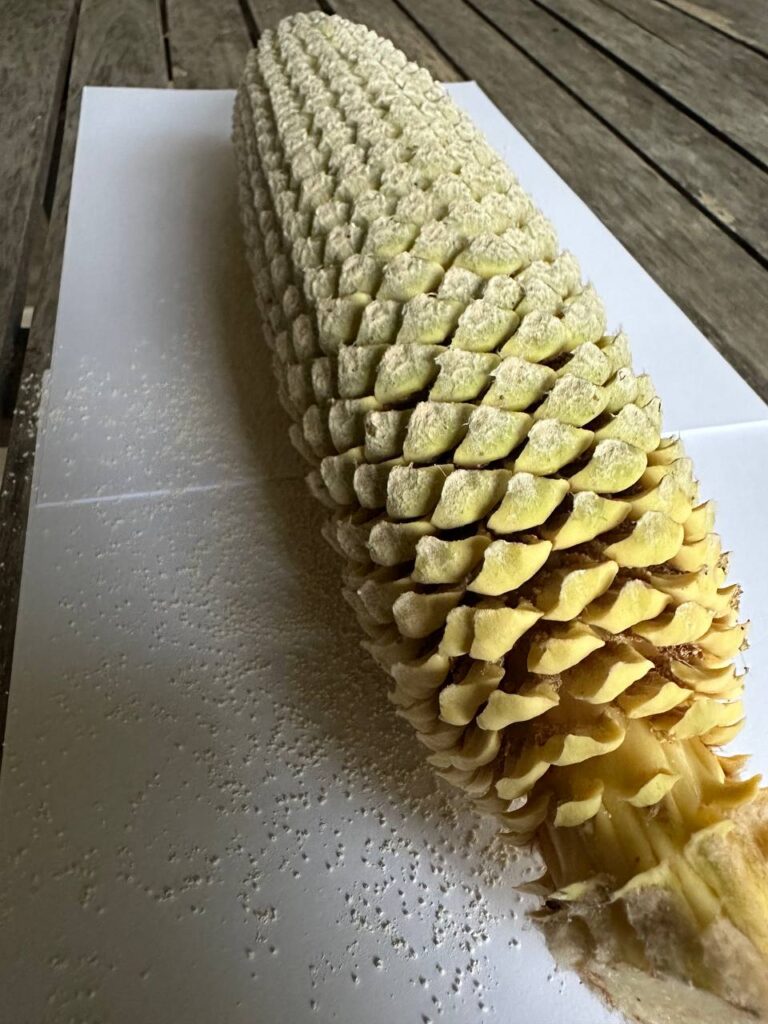
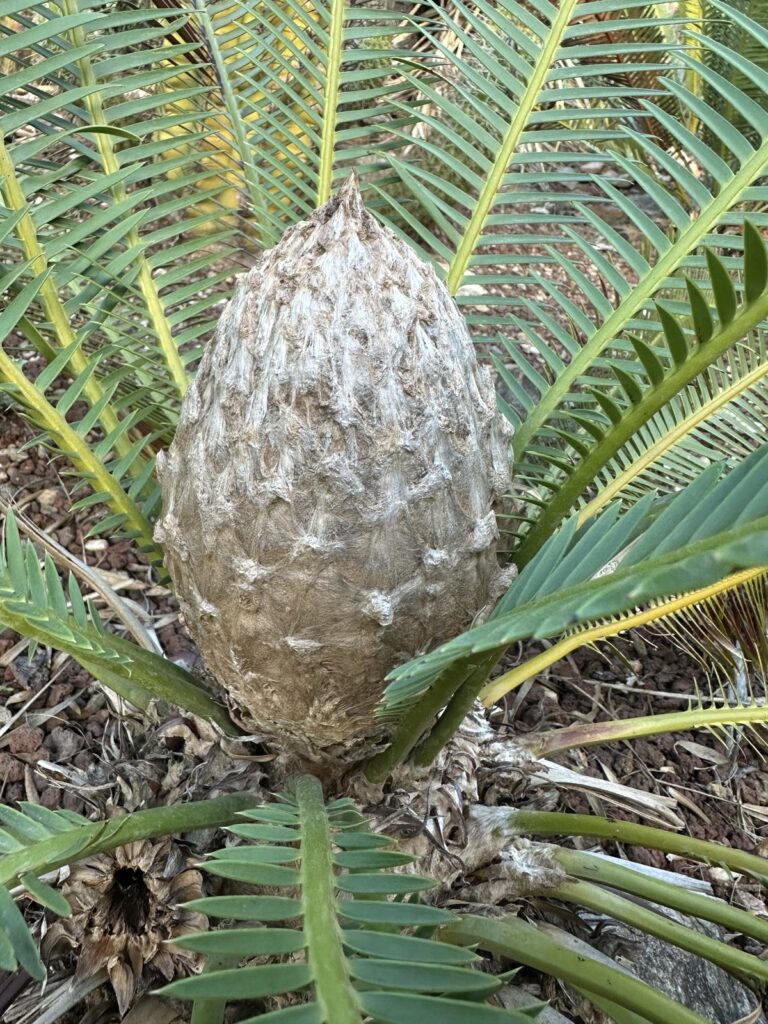
Hybrids
No natural hybrid of Dioon edule has been formally described. The question does arise with Dioon angustifolium: in San Luis Potosí, Rubio-Méndez and colleagues (2020) found populations with characters intermediate between the two species and consider that only genetic studies will show whether hybridisation has taken place. No reliable publication deals with hybrids raised in cultivation.
Possible confusion
With Dioon angustifolium
This is the most frequent confusion, and it often cannot be settled without knowing the plant’s origin. Dioon angustifolium, from Nuevo León and Tamaulipas, has narrower leaflets (4 to 6 mm against 6 to 10 mm according to Jones, 1993, quoted by The Gymnosperm Database), more widely spaced and set at a more acute angle. The specialist nursery Cycadales.eu, which compares plants grown at Nong Nooch Tropical Garden in Thailand, adds that its axis tends to twist, giving the plant a more tousled look than Dioon edule, whose leaves are straight. It also reports that many plants sold in Europe as angustifolium are in fact Dioon edule, and concludes that only a precise geographical origin makes a plant’s identity certain.
With Dioon spinulosum
Dioon spinulosum, from Veracruz and Oaxaca, is easy to tell apart when adult: its broader leaflets keep spines on their margins throughout life, and the plant grows far larger, reaching more than 10 m. It is also a species of moist forest and much less cold-tolerant: the University of Florida recommends it only from USDA zone 9b.
With Dioon merolae and Dioon holmgrenii
The Gymnosperm Database, after Norstog and Nicholls (1997), places Dioon edule close to Dioon merolae and Dioon holmgrenii, two species from southern Mexico that also have stiff leaves with crowded leaflets. According to the 2020 revision, Dioon holmgrenii carries three or four spines on the margin of its convex leaflets, and Dioon merolae has clearly overlapping leaflets. Without an origin label, young plants remain hard to separate.
With Cycas revoluta
In garden centres, Dioon edule is sometimes compared with the sago palm, Cycas revoluta, as the University of Florida does. The leaflets of the Cycas have a single midrib and a margin rolled under, whereas those of the Dioon have several parallel veins and a flat margin; the female cone of the Dioon is compact, whereas the Cycas bears a loose crown of fertile leaves.
Taxonomy
Dioon edule is the type species of the genus. John Lindley described it in 1843 in Edwards’s Botanical Register (29, misc. 59–60) as Dion edule, from a living plant and a cone brought from Mexico and presented to the Horticultural Society of London; the type is kept at Cambridge (CGE), according to The World List of Cycads. The spelling Dioon, closer to the Greek, was adopted later and is now conserved; Kew’s World Checklist of Vascular Plants treats Dion as an orthographic variant.
Several names described in the nineteenth century from plants grown in Europe are placed in its synonymy: Zamia maelenii Miq. (1844), Platyzamia rigida Zucc. (1846), Dioon imbricatum Miq. (1847), Dioon strobilaceum Lem. ex A.DC. (1868) and Dioon edule var. lanuginosum Wittm. (1899), according to The World List of Cycads and the 2020 revision. Species+ adds Macrozamia littoralis and Macrozamia pectinata, two names of Liebmann published by Hemsley in 1883, which the 2020 revision also refers to this species. The name Dioon edule var. latipinnium Dyer, on the other hand, belongs to the Honduran species Dioon mejiae.
Dioon angustifolium, a former variety of Dioon edule
The northern populations of the range have changed rank several times. Miquel described Dioon angustifolium in 1847, before turning it into a form and then a variety of Dioon edule (1861, 1868). De Luca, Sabato and Vázquez Torres (1982), who studied the distribution and variation of the species, kept it as a variety, Murray (1983) as a subspecies and Jones (1993) again as a variety. In 2003, González-Astorga and colleagues (Biological Journal of the Linnean Society), after a genetic study of eight populations covering the whole range of the species, recognised Dioon angustifolium as a distinct species for the isolated northernmost populations, in Nuevo León and Tamaulipas. The World List of Cycads, the 2020 revision and the IUCN Red List follow this choice.
In 2005 a genetic study of the three populations then known confirmed this rank (González-Astorga et al., Annals of Botany), and the Mexican standard NOM-059-SEMARNAT-2010 also treats the two as separate species. The studies of González-Astorga and colleagues (2003, 2005) trace the origin of Dioon angustifolium to the isolation of the northern populations during the climatic cycles of the Pleistocene, the period to which Dorsey and colleagues (2018) also date the diversification of the genus. The varietal name therefore now refers only to an earlier stage of the classification: a plant labelled “Dioon edule var. angustifolium” is Dioon angustifolium, provided its identity is correct.
Cultivated “forms”
In The Botanical Review (2004), Loran Whitelock proposed dividing the populations of Dioon edule into seven “forms” according to provenance: “angustifolium” (Nuevo León, Tamaulipas), “rioverde” and “valles” (San Luis Potosí), “querétaro”, “hidalgo”, “palma sola” and “edule” (Veracruz). According to the table reproduced by Rubio-Méndez and colleagues (2020), the “valles” form, at about 150 m, hardly exceeds 30 cm in height, whereas the “hidalgo” and “edule” forms reach 3 m, and even 5 m for the latter. These names circulate in the trade as Dioon edule “Palma Sola”, “Rio Verde”, “Valles” or “Jacala”.
Their botanical value is disputed. Rubio-Méndez and colleagues, measuring 318 plants from 15 populations, recognised the “edule” and “rioverde” forms and proposed a new one, “tamasopo”, but many individuals were intermediate. The 2020 revision concludes, on the contrary, that these forms are not valid, since several morphologies occur together in a single locality, and treats the species as polymorphic. None of these forms has official botanical rank, and no reliable source allows any of them to be credited with better cold tolerance: the figures put forward by some sellers are advertising.
Etymology and history
The epithet edule comes from the Latin edulis, “edible”, referring to the eating of the seeds in Mexico (Haynes, 2022, after The World List of Cycads). The generic name, from the Greek dis, “two”, and ōon, “egg”, recalls that each scale of the female cone bears two seeds.
Lindley’s text tells how the species reached England. A Mrs Lavater, who had lived for a long time in Mexico, brought back a cone and a living plant, presented to the Horticultural Society. The cone was full of seeds “the size of a Spanish chestnut”, but all lacked an embryo. The plant had a single stem “buried in wool” and leaves about two feet (60 cm) long with some sixty pairs of leaflets. Lindley adds that the seeds were used in Mexico to make arrowroot-like starch, and that a collector had already imported a batch, sold to the Loddiges nursery.
Dioon edule is also famous for its longevity. Chamberlain reports in The Living Cycads (1919) that Professor Luis Murillo, at Xalapa, had recorded every leaf produced by a plant in his garden for eleven years: it formed a crown every two years, and by counting the leaf bases on the trunk this plant, less than 1.5 m tall, was estimated to be 970 years old. Vovides (1990) confirmed the order of magnitude of this estimate, and an article by the Universidad Veracruzana (2017) states that the plant, found again in the garden of the Quinta de las Rosas, would now be more than a thousand years old.
In Europe, the species has been grown outdoors on the Riviera since the late nineteenth century: the Hortus Mortolensis catalogue (1912) of the Hanbury gardens at La Mortola, near Ventimiglia, mentions a large male plant bought in July 1888, planted in full sun in dry sandy soil and doing “extremely well”.
Common names
In English, the University of Florida calls it the chestnut dioon. The 2020 revision, after Bonta and colleagues (2019) and Bonta and Osborne (2007), lists for Mexico chamal, chamalito, quiotamal, sotol, palma de Dolores, palma de macetas, palma de Santa Teresita, palma de serrucho, palma de la virgen, palmita and tullidora. Species+ gives palma de Santa Teresita and palma de dolores, and the Universidad Veracruzana (2017) tiotamal, quiotamal and chamal for the Xalapa region. In indigenous languages, Bonta and colleagues (2019) record dameu among the Xi’iuy (southern Pame) and tzamaal among the Teenek. Some of these names are ambiguous: sotol mainly refers to other plants (Dasylirion), and palma de la virgen is also applied to other Dioon.
In the wild
Dioon edule grows along the Gulf of Mexico and in the Sierra Madre Oriental, in the states of Hidalgo, Querétaro, San Luis Potosí, Tamaulipas and Veracruz, from sea level to about 1,550 m (2020 revision). It is found in oak woodland, tropical deciduous forest, xerophytic scrub and even on coastal dunes, in climates ranging from semi-arid to hot and humid. González-Astorga and colleagues (2003) describe it in the contact zone between tropical deciduous forest and evergreen oak woodland, on steep slopes, cliffs and ravines. Chamberlain saw it in full sun, taller than the dwarf oaks around it.
Reproduction is very slow. Vovides (1990), who followed a population in central Veracruz, records one cone every 2.8 to 8.8 years in male plants and every 10 to 52 years in females; prolonged drought and fire kill most seedlings there. Adults, on the other hand, survive slash-and-burn fires and grow new leaves, according to Bonta and colleagues (2019). According to González-Astorga and colleagues (2003), the cones ripen from August to December. Their genetic study suggests that the species spread northwards from the south of its range after the Pleistocene.
Conservation status and regulation
Dioon edule is listed as Near Threatened (NT) on the IUCN Red List, under criterion A2cd (past reduction in numbers linked to habitat loss and exploitation), in the assessment by J. Chemnick and T. Gregory dated 2 July 2020 and published in 2022 (The World List of Cycads, GBIF and Crossref). Among the species of the genus assessed by the IUCN, it is the only one that is neither Vulnerable nor Endangered. Bonta and colleagues (2019) report that landowners dig cycads out of their land, and that harvesting the trunks for their starch has wiped out whole populations elsewhere in Mexico.
Like the whole genus since 4 February 1977, the species is listed in CITES Appendix II, with annotation #4 in the version adopted at CoP20, in force since 5 March 2026, which exempts seeds and pollen in particular; international trade in live plants requires a permit. In the European Union it falls under Annex B of Regulation (EC) No 338/97, whose annexes are now set by Regulation (EU) 2026/1383, applicable since 29 June 2026. In Mexico, the standard NOM-059-SEMARNAT-2010 lists Dioon edule as “in danger of extinction” (category P) and treats Dioon angustifolium as a separate species in the same category (Diario Oficial de la Federación).
Databases checked on 26 October 2026 (Species+, GBIF, The World List of Cycads, Crossref). This information does not replace the official texts: check the regulations in force before any purchase, and prefer seed-grown plants.
Growing Dioon edule
Dioon edule is an easy Dioon, provided it gets plenty of summer heat and a soil that never stays waterlogged. The University of Florida (UF/IFAS) sums up its needs:
- Light: full sun to partial shade.
- Soil: well drained; the plant also grows in poor soil, but an occasional balanced fertiliser with trace elements improves growth.
- Water: very drought-tolerant once established, but grows better with summer watering.
- Salt: very good tolerance, which makes it a possible plant for coastal gardens.
- Growth: very slow; the plant may form several trunks and reach about 8 feet (2.4 m) in cultivation.
Outdoor and in-ground cultivation
The specialist nursery Cycadales.eu describes it as easy to grow “as long as it is given warmth and water in summer”, preferably with a slow-release fertiliser. The reports of French growers confirm the importance of drainage: the only loss reported in the ground at a moderate frost, in Nantes, is put down by its author to excess water despite good drainage (see Cold hardiness). In heavy soil, a mound or a mineral rockery limits this risk. Growth is slow: on the French Fous de palmiers forum, a grower in the Ardèche speaks of a single leaf a year on a young plant.
At the Jardin zoologique tropical at La Londe-les-Maures, in the Var (southern France), Dioon edule is grown in a rockery, and a male plant there has borne a male cone shedding its pollen (photos published on the site in September 2026). No cold data have been published for these plants; for readers in comparable Mediterranean-type climates, such as coastal California or southern Australia, they simply show that the species grows and cones in the open ground on a well-drained site.
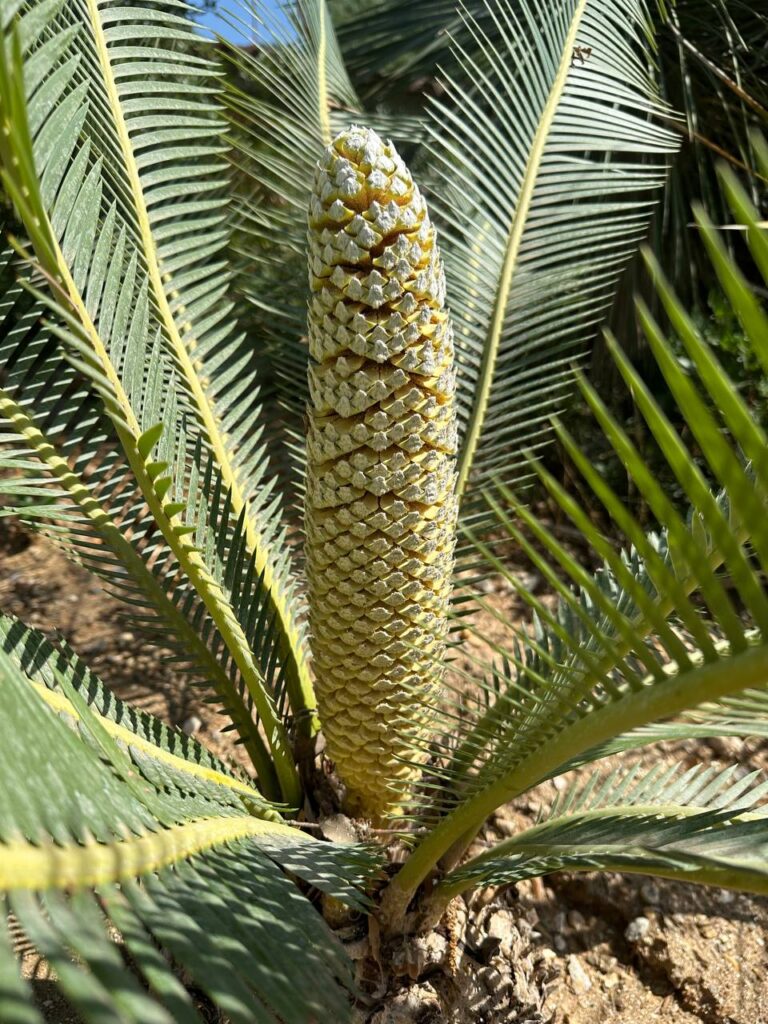

Container cultivation
Its slow growth makes it a good long-term container plant. In regions with long, wet winters, a pot brought in or sheltered from rain in winter is safer than the open ground; but a pot does not protect from cold: in Ravenna, northern Italy, a 21-year-old plant kept in a pot under a terrace was lost at −7 °C (19.4 °F) (see Cold hardiness). Use a very free-draining mix, water freely in summer and sparingly in winter.
In cultivation in the UK, US and Australia
- United Kingdom: the Royal Botanic Garden Edinburgh lists the species in its Garden Explorer and the Cambridge University Botanic Garden in its online catalogue; Kew, RHS Wisley, Glasgow Botanic Gardens, the University of Bristol Botanic Garden and Paignton Zoo declare it to BGCI PlantSearch. These collections are grown under glass as far as is known; no planting in the open ground is documented in Britain.
- United States: at the Missouri Botanical Garden in St. Louis, two plants received from the Mexican commission at the 1904 World’s Fair were planted in the Climatron glasshouse in 1966 and are still alive; after hand pollination in September 2022, viable seeds were harvested in January 2024 (Deloso et al., 2025). The Montgomery Botanical Center (Coral Gables, Florida) lists more than twenty accessions in its online catalogue, including batches from 2001 and 2012, and the Fairchild Tropical Botanic Garden, in Miami, declares it to BGCI PlantSearch. In Florida, the University of Florida describes it as one of the two most planted Dioon and the hardier of the two. BGCI PlantSearch lists some fifty American gardens, among them the Huntington, Lotusland, San Diego Botanic Garden, Naples Botanical Garden, the United States Botanic Garden, Longwood Gardens and the Desert Botanical Garden in Phoenix.
- Australia: the census of the Royal Botanic Gardens Victoria (October 2026) lists Dioon edule in outdoor beds at Melbourne Gardens, and the Royal Botanic Garden Sydney lists it in its Garden Explorer; Brisbane Botanic Gardens Mount Coot-tha, the Adelaide Botanic Garden, the Hunter Region Botanic Gardens and the System Garden of the University of Melbourne declare it to BGCI.
A BGCI listing is a declaration by the garden, not proof that the plant is alive today.
Propagation
Dioon edule is propagated from seed. A male and a female plant are needed: the seeds of an unpollinated cone have no embryo, as Lindley found in 1843 on the first cone to reach England. A grower in Naples reports on the Italian Tropicamente forum that he has always obtained about 50% germination, germinating the seeds under cover on a layer of moist perlite at about 25 to 30 °C (77 to 86 °F) before potting them. The seedlings grow very slowly. Since seeds are exempt from CITES permits, they are the simplest way to obtain plants of known origin. The University of Florida notes that plants may form several trunks; no source describes the rooting of offsets.
Pests and diseases
No disease specific to the species is documented. In cultivation, the main danger is root and trunk rot in cold, wet soil. The University of Florida presents the Dioon as an alternative to Cycas revoluta, which is heavily attacked in Florida by the cycad aulacaspis scale (Aulacaspis yasumatsui), without stating how susceptible Dioon are to this pest. As with other cycads, watch for scale insects on plants brought indoors for the winter.
Cold hardiness
Dioon edule is one of the most cold-tolerant cycads, provided the soil stays dry in winter. The University of Florida rates it for USDA zones 8 to 11, that is, average annual minimums of about −12 °C (10 °F) and above; Cycadales.eu gives zone 8b, −8 to −9 °C (17.6 to 15.8 °F), with possible leaf damage at milder temperatures (a commercial rating). The trunk is hardier than the leaves, which can be scorched and then regrow.
Mediterranean and European experience
The reports below come from the French Fous de palmiers forum, unless stated otherwise; they are amateur observations of indicative value.
- Mediterranean coast: at the Jardin zoologique tropical at La Londe-les-Maures (Var), the species grows in a rockery and cones, with no published cold data. A grower in Carqueiranne (Var) reports that his unprotected plant was clearly damaged during the winter of 2009–2010, with a minimum of −4.7 °C (23.5 °F) in open ground and about ten frosty nights; he thinks it was not yet dormant when the first frosts came (posts of April 2010).
- Gard: a grower in Nîmes reports that his plant, an 18-month-old seedling planted out in spring 2011, survived −8 to −10 °C (17.6 to 14 °F) in February 2012, with several days without thaw, protected only by fleece and a plastic sheet: the leaves were intact, while his Cycas revoluta lost 80% of its leaves (March 2012). Another grower in the Gard reports that his plant, set out in spring 2011, did not budge during the winter of 2011–2012 despite lows of −9 °C (15.8 °F), on dry soil (December 2012).
- South-west France: a grower in Agen (Lot-et-Garonne) reports that his plant, in the ground for two years and unprotected, had its leaves scorched during the winter of 2009–2010, at about −6 to −7 °C (21.2 to 19.4 °F), and then recovered (June and November 2010). A grower in the Tarn, near Toulouse, reports keeping his plant in the ground through the winter of 2025–2026, with lows of −9 °C (15.8 °F), without specifying any protection (August 2026).
- Paris suburbs (Île-de-France): a grower reports that his plant, in the ground since 2009, came through the winter of 2009–2010 at −7 °C (19.4 °F) under passive protection, leaves intact (November 2010); during the cold wave of February 2012, the crown of a small plant in its third winter in the ground under passive protection was scorched, but the trunk remained sound (March 2012). The same grower had lost a Dioon angustifolium at −12 °C (10.4 °F) during the winter of 2008–2009.
- Atlantic coast: a grower in Nantes (Loire-Atlantique) reports losing his Dioon edule and Dioon califanoi, planted out in 2007, during a mild winter (−4 °C (24.8 °F), few frost days), and puts it down to excess water despite good drainage (January 2011).
- Ravenna (Emilia-Romagna, Italy): a grower reports on the Tropicamente forum that his 21-year-old plant, in a pot under a terrace, against a wall and sheltered from rain, did not survive the episode of December 2009: −7 °C (19.4 °F) under the terrace (−10 °C (14 °F) in the open), with hoar frost and a daytime maximum of −3 °C (26.6 °F); it looked intact in January 2010 and had lost almost all its leaves by April.
- La Mortola (Liguria, Italy): a large male plant set out in 1888 in full sun, in dry sandy soil, was doing “extremely well” in 1912 (Hortus Mortolensis).
These reports suggest that, in the ground, the species withstands frosts of −7 to −9 °C (19.4 to 15.8 °F) when the soil is dry, sometimes at the cost of its leaves, but that winter wet can kill it at much milder temperatures; this is a synthesis of isolated reports, not a measurement. For the mild but wet winters of south-west England and Ireland, the Nantes failure is the most relevant warning.
United Kingdom, United States and Australia
- Florida: USDA zones 8 to 11; the species is one of the two most planted Dioon there, and the hardier of the two (UF/IFAS).
- British Columbia (Canada): a small cycad nursery on the Sunshine Coast reports on the UBC Botanical Garden forums, in May 2006, that a three-year-old Dioon edule planted out the previous winter lost its leaves and might not survive, while a Macrozamia communis planted at the same time stayed green; no temperature is given.
- Melbourne (Australia): plants grow in outdoor beds at the Royal Botanic Gardens Victoria (see In cultivation), but no cold data are published for them.
- United Kingdom: no planting in the open ground is documented in a verifiable source.
- Mexico: in the wild, adults withstand prolonged drought and resprout after fires (Vovides, 1990; Bonta et al., 2019).
Toxicity and precautions
Yes, Dioon edule is toxic, especially its raw seeds. Cycads contain toxic glycosides (cycasin, macrozamin), from which methylazoxymethanol is derived, a toxin affecting the liver and the nervous system. In Dioon edule, a study by Yagi (2004) did not detect these glycosides in the adult leaves of the three Dioon analysed, but showed that leaf extracts of the species actively break down macrozamin. Traditional uses confirm the danger: according to Bonta and colleagues (2019), raw seeds were used as rat poison, livestock are poisoned by grazing the young leaves, and badly detoxified flour causes stomach pain, nausea and vomiting, sometimes death.
Wear gloves to handle the seeds, and keep plants and seeds out of reach of children and animals. If any part has been eaten, contact a poison centre, a doctor or a vet without delay.
Traditional uses
The seeds of Dioon edule are a traditional food of north-eastern Mexico. According to the ethnobotanical study by Bonta and colleagues (2019), chamal was a staple food of the Xi’iuy (southern Pame) and of the mestizos of the Sierra Gorda and the Pamería, and a famine food for other groups. The seeds, stripped of their fleshy coat, are cut, washed in ash and boiled repeatedly, in cycles of about two days, before being ground into a dough for tamales, tortillas or porridge; the cook tests the dough before judging it safe. The sweet fleshy coat is also eaten raw or as jam. Chamberlain (1919) already mentioned tortilla flour, and Lindley (1843) the use of the seeds for starch. An analysis of seeds from the Huasteca Potosina measured about 61% carbohydrates and 21% protein (Carranza Álvarez and Carrillo Inungaray, 2017).
The leaves decorate churches during religious festivals (2020 revision); among the Xi’iuy, chamal tamales and leaves of the plant adorn the altars of the Day of the Dead (Bonta et al., 2019). The hard seed shell was used to make toys called rezumbadores (2020 revision; Chamberlain, 1919). Bonta and colleagues (2019) identified cones and leaves of dameu carved on the baroque façade of the mission of Tancoyol, in Querétaro. These practices rest on traditional know-how: never try to eat the seeds.
Frequently asked questions
Is Dioon edule hardy?
Yes, by cycad standards, provided the soil stays dry in winter. In France, plants have survived in the ground at −7 °C (19.4 °F) under passive protection near Paris, at −8 to −10 °C (17.6 to 14 °F) under fleece in Nîmes in February 2012, and at −9 °C (15.8 °F) in the Gard and the Tarn. The leaves can be scorched without protection, as in Agen at about −6 to −7 °C (21.2 to 19.4 °F), but the plant recovers. On the other hand, plants died in Nantes at only −4 °C (24.8 °F), because of winter wet. The University of Florida rates it for USDA zones 8 to 11.
Can it be grown outdoors in the UK?
No planting in the open ground is documented in Britain, and Kew, Edinburgh and Cambridge grow it under glass. Its tolerance of dry cold suggests that the mildest coastal gardens of southern England could try an established plant in a very free-draining, raised bed sheltered from winter rain, but this is a deduction, not a documented result; elsewhere, grow it in a pot brought into a cool, frost-free place for the winter.
Should it be grown in a pot or in the ground?
It depends on climate and soil. In Mediterranean-type climates and in the south-west of France, planting out succeeds in well-drained soil or on a mound. Where winters are long and wet, a pot, brought in or sheltered from rain in winter, is safer; but in Ravenna, Italy, a potted plant was lost at −7 °C (19.4 °F), which shows that a pot does not protect from cold.
What is the difference from Dioon angustifolium?
Mainly leaflet width and origin. Dioon angustifolium, from Nuevo León and Tamaulipas, has narrower, more widely spaced leaflets and an axis that tends to twist. The two plants are so alike that provenance alone often settles the question.
Are the seeds edible?
Not raw: they are toxic. In Mexico they are eaten after lengthy detoxification (washing in ash, repeated boiling, testing), and a badly made preparation can kill. Never try to prepare them yourself, and call a poison centre if any has been eaten.
Is it toxic to dogs and cats?
Yes, it should be treated as toxic. The danger of cycads to animals is well documented, especially for dogs that chew the seeds, and in Mexico livestock are poisoned by grazing the young leaves. Remove ripe female cones if animals have access to the garden.
What about the forms “Palma Sola”, “Rio Verde” or “Valles”?
They are provenances, not botanical varieties. Whitelock (2004) described them as forms, but the 2020 revision judges them invalid, since several morphologies occur together in one locality. No reliable source shows that any of them is hardier than the others.
Is it endangered in the wild?
Less than most of its relatives: it is listed as Near Threatened by the IUCN (assessment published in 2022), whereas almost all other Dioon are Vulnerable or Endangered. It remains protected by CITES (Appendix II) and by Mexican law, and its populations have declined through habitat loss and exploitation.
Further reading on Succulentes
- How to Grow Cycads from Seed: Germination, Seedling Care and Propagation Setup
- Watering Cycads: Common Mistakes and How to Avoid Them
- Is Sago Palm Toxic to Dogs, Cats & Children? What to Know
Sources
Reference sites
- The World List of Cycads (version 2026.08.15), Dioon edule: https://cycadlist.org/scientific_name/248 — author, publication, type (CGE), range, IUCN status (NT A2cd), synonyms, etymology, references. The reference list of the IUCN Cycad Specialist Group; checked on 26 October 2026.
- The World List of Cycads, Dioon angustifolium: https://cycadlist.org/scientific_name/244 — combinations at the rank of form, variety and subspecies, lectotypification by De Luca et al. (1982). Reference list.
- World Checklist of Vascular Plants (WCVP, Royal Botanic Gardens, Kew), June 2026 version published on GBIF: https://www.gbif.org/species/207874330 — accepted name; Dion an orthographic variant of the conserved spelling Dioon. Kew checklist on which POWO is based; reliable.
- GBIF, Dioon edule: https://www.gbif.org/species/2683503 — accepted name and IUCN category (NT). International database; checked on 26 October 2026.
- Plazi TreatmentBank, Dioon edule (Hernández-Tapia et al. 2020): https://tb.plazi.org/GgServer/summary/DD3ECC5EC9187E039074FFDBFFE64854 — description, synonyms, habitat, altitudes, common names, uses, opinion on Whitelock’s forms. Revision published in Phytotaxa.
- Internet Archive, Edwards’s Botanical Register 29 (1843): https://archive.org/details/botanicalregist02lindgoog — original description of Dion edule (no. 82, pp. 59–60). Primary source.
- Species+ (UNEP-WCMC), Dioon edule: https://speciesplus.net/species#/taxon_concepts/19968/legal — CITES Appendix II, EU Annex B, Spanish names, synonyms. Official database; checked on 26 October 2026.
- Diario Oficial de la Federación, NOM-059-SEMARNAT-2010: https://dof.gob.mx/normasOficiales/4254/semarnat/semarnat.htm — category P for Dioon edule and Dioon angustifolium, common names. Official text.
- UF/IFAS Gardening Solutions (University of Florida), Dioon: https://gardeningsolutions.ifas.ufl.edu/plants/trees-and-shrubs/palms-and-cycads/dioon/ — English name, USDA zones, light, soil, drought, salt, size in cultivation. University extension service, reliable.
- The Gymnosperm Database, Dioon edule: https://www.conifers.org/za/Dioon_edule.php — description after Jones (1993) and Norstog and Nicholls (1997), Jones’s treatment of angustifolium as a variety, related species. Reference database, second-hand data.
- Cycadales.eu, “Reconnaître les différences entre Dioon edule et Dioon angustifolium” (2021): https://cycadales.eu/2021/02/16/reconnaitre-les-differences-entre-dioon-edule-et-dioon-angustifolium/ — distinguishing features, mislabelling, plants of known provenance at Nong Nooch; product page for Dioon edule (zone 8b, cultivation). Specialist nursery: practical experience.
- Universidad Veracruzana, “Una planta milenaria en Xalapa” (Ciencia y Luz, 2017): https://www.uv.mx/cienciauv/files/2017/10/037-CYL-UNA-PLANTA-MILENARIA-EN-XALAPA-00.pdf — story of Murillo’s plant, local names. University popular-science article.
- Hortus Mortolensis (1912), Internet Archive: https://archive.org/details/hortusmortolensi00giar — male plant of Dioon edule bought in 1888 for the Hanbury gardens, cultivation notes. Historical source.
- Royal Botanic Garden Edinburgh, Garden Explorer: https://rbge.gardenexplorer.org/ — Dioon edule listed. Garden catalogue, updated 18 October 2026.
- Cambridge University Botanic Garden, Living Collections Portal: https://www.botanic.cam.ac.uk/collections/collectionsportal/search-results?genus=&species=&family=Zamiaceae — Dioon edule. Garden catalogue; consulted on 19 October 2026.
- Montgomery Botanical Center, BG-BASE catalogue (cycad collection): https://websites.rbge.org.uk/cgi-bin/nph-readbtree.pl/dataset=CYCADS/filename=n132_cyc/firstval=1?ETI=dioon%20edule* — more than twenty accessions, including 20010188 to 20011093 (2001) and 20120316 to 20120592 (2012). Garden catalogue; checked on 26 October 2026.
- Royal Botanic Garden Sydney, Garden Explorer: https://rbgsydney.gardenexplorer.org/ — Dioon edule listed. Garden catalogue, updated 1 October 2026.
- Royal Botanic Gardens Victoria, living collection census: https://data.rbg.vic.gov.au/rbgcensus/ — Dioon edule in outdoor beds at Melbourne Gardens (census consulted on 19 October 2026). Garden catalogue.
- BGCI PlantSearch, Dioon edule: https://plantsearch.bgci.org/ — gardens declaring the species (155 worldwide). International database of botanic gardens; declarations without dates.
- UBC Botanical Garden Forums, thread “Cycad hardiness report” (11 May 2006): https://forums.botanicalgarden.ubc.ca/threads/cycad-hardiness-report.14118/ — Dioon edule planted out in British Columbia, defoliated after its first winter. Growers’ forum, indicative value.
- Fous de palmiers, French growers’ forum: https://www.fousdepalmiers.fr/html/forum/viewtopic.php?p=111421 (Paris suburbs, 2010); https://www.fousdepalmiers.fr/html/forum/viewtopic.php?p=173371 and https://www.fousdepalmiers.fr/html/forum/viewtopic.php?p=173417 (Nîmes and Paris suburbs, 2012); https://www.fousdepalmiers.fr/html/forum/viewtopic.php?p=111417 and https://www.fousdepalmiers.fr/html/forum/viewtopic.php?p=94822 (Agen, 2010); https://www.fousdepalmiers.fr/html/forum/viewtopic.php?p=229077 (Gard, 2012); https://www.fousdepalmiers.fr/html/forum/viewtopic.php?p=511778 (Tarn, 2026); https://www.fousdepalmiers.fr/html/forum/viewtopic.php?p=87585 and https://www.fousdepalmiers.fr/html/forum/viewtopic.php?p=87708 (Carqueiranne, 2010); https://www.fousdepalmiers.fr/html/forum/viewtopic.php?p=116534 (Nantes, 2011). Dated reports, quoted anonymously.
- Tropicamente, Italian growers’ forum: https://www.tropicamente.it/forums/topic/piante-che-ce-lhanno-fatta-non-ce-lhanno-fatta/ (Ravenna, 2009–2010) and https://www.tropicamente.it/forums/ (sowing, Naples). Dated reports, quoted anonymously.
Bibliography
- Lindley, J. (1843). Dion edule. Edwards’s Botanical Register 29 (misc.): 59–60. [Original description, history of the introduction, use of the seeds; text on the Internet Archive.]
- Chamberlain, C.J. (1919). The Living Cycads. University of Chicago Press, Chicago. [Observations at Chavarrillo, trunk size, estimated age of Murillo’s plant, tortilla flour; full text on the Internet Archive.]
- De Luca, P., Sabato, S. & Vázquez Torres, M. (1982). Distribution and variation of Dion edule (Zamiaceae). Brittonia 34(3): 355–362. doi:10.2307/2806710 [Treatment of angustifolium as a variety; cited after The World List of Cycads and Hernández-Tapia et al. (2020).]
- Vovides, A.P. (1990). Spatial distribution, survival, and fecundity of Dioon edule (Zamiaceae) in a tropical deciduous forest in Veracruz, Mexico, with notes on its habitat. American Journal of Botany 77(12): 1532–1543. doi:10.1002/j.1537-2197.1990.tb11394.x [Cone frequency, seedling mortality, age; abstract.]
- González-Astorga, J., Vovides, A.P., Ferrer, M.M. & Iglesias, C. (2003). Population genetics of Dioon edule Lindl. (Zamiaceae, Cycadales): biogeographical and evolutionary implications. Biological Journal of the Linnean Society 80: 457–467. doi:10.1046/j.1095-8312.2003.00257.x [Eight populations, recognition of Dioon angustifolium, habitat, cone ripening.]
- González-Astorga, J., Vovides, A.P., Cruz-Angón, A., Octavio-Aguilar, P. & Iglesias, C. (2005). Allozyme variation in the three extant populations of the narrowly endemic cycad Dioon angustifolium Miq. (Zamiaceae) from north-eastern Mexico. Annals of Botany 95: 999–1007. doi:10.1093/aob/mci106 [Confirmation of the species rank of Dioon angustifolium.]
- Whitelock, L.M. (2004). Variation in the Mexican cycad Dioon edule (Zamiaceae). The Botanical Review 70(2): 240–249. doi:10.1663/0006-8101(2004)070[0240:VITMCD]2.0.CO;2 [Seven provenance forms; cited after Rubio-Méndez et al. (2020).]
- Dorsey, B.L., Gregory, T.J., Sass, C. & Specht, C.D. (2018). Pleistocene diversification in an ancient lineage: a role for glacial cycles in the evolutionary history of Dioon Lindl. (Zamiaceae). American Journal of Botany 105: 1512–1530. doi:10.1002/ajb2.1149 [Four clades of Pleistocene age; abstract.]
- Bonta, M., Pulido-Silva, M.T., Diego-Vargas, T., Vite-Reyes, A., Vovides, A.P. & Cibrián-Jaramillo, A. (2019). Ethnobotany of Mexican and northern Central American cycads (Zamiaceae). Journal of Ethnobiology and Ethnomedicine 15: 4. doi:10.1186/s13002-018-0282-z [Food and religious uses, detoxification, indigenous names, poisonings; open-access article (Europe PMC).]
- Hernández-Tapia, J.E., Jiménez-Ramírez, J. & Vovides, A.P. (2020). Taxonomic revision of the genus Dioon (Zamiaceae). Phytotaxa 442(4): 267–290. doi:10.11646/phytotaxa.442.4.2 [Description, synonyms, habitat, common names, uses, opinion on the forms; treatments on Plazi.]
- Rubio-Méndez, G., Yáñez-Espinosa, L. & Leija, E.G. (2020). Are the Dioon edule (Zamiaceae) forms from San Luis Potosí proposed by Whitelock (2004) recognizable? Morphological evidence. Revista Mexicana de Biodiversidad 91: e913167. doi:10.22201/ib.20078706e.2020.91.3167 [Whitelock’s forms, intermediate populations.]
- Yagi, F. (2004). Azoxyglycoside content and β-glycosidase activities in leaves of various cycads. Phytochemistry 65: 3243–3247. doi:10.1016/j.phytochem.2004.09.013 [Cycasin and macrozamin, release of methylazoxymethanol, the case of Dioon; abstract.]
- Carranza Álvarez, C. & Carrillo Inungaray, M.L. (2017). Perfil nutrimental de diferentes tejidos y frutos de la palma chamal (Dioon edule). Acta Universitaria 27: 3–9. doi:10.15174/au.2017.1208 [Seed composition; abstract.]
- Deloso, B.E., Colligan, A., Sucher, R. & Ramirez, V. (2025). Missouri Botanical Garden’s cycad collection: a journey through time. Plant Species Biology 40(6): 607–624. doi:10.1111/1442-1984.12509 [Dioon edule from the 1904 World’s Fair in the Climatron, hand pollination of 2022 and seeds of 2024; open-access article.]
- Chemnick, J. & Gregory, T. (2022). Dioon edule. The IUCN Red List of Threatened Species 2022: e.T42158A69829495. doi:10.2305/IUCN.UK.2022-1.RLTS.T42158A69829495.en [Near Threatened; reference checked on Crossref.]
- Haynes, J.L. (2022). Etymological compendium of cycad names. Phytotaxa 550(1): 1–31. doi:10.11646/phytotaxa.550.1.1 [Etymology, as given by The World List of Cycads.]
- Calonje, M., Stevenson, D.W. & Osborne, R. (2026). The World List of Cycads, version 2026.08.15. Montgomery Botanical Center, Coral Gables. doi:10.5281/zenodo.21958524 [Reference checklist.]