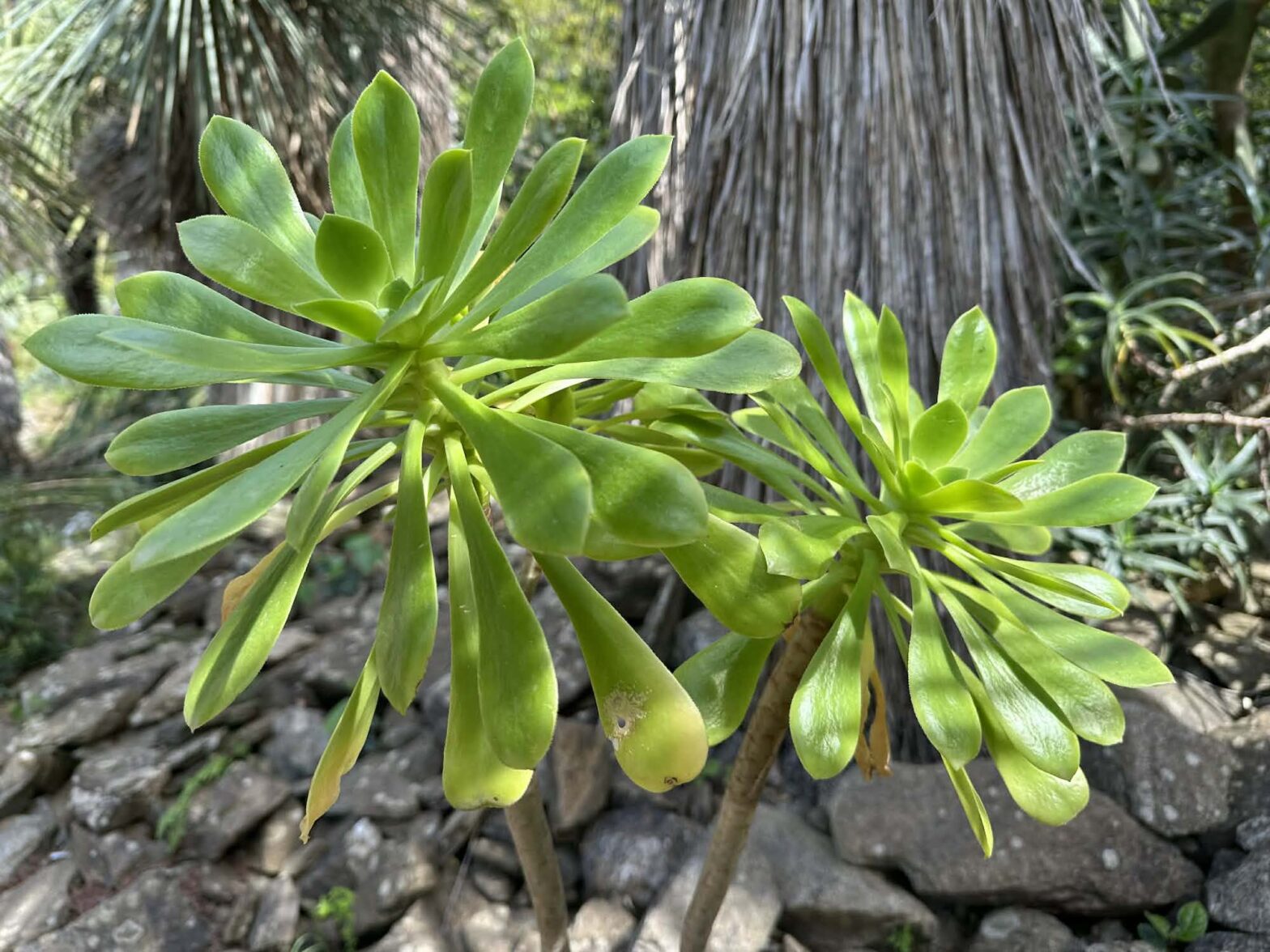
Aeonium arboreum subsp. korneliuslemsii is a succulent subshrub in the family Crassulaceae and the only member of the genus Aeonium native to mainland Africa. While the typical subspecies of Aeonium arboreum is endemic to the Canary Islands, this Moroccan taxon occupies a narrow range along the Atlantic coast and mountains of the western Anti-Atlas, where it was discovered alongside the equally remarkable Dracaena draco subsp. ajgal. Vigorous, easy to grow, and more cold-tolerant than most aeoniums, it deserves far more attention from succulent collectors and Mediterranean gardeners.
Taxonomy and Etymology
Aeonium arboreum subsp. korneliuslemsii (H.Y.Liu) Dobignard is the accepted name according to POWO (Plants of the World Online). The taxon was first described at species rank as Aeonium korneliuslemsii by H.Y. Liu in 1989 in his monograph Systematics of Aeonium (NMNS Taiwan Special Publication 3: 63). Dobignard later transferred it to subspecific rank within Aeonium arboreum in his Index synonymique de la flore d’Afrique du Nord (vol. 3: 354, 2011). The basionym Aeonium korneliuslemsii remains a synonym.
The subspecific epithet honors Kornelius Lems, a Dutch-American botanist who devoted much of his career to studying the flora of the Canary Islands and Macaronesian biogeography. The genus name Aeonium derives from the Greek aionos, meaning “ageless” or “eternal,” a reference to the persistent rosette habit of these succulents.
Within the infraspecific classification of Aeonium arboreum, three subspecies are currently accepted by POWO: subsp. arboreum (endemic to northern and central Gran Canaria), subsp. holochrysum (widespread across the western Canary Islands except Gran Canaria), and subsp. korneliuslemsii (southwestern Morocco). The Moroccan subspecies is distinguished from the Canarian forms primarily by its pubescent-glandular calyx and inflorescence branches (versus glabrous in subsp. arboreum) and by slightly more prominent cilia and denticulations along the leaf margins.
Cristini’s comprehensive revision of the genus (Piante Grasse 42, Supplement, 2022) provides the most recent taxonomic treatment of the group.
Botanical Description
Aeonium arboreum subsp. korneliuslemsii forms a compact, freely branching subshrub that can exceed one meter in height when planted in the ground or given a large container. The stems are robust and woody at the base, erect or pendent when the plant grows on cliff faces, with a smooth, pale bark that is not net-patterned. Branching is generous, often more prolific than in the typical Canarian subspecies, and offsets may also arise from the base.
The leaves are arranged in symmetrical, flattened terminal rosettes. Each leaf is broadly spathulate to obovate, fleshy, and a consistent tender green that remains stable across seasons without developing the purplish tones common in subsp. arboreum. Leaf margins bear fine cilia that are slightly more pronounced than in the type subspecies. During hot summer weather, the foliage produces a noticeable balsamic fragrance, a trait shared with the closely related Aeonium balsamiferum from Lanzarote, though less intense.
The inflorescence is a conical to ovoid panicle of small, star-shaped, golden-yellow flowers, typical of the Aeonium arboreum complex. The sepals are pubescent-glandular, which is the key morphological character separating this subspecies from the Canarian forms. Flowering occurs in late winter to spring. As with all members of the genus, individual rosettes are monocarpic: once a rosette flowers, it dies, but the plant as a whole persists through its many branches.
Natural Habitat and Ecology
This subspecies is endemic to southwestern Morocco, where its range is very restricted. Two main habitat types are documented. The first consists of maritime cliffs along the southern Atlantic coast, particularly in the vicinity of Sidi Ifni, where the plants grow on vertical rock faces buffeted by ocean fog and salt-laden winds. Associated species in these coastal stations include Kleinia anteuphorbium, Sonchus pinnatifidus, and Autonoë latifolia.
The second and most celebrated population occurs on the slopes of Jbel Imzi in the western Anti-Atlas, an isolated mountain massif reaching 1,540 meters in elevation. Here, Aeonium arboreum subsp. korneliuslemsii grows on east-facing rocky slopes from approximately 300 meters to the summit, in the company of Dracaena draco subsp. ajgal, xerophytic ferns (Cheilanthes guanchica, Cheilanthes vellea), Lavandula rejdalii, and spiny Euphorbia species. This remarkable flora represents a continental Macaronesian enclave, where Atlantic fog and orographic moisture create conditions analogous to the laurel-cloud forests of the Canary Islands.
The Jbel Imzi population was discovered in spring 1996 by Abdelmalek Benabid and Fabrice Cuzin during fieldwork initially focused on other research objectives. Their serendipitous sighting of what appeared to be dragon trees high on the cliffs led to the botanical description of both the dragon tree subspecies and the formal recognition of the aeonium population. Additional stations have been documented at Jbel Adad Medni and on the Plateau des Akhassas, as well as around rural villages in the Ifrane de l’Anti-Atlas area where the plant is also cultivated around homesteads.
Aeonium arboreum subsp. korneliuslemsii has not been formally assessed by the IUCN Red List at the subspecific level. However, its extremely localized distribution and the general vulnerability of Macaronesian relict habitats in Morocco suggest that a conservation evaluation would be warranted.
Cultivation and Care
This is one of the easiest aeoniums to grow. Its robust constitution, tolerance of drought, and relatively good frost resistance make it an excellent choice for both garden planting and large container culture in USDA hardiness zones 9b to 11b. In zone 9b, brief frosts down to around −3 °C (27 °F) are generally tolerated if the substrate is well-drained and conditions are dry, though prolonged freezing or wet cold will cause damage. Among aeoniums, this subspecies is considered somewhat more cold-hardy than most.
Exposure. Full sun to light shade. In hot inland climates, afternoon shade during midsummer prevents leaf scorch and reduces the stress of summer dormancy. Coastal gardens with morning fog and afternoon sun replicate its native conditions well.
Substrate. A standard succulent mix with added mineral aggregate (pumice, perlite, or coarse volcanic grit) works well. Unlike many succulents, aeoniums appreciate slightly more organic matter than typical cactus mixes, so a blend of roughly 60% mineral and 40% quality potting soil is appropriate. Good drainage is essential.
Watering. Aeonium arboreum subsp. korneliuslemsii is a winter grower. Water regularly from autumn through spring, allowing the substrate to dry between waterings. Reduce watering significantly in summer, when the plant enters dormancy and rosettes contract. The thick, sturdy stems store substantial reserves and the plant can withstand prolonged dry periods without visible wilting.
Fertilization. A dilute balanced liquid fertilizer applied once or twice during the active growing season (late autumn and early spring) is sufficient.
Temperature. Hardy to approximately −3 °C (27 °F) for short periods in dry conditions. In areas with regular frost, grow in containers that can be moved to a frost-free shelter. The plant tolerates summer heat well provided watering is reduced.
Propagation
Stem cuttings are the simplest and most reliable propagation method. Take cuttings of healthy, non-flowering branches in autumn at the start of the growing season. Allow the cut end to callus for two to three days, then insert into a slightly moist mineral mix. Rooting typically occurs within two to three weeks. The species branches so freely that material for cuttings is rarely in short supply.
Seed propagation is possible but rarely necessary given the ease of vegetative reproduction. Aeonium seeds are extremely fine, almost dust-like, and should be surface-sown on a moist, well-drained mineral substrate. Germination occurs within one to three weeks at temperatures around 15–20 °C. Seedlings are slow-growing in their first year.
Pests and Diseases
Aeonium arboreum subsp. korneliuslemsii is generally a trouble-free plant but shares the common vulnerabilities of the genus.
Root rot is the primary threat, almost always caused by overwatering during the summer dormancy period when the root system is inactive. Ensuring good drainage and reducing irrigation in summer prevents this problem entirely.
Mealybugs can colonize the tight center of rosettes, especially in sheltered conditions. Inspect regularly and treat with isopropyl alcohol on a brush or a systemic insecticide if infestations are heavy.
Aphids occasionally attack young inflorescence stalks in spring.
Leaf drop during summer is normal dormancy behavior, not a sign of disease. The rosettes contract and shed outer leaves to conserve moisture. This is a physiological response and the plant resumes vigorous growth once autumn rains (or watering) resume.
Ornamental Interest and Uses
The architectural branching habit, symmetrical green rosettes, and vigorous constitution of Aeonium arboreum subsp. korneliuslemsii make it a superb specimen plant for Mediterranean and subtropical gardens. Its consistent bright green coloration, maintained year-round, provides a fresh contrast to the purples and burgundies of cultivars like Aeonium arboreum ‘Zwartkop’. The balsamic leaf fragrance in warm weather is an unusual and pleasant bonus.
In the landscape, it works beautifully as a background plant in a rockery, as a structural element in mixed succulent borders, or as a standalone specimen in a large terracotta pot. Its tolerance of coastal conditions (salt spray, wind) makes it particularly well suited to seaside gardens. Combined with other Macaronesian flora such as Dracaena draco, Euphorbia regis-jubae, or Echium species, it contributes to an authentic Atlantic island planting scheme with genuine biogeographical coherence.
Beyond ornamental use, the species holds considerable botanical and conservation interest as a living witness to the Macaronesian floristic connections between the Canary Islands and the Moroccan mainland, a biogeographical link that continues to fascinate researchers and plant enthusiasts alike.