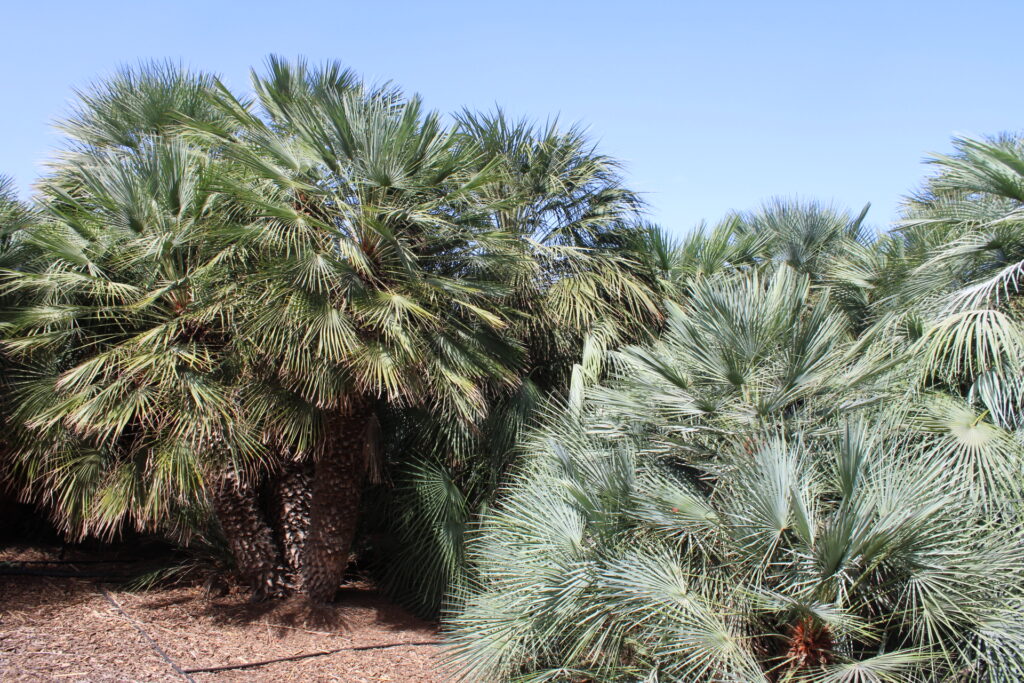
Chamaerops humilis var. argentea André — also known under the synonymous var. cerifera (Becc.) Maire — is the silver-leaved form of the European fan palm, native to the mountains of Morocco (Atlas and Rif). Its strikingly glaucous, blue-silver fronds make it one of the most visually distinctive palms in cultivation, and one of the hardiest.
Identification and distinguishing features
The key distinguishing character of var. argentea is the pronounced waxy bloom (epicuticular wax) on its fronds, which gives them their characteristic silver-blue colour. This feature is especially marked on young fronds. In contrast, the typical form of C. humilis has green to grey-green leaves with little or no glaucous coating. The two forms can be seen side by side at the Palmetum de Tenerife, where the difference is immediately striking.
Distribution and habitat
While Chamaerops humilis is distributed across the western Mediterranean — from Morocco and Portugal to Italy and Malta — var. argentea is more restricted in its natural range, being found in the mountains of Morocco (Atlas and Rif). It grows on rocky, well-drained slopes in full sun, enduring both summer drought and significant winter cold.
Cultivation
Var. argentea is highly prized in horticulture for its ornamental silver foliage and its exceptional cold-hardiness — tolerating temperatures as low as −12 to −15°C once established. It thrives in full sun with excellent drainage and is remarkably drought-tolerant. Growth is slow but steady; mature specimens develop a pronounced trunk covered in old leaf-base fibres.
Conservation
Chamaerops humilis is listed as Least Concern on the IUCN Red List. However, var. argentea populations in Morocco are locally threatened by overgrazing and collection pressure from the horticultural trade. It is protected under Moroccan national legislation.