Neobuxbaumia polylopha is a tall columnar cactus of central-eastern Mexico, with a green ribbed trunk, usually unbranched, that can exceed ten metres in the wild. Plants of the World Online (POWO) now records it as Cephalocereus polylophus, but Neobuxbaumia polylopha remains the name under which it is sold and found in most collections. It belongs to the genus Neobuxbaumia, in the Cactaceae family.
Key facts
- Accepted name (POWO): Cephalocereus polylophus (DC.) Britton & Rose, published in 1909; Neobuxbaumia polylopha (DC.) Backeb. is a synonym, kept here as a working name
- Family: Cactaceae, subfamily Cactoideae
- Origin: Mexico, from Guanajuato to Veracruz according to POWO; the 2009 IUCN assessment cites only Hidalgo, Querétaro and Guanajuato
- Habit: green column 7 to 13 m, sometimes 15 m in the wild, up to 50 cm across
- Flowers: dark red, 4 to 6 cm, near the top
- Fruit: egg-shaped, green, 24 to 40 mm, edible
- IUCN: Vulnerable
- CITES: Appendix II (genus Cephalocereus)
- Documented hardiness: low; damage reported from −2 °C by a horticultural source
- Common names: “cone cactus”, “wax cactus” and “golden saguaro” (trade names)
Name and classification
The species was described in 1828 by Augustin Pyramus de Candolle as Cereus polylophus. It was later placed in Pilocereus by Salm-Dyck, then in Cephalocereus by Britton and Rose in 1909, in Neobuxbaumia by Backeberg, and even in Carnegiea, the saguaro genus, as Carnegiea polylopha. Since Neobuxbaumia was merged into Cephalocereus (Tapia and colleagues, 2017), POWO uses Cephalocereus polylophus. The details are explained on the genus page. The epithet polylophus comes from the Greek poly, “many”, and lophos, “crest”, referring to the numerous ribs of the stem.
How to recognise Neobuxbaumia polylopha
Habit and stem
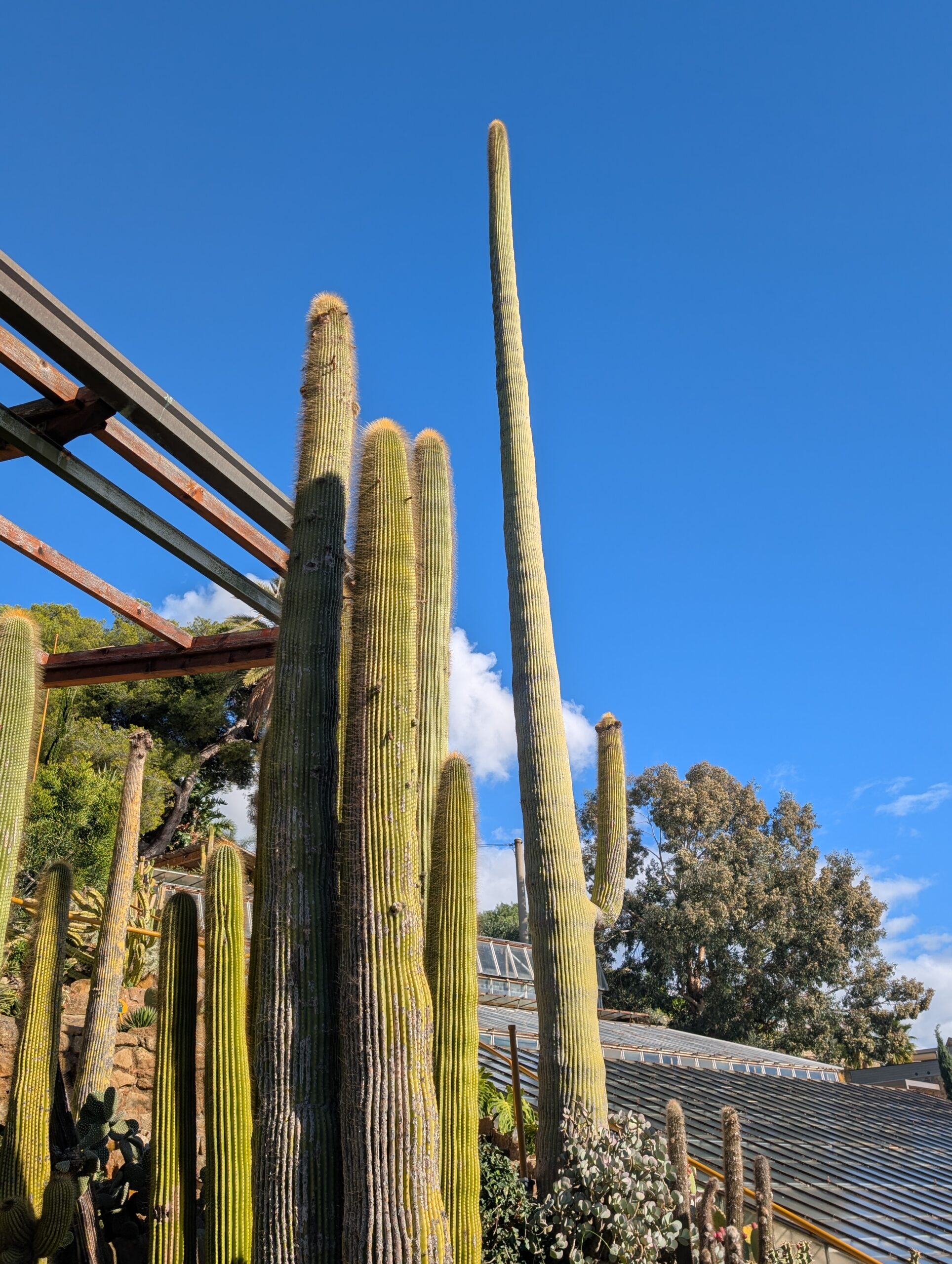
The plant grows as a single column, light green when young and darkening with age. It can reach 13 m, possibly 15 m, weighing several tonnes, with a diameter of up to 50 cm. In the photograph below, taken in a botanical garden, several columns of different heights can be seen; only one carries a side branch, which confirms that branching remains exceptional.
Ribs and spines
The ribs are narrow, slightly curved and separated by sharp furrows. Their number varies between sources, from 10 to 36, most often 22 to 36 on adult plants. Each areole bears one flexible central spine, sometimes absent, and seven to eight flexible marginal spines 1 to 2 cm long, yellowish to brownish, turning grey with age. The areoles at the top, golden yellow in the photograph, give the column its pale crown.
Flowers and fruit
The dark red flowers are 4 to 6 cm long and 30 to 35 mm across, and appear in groups near the stem tips. The floral tube bears fairly large tubercles and small scales. The egg-shaped green fruits, 24 to 40 mm, are covered with scales, wool and bristles; they are edible, with a delicate, nutty flavour. A flower of this colour and size is unusual in the genus, where most species have white or pink flowers.
Distribution and habitat
Neobuxbaumia polylopha is endemic to Mexico. POWO gives a range from Guanajuato to Veracruz, in dry vegetation (desert and dry shrubland biomes); species accounts cite Hidalgo, Querétaro, Guanajuato and San Luis Potosí. The sources consulted do not describe its precise habitat in detail.
Status and protection
The IUCN lists the species as Vulnerable. It is naturally rare and scattered, and is declining because of canyon development for tourism and other construction; bacteria also affect many subpopulations. The genus is in CITES Appendix II, so international trade requires a permit. Plants sold in Europe come from seed.
Cultivation
The species is popular with collectors and propagates well from seed. It needs plenty of light (light shade for young plants, full sun afterwards), a fast-draining mineral substrate and a dry winter. It grows slowly in a pot and stays modest in size for a long time, which makes it a conservatory or collection plant before it is a garden plant.
Data on frost are thin. A Canadian horticultural source reports damage from −2 °C, sometimes fatal, and the plant fears cold damp above all. Only the most sheltered gardens of the Mediterranean coast allow it to be tried in the ground; elsewhere it is grown in a pot and kept frost-free. No documented results of open-ground cultivation in France were found. The substrate must stay very permeable, because excess cold water causes crown and root rot.
FAQ
Neobuxbaumia polylopha or Cephalocereus polylophus?
Botanically, Cephalocereus polylophus, the name accepted by POWO. Neobuxbaumia polylopha is a synonym but remains the name on plant labels and in catalogues.
Is it a saguaro?
No. The saguaro is Carnegiea gigantea, from the Sonoran Desert. The trade name “golden saguaro” and the species’ former placement in Carnegiea keep the confusion alive.
Is the fruit edible?
Yes, according to published descriptions, with a delicate nutty flavour. Collection plants rarely flower and fruit even more rarely.
Reference sites
- Plants of the World Online (POWO), Cephalocereus polylophus: https://powo.science.kew.org/taxon/urn:lsid:ipni.org:names:52188-2 — accepted name, range, 1909 publication. Reference database (Kew).
- Wikipedia, Cephalocereus polylophus: https://en.wikipedia.org/wiki/Cephalocereus_polylophus — description, synonyms, IUCN status. Secondary source.
- World Plants, Neobuxbaumia polylopha: https://worldplants.ca/display.php?id=9083 — trade names, frost sensitivity. Horticultural site.
Bibliography
- Candolle, A.P. de (1828). Cereus polylophus. [Original description, per Wikipedia.]
- Britton, N.L. & Rose, J.N. (1909). Contributions from the United States National Herbarium 12: 419. [Combination in Cephalocereus, per POWO.]
- Tapia, H.J., Bárcenas-Argüello, M.L., Terrazas, T. & Arias, S. (2017). Phylogeny and circumscription of Cephalocereus (Cactaceae) based on molecular and morphological evidence. Systematic Botany 42(4): 709–723.