

No other tree in succulent’s botany carries as much myth as the Canary Islands dragon tree. Ancient Romans confused its crimson sap with cinnabar — mercury sulfide — and medieval encyclopedists claimed it was literally the blood of dragons slain by elephants.
When the French explorer Jean de Béthencourt landed on the Canary Islands in 1402, the Guanches — the indigenous Berber people of the archipelago — offered him dried drops of garnet-red resin in exchange for iron tools, a transaction in which the resin was worth a hundred times more than the metal. The Guanches embalmed their dead with it, dyed their textiles with it, brushed their teeth with it, and held court under the canopy of monumental specimens they believed to be the incarnation of fallen dragons.
Three centuries later, when Italian luthiers began coating their finest violins in varnish formulated with this same resin — including, legendarily, Stradivarius himself — the scarlet substance had already traversed two thousand years of continuous use as pigment, medicine, and sacred material. The tree that produces it, Dracaena draco, is a species in the genus Dracaena — one of the most majestic Agavoids in cultivation, a Tertiary relict that once grew across the Mediterranean basin and now survives in the wild only on a handful of Atlantic islands and in a single Moroccan canyon.
Quick Facts
| Scientific name | Dracaena draco (L.) L. |
| Family | Asparagaceae (subfamily Nolinoideae) |
| Origin | Canary Islands, Madeira, Cape Verde, Anti-Atlas (Morocco); possibly introduced in the Azores |
| Adult size | 10–15 m tall (exceptionally 20+ m); trunk circumference to 5 m or more |
| Hardiness | −3 to −5 °C / USDA zones 10–11 ; Marginal in 9b. |
| IUCN | Vulnerable (VU) — populations declining |
| Cultivation difficulty | 2/5 |
Taxonomy and Nomenclature
The species was first described by Carl Linnaeus in 1762 as Asparagus draco (Species Plantarum, ed. 2: 451). In 1767, Linnaeus transferred it to his newly erected genus Dracaena (Systema Naturae, ed. 12, 2: 246). The type locality was erroneously stated as “India orientali” — a common 18th-century confusion for Macaronesian plants that reached European herbaria via Portuguese trade routes. The lectotype is an illustration by Clusius (Rariorum Plantarum Historia 1: 1, 1601), designated by Bos in 1993.
The genus name Dracaena derives from the Greek δράκαινα (drakaina), “female dragon.” The specific epithet draco is the Latin word for dragon.
Subfamily placement. Dracaena draco belongs to the subfamily Nolinoideae within Asparagaceae (APG IV, 2016) — not to the subfamily Agavoideae to which Agave and Yucca belong. On this site, both subfamilies are treated together under the broad horticultural term “Agavoids,” as they share the rosette habit, xeric adaptation, and architectural garden use.
Three Subspecies — or Three Species?
The traditional treatment recognizes three subspecies, each endemic to a distinct geographic area:
| Subspecies | Range | Described by |
|---|---|---|
| Dracaena draco subsp. draco | Canary Islands (Tenerife, Gran Canaria, La Palma) and Madeira | Linnaeus (1767) |
| Dracaena draco subsp. ajgal | Anti-Atlas Mountains, SW Morocco | Benabid & Cuzin (1997) |
| Dracaena draco subsp. caboverdeana | Cape Verde (Santo Antão, São Nicolau, Fogo) | Marrero Rodr. & R.S.Almeida (2012) |
However, Rivas-Martínez et al. (2017) elevated the Moroccan and Cape Verdean forms to full species: Dracaena ajgal and Dracaena caboverdeana. As of 2025, POWO accepts both these species-level names alongside the subspecies names — a somewhat ambiguous situation. Most recent phylogeographic studies (García-Verdugo et al. 2019, 2020) continue to use the subspecies framework, and plastid DNA data confirm that all three taxa form a monophyletic group (the “Macaronesian Dragon Tree” clade, or MDT) that is not closely related to the morphologically similar East African and Arabian dragon trees (Dracaena cinnabari, Dracaena ombet, Dracaena serrulata). In this article, we follow the three-subspecies treatment while noting the alternative species-level classification.
A Fourth Macaronesian Dragon Tree: Dracaena tamaranae
Gran Canaria hosts a second species, Dracaena tamaranae Marrero, Almeida & González-Martín (1998) — a smaller, more shrub-like dragon tree with morphological affinities to the East African Dracaena ombet rather than to Dracaena draco. This remarkable biogeographic anomaly — two dragon trees on the same island, one related to the western clade and one to the eastern clade — was a key piece of evidence supporting the hypothesis that Macaronesia was colonized at least twice, independently, by dragon trees from different source lineages.
Synonyms
- Asparagus draco L. (1762) — basionym
- Palma draco (L.) Mill. (1768)
- Stoerkia draco (L.) Crantz (1768)
- Draco dragonalis Crantz (1768), nom. illeg.
- Dracaena resinifera Salisb. (1796), nom. superfl.
- Drakaina draco (L.) Raf. (1838)
- Dracaena yucciformis Vand.
- Dracaena boerhaavei Ten.
Common Names
English: Canary Islands dragon tree, dragon tree, dragon’s blood tree, drago. French: dragonnier des Canaries, dragonnier commun. Spanish: drago, drago de Canarias. Portuguese: dragoeiro, sangue-de-dragão. Italian: albero del drago. German: Kanarischer Drachenbaum.
Morphological Description
Habit and Growth Pattern
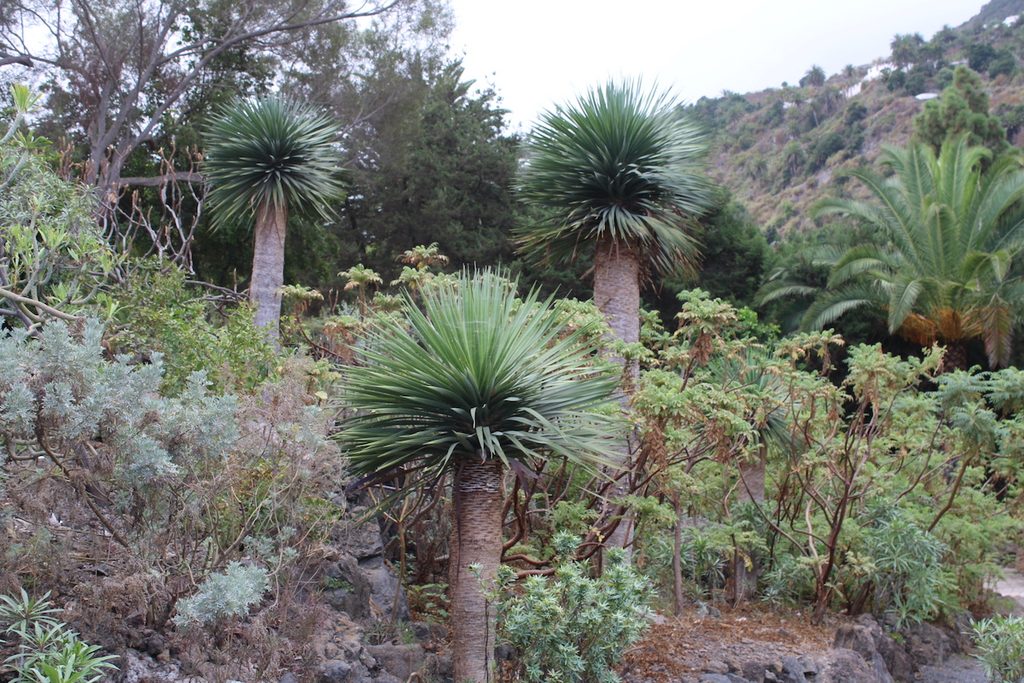
Dracaena draco is a massively arborescent, evergreen monocotyledon that can reach 10–15 m in height, with exceptional specimens exceeding 20 m and trunk circumferences surpassing 5 m. The growth pattern is unlike any dicotyledonous tree. The stem begins as a single, unbranched column for the first 10–15 years. The apical meristem then terminates in a flower spike. After flowering, a crown of axillary buds emerges, and the plant begins to branch. Each branch then grows for another 10–15 years before flowering and branching in turn. The result, over centuries, is the species’ unmistakable umbrella-shaped canopy — a vast, hemispherical dome of densely packed branch tips, each crowned with a rosette of stiff leaves.
This “dracoid habitus” provides a rough method of age estimation: by counting the number of successive branching events from trunk base to canopy edge and multiplying by 10–15 years. However, the method is imprecise, as flowering intervals vary with climate, nutrition, and light exposure.
Anomalous Secondary Growth
As a monocotyledon, Dracaena draco does not possess true vascular cambium. Instead, its trunk thickens through anomalous secondary growth — the classic textbook example of this process in botany. A specialized meristematic zone called the monocot cambium (or secondary thickening meristem) forms in the inner cortex and produces secondary vascular bundles and parenchyma on its inner face. The result is a cylinder of “wood” that is structurally and developmentally different from the wood of any gymnosperm or eudicot. The secondary tracheary elements form braid-like arrangements within amphivasal bundles, providing both mechanical support and water transport — a dual function that has allowed this monocotyledon to reach tree stature in an environment of chronic water deficit.
Trunk and Bark
The trunk is silvery-grey, smooth in youth, developing a rougher, more scaly texture with age. In very old specimens, the base may develop massive aerial adventitious roots that descend from the lower trunk and branches, giving the tree an increasingly grotesque and dragon-like appearance. The trunk contains no annual growth rings — a key reason why the age of famous specimens (including the Drago Milenario) has been so hotly debated.
Leaves
Leaves are linear-lanceolate, sessile, 60–120 cm long and 3–4 cm wide, glaucous silvery-grey-green, arranged in dense terminal rosettes at the apex of every branch. They are stiff, leathery, and slightly channeled above. The leaf margin is entire but can be slightly rough.
Inflorescence and Flowers
The inflorescence is a loosely branched terminal panicle, 40–60 cm long, emerging from within the leaf rosette. Flowers are small, numerous, grouped in clusters of 4–5 on pedicels of 5–10 mm. The perianth is white to greenish-white, occasionally pinkish, campanulate, with tepals 7–11 mm long. Fragrance is sweet and delicate. Flowering occurs at intervals of approximately 10–15 years in the wild — more frequently in the Azores (possibly every 5–10 years) and in irrigated cultivation.
Fruits and Seeds
Fruits are globose berries, 1–1.5 cm in diameter, bright coral-red to orange when ripe, borne in large pendant clusters. Each berry contains 1–3 seeds. The fruits are fleshy and attractive to birds — which are the primary natural dispersers. The loss of an extinct, endemic, flightless bird that may have been a key seed disperser is one hypothesis proposed to explain the poor natural regeneration of wild populations.
Subspecies: Morphological and Ecological Differences
Dracaena draco subsp. draco — Canary Islands & Madeira
The nominate subspecies and the most widely cultivated. Wild populations are now restricted to Tenerife (the largest remaining populations) and Madeira (low-elevation cliffs). The species has recently gone extinct in the wild on Gran Canaria (where it is replaced by the separate species Dracaena tamaranae at higher elevations), though cultivated specimens abound. On La Palma, wild trees persist in the Barranco de Buracas. Historically, dragon trees were much more widespread across all seven Canary Islands, but centuries of resin exploitation, deforestation for agriculture, and grazing by introduced goats have reduced them to fragmented cliff populations.
Dracaena draco subsp. ajgal — Anti-Atlas, Morocco
Described by Benabid & Cuzin (1997). This subspecies was a major biogeographic discovery: the only mainland population of Dracaena draco, growing in steep, rocky gorges of the Jbel Imzi area in the western Anti-Atlas, between approximately 1,100 and 1,540 m elevation. Several thousand individuals occupy an area of roughly 500 hectares — making subsp. ajgal the most numerous wild population of Dracaena draco in absolute numbers. It is distinguished by smaller leaves and smaller flowers than the Canarian type. Plastid DNA haplotype H2 is shared with subsp. draco, suggesting a relatively recent colonization from the Canary Islands during the Pleistocene — a remarkable case of island-to-mainland dispersal.
Dracaena draco subsp. caboverdeana — Cape Verde
Described by Marrero Rodríguez & R.S. Almeida (2012) based on quantitative morphological analysis of 92 individuals across the three main distribution areas. This subspecies differs from the nominate form in plant shape, leaf colour and width, pedicel shape, and fruit and seed size. Wild populations survive on three islands: Santo Antão, São Nicolau, and Fogo, growing on windward northeastern cliff faces at elevations from 50 m to 1,400 m, where they benefit from trade-wind-driven humidity. The subspecies is extinct in the wild on Santiago and São Vicente, though subspontaneous populations persist on Santiago and Brava. The climate is tropical xeric to tropical pluviseasonal — strikingly different from the Mediterranean climate of the Canarian populations. Plastid DNA analysis revealed three private haplotypes not found in any other subspecies, and dating analyses suggest diversification within subsp. caboverdeana began in the middle Pleistocene.
The Azores Question: Native or Introduced?
Dragon trees grow on several Azorean islands, most notably São Jorge (200–300 individuals on remote coastal sites) and Pico (the Museu do Vinho on Pico Island shelters one of the largest concentrations of Dracaena draco in Macaronesia, with some specimens over 100 years old). The question of whether these populations are native or introduced has never been definitively resolved, but the weight of evidence points toward early Portuguese introduction, likely before 1500.
The key evidence:
- No fossil record of Dracaena has been found in the Azores, unlike in the Canary Islands where Pliocene imprints exist.
- Some Azorean individuals show morphological similarities with subsp. caboverdeana (Cape Verde) rather than with subsp. draco (Canaries/Madeira) — consistent with Portuguese mariners sourcing seeds from Cape Verde, a major 15th-century Portuguese colonial stopover, during the settlement of the Azores.
- The Portuguese settled the Azores beginning in the 1430s and maintained extensive trade routes linking Madeira, the Azores, and Cape Verde. Transporting ornamental and useful trees between these archipelagos was standard practice.
The most likely scenario is a mixed-provenance introduction — seeds from both Madeira (subsp. draco) and Cape Verde (subsp. caboverdeana) brought to the Azores by Portuguese settlers in the 15th century. These populations are therefore of considerable conservation interest as potential reservoirs of genetic diversity from source populations that may have since declined.
Distribution and Natural Habitat
The overall distribution of Dracaena draco (sensu lato, including all three subspecies) traces a discontinuous arc across the northeastern Atlantic, from the Azores (~38°N) to Cape Verde (~15°N), with a disjunct mainland enclave in southwestern Morocco. This distribution pattern — fragments on Atlantic islands and one mainland refuge — is interpreted as a classic Macaronesian Tertiary relict pattern. Oligocene and Miocene fossils of dragon trees found in southern Europe confirm that the group was once widespread across the Mediterranean, before Quaternary glacial cycles eliminated all continental populations except the Moroccan enclave.
Habitat. In all three subspecies, the natural habitat is rocky cliff faces, steep ravines, and thermosclerophyllous woodland in areas with 200–500 mm annual precipitation. The trees are typically associated with semi-arid lowland to mid-elevation communities, always on well-drained substrates. In the Canary Islands, dragon trees were historically a component of the thermophilous woodland zone (below the laurel forest belt). In Morocco, subsp. ajgal grows in narrow gorges of Assif Oumarhouz stream, benefiting from residual humidity in otherwise xeric terrain. In Cape Verde, subsp. caboverdeana colonizes northeast-facing sea cliffs exposed to trade-wind moisture.
Elevation range. Sea level to ~1,540 m (subsp. ajgal in Morocco).
Conservation
Dracaena draco is classified as IUCN Vulnerable (VU), with populations in long-term decline. Wild populations of the nominate subspecies are very small and fragmented — a few hundred individuals on Tenerife, a handful on Madeira, extinct in the wild on Gran Canaria and Porto Santo. The widespread presence of the species in cultivation (parks, gardens, public plantings throughout the Mediterranean and beyond) gives a misleading impression of abundance: in the wild, the dragon tree is rare and declining.
Threats:
- Habitat loss: Centuries of deforestation, agricultural conversion, and urbanization have eliminated most natural habitat. On the Canary Islands, the thermophilous woodland zone where dragon trees grew has been almost entirely converted to agriculture and settlements.
- Overexploitation: Historical resin tapping weakened trees and reduced populations. By 1810, the French naturalist Ledru estimated fewer than 50 dragon trees remained on Tenerife — a decline driven by both Guanche and Spanish-era exploitation.
- Loss of seed dispersers: One hypothesis suggests that an extinct, endemic flightless bird played a critical role in seed dispersal and germination. Without this mutualist, natural regeneration may be impaired.
- Grazing: Introduced goats browse seedlings and prevent natural regeneration in accessible areas.
- Climate change: SDMs project that suitable habitat for subsp. caboverdeana on Cape Verde may decrease by 28% by 2080. Decreasing fog and mist exposure may further stress populations that depend on trade-wind moisture.
Dracaena tamaranae, the Gran Canaria species, is IUCN Critically Endangered (CR) — one of the rarest trees in the world, with fewer than a hundred wild individuals.
The Drago Milenario
The most famous dragon tree in the world stands in the Parque del Drago at Icod de los Vinos, on the north coast of Tenerife. Known as the Drago Milenario (“Thousand-Year-Old Dragon”), it is the largest and oldest living specimen of Dracaena draco: approximately 17–21 m tall, with a trunk circumference of ~20 m at the base, over 300 main branches, and an estimated weight of 140 tonnes. The hollow trunk rises 6 m internally and is accessed through a door, with a fan installed to ensure ventilation and prevent fungal growth.
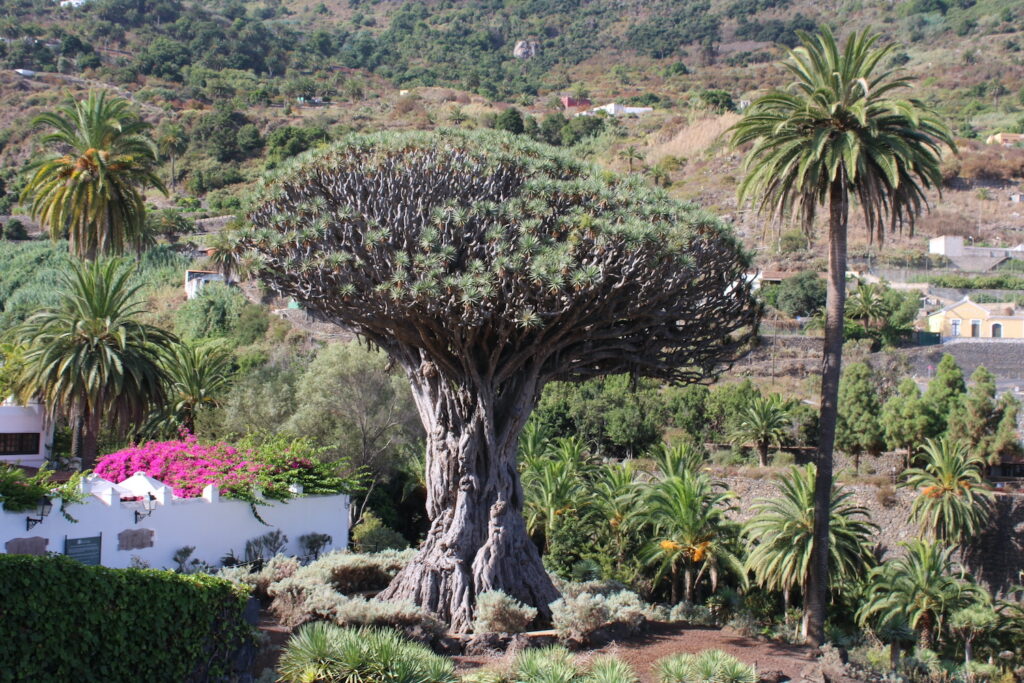
The tree’s age has been fiercely debated. The name implies a thousand years, and some 19th-century estimates ranged up to 6,000 years. A 1907 study by the Zurich Polytechnic School suggested 2,500 years. But modern analyses — handicapped by the absence of growth rings — converge on an estimate of 800–1,000 years. A lower bound of 350 years was proposed by Mägdefrau (1975), while other studies support approximately 1,000 years. It was declared a national monument in 1917, appeared on the 1,000-peseta banknote, and features on the coat of arms of Icod de los Vinos.
The Drago Milenario is not, however, the most famous dragon tree ever recorded. That distinction belongs to the colossus of Orotava, measured by Alexander von Humboldt in 1799 at 21 m tall and 14 m in circumference, with a hollow interior that the Guanches had used as a sanctuary. Humboldt declared it “one of the oldest inhabitants of our world.” It fell in a storm in 1867.
Dragon’s Blood: Two Thousand Years of Trade
The red resin that exudes from wounded bark and cut branches of Dracaena draco — traditionally called “dragon’s blood” (sanguis draconis) — is one of the oldest continuously traded natural products in human history. It should be distinguished from the chemically different “dragon’s blood” resins produced by Dracaena cinnabari (Socotra), Calamus rattan palms (Southeast Asia), and Croton spp. (South America).
Pre-colonial use. The Guanches of the Canary Islands used dragon’s blood extensively: for embalming the dead (mummification), as a wound-healing medicine, as a textile dye, as a varnish, and as a toothpaste. They held the tree sacred, believing that dead dragons transformed into dragon trees, and held assemblies and judicial proceedings under the canopy of monumental specimens.
European trade. From the 15th century onward, dragon’s blood entered the European pharmacopoeia as an astringent used to treat wounds, dysentery, diarrhea, and respiratory ailments. It appeared in John Gerard’s Herball (1633) and John Parkinson’s Theatrum Botanicum (1640). Commercial demand was intense: Béthencourt noted in 1402 that the resin exchanged for goods worth “two hundred ducats” while what was given in return was “hardly worth two francs.”
Violin varnish. Both Dracaena draco and Dracaena cinnabari resins were used in 18th-century Italy as a component of violin varnish. The claim that Antonio Stradivari used dragon’s blood in his varnish formula has become legendary, though the exact composition of Stradivarius varnish remains debated.
Modern uses. Dragon’s blood is still employed in photoengraving (to protect etching surfaces), as a pigment, as an incense resin, and in traditional medicine. Its commercial importance has declined sharply since the 19th century, replaced in most applications by synthetic alternatives.
Similar Species and Frequent Confusions
Dracaena cinnabari Balf.f. — Socotra Dragon Tree
The other “famous” dragon tree. Endemic to the island of Socotra (Yemen). Resembles Dracaena draco in its arborescent habit and red resin, but the two are not closely related: molecular phylogenetics places Dracaena cinnabari in an East African–Arabian clade that is sister to — not derived from — the Macaronesian clade. Dracaena cinnabari has a more distinctly mushroom-shaped canopy, and its resin was the “dragon’s blood” known to the ancient Greeks via the Incense Road.
Dracaena tamaranae Marrero, Almeida & González-Martín — Gran Canaria Dragon Tree
Smaller, shrub-like, with inflorescence and leaf morphology more similar to the East African species than to Dracaena draco. IUCN Critically Endangered. The two species are not closely related despite co-occurring in the same archipelago.
| Character | Dracaena draco | Dracaena cinnabari | Dracaena tamaranae |
|---|---|---|---|
| Range | Canaries, Madeira, Cape Verde, Morocco | Socotra (Yemen) | Gran Canaria only |
| Height | 10–15 m (max 20+) | 10–12 m | 6–8 m |
| Canopy shape | Hemispherical umbrella | Inverted mushroom | Irregular, sparse |
| Clade | Macaronesian (western) | East African–Arabian (eastern) | East African–Arabian (eastern) |
| IUCN | Vulnerable | Vulnerable | Critically Endangered |
Cultivation
| Parameter | Value |
|---|---|
| Hardiness | −3 to −7 °C (27 to 19 °F) / USDA zones 9b–11 |
| Light | Full sun preferred; tolerates partial shade when young |
| Soil | Extremely well-drained; volcanic, sandy, or rocky; tolerates poor, alkaline soils |
| Watering | Low to moderate; drought-tolerant once established; less water is better |
| Salt tolerance | Good (coastal planting possible) |
| Adult size | 10–15 m tall; 4–8 m canopy spread (centuries to reach full size) |
| Growth rate | Very slow (approximately 10 years to reach 1.2 m) |
| Difficulty | 2/5 |
Why Dracaena draco Is Easier Than It Looks
Despite its mythic status and its classification as IUCN Vulnerable, the Canary Islands dragon tree is paradoxically one of the easiest trees to grow in frost-free or near-frost-free Mediterranean climates. It is very adaptable: tolerant of poor soils, salt spray, full sun, heat, drought, and moderate neglect. It thrives in parks and gardens from southern California to coastal Australia, from the Algarve to the Côte d’Azur, from Sicily to Durban. The difficulty rating of 2/5 reflects the fact that the only truly critical requirement is avoiding prolonged frost below −5 °C and ensuring well-drained soil.
The challenge is not keeping it alive — it is patience. Growth is painfully slow. A decade to reach 1.2 m of trunk. Another decade or two before first flowering and the first branching event. The majestic umbrella canopy that visitors admire at Icod de los Vinos is the product of centuries, not decades. Most garden specimens will remain in the single-trunk, unbranched “juvenile column” phase for 15–20 years.
Cold Hardiness
Dracaena draco tolerates brief frosts to approximately −5 to −7 °C (23 to 19 °F) when mature and established in well-drained ground. However, tolerance varies significantly with provenance. Moroccan subsp. ajgal populations, which grow at 1,100–1,540 m in the Anti-Atlas where frost is regular, are likely the hardiest provenance — but this material is virtually unavailable in the horticultural trade. Young plants are significantly less cold-hardy than mature specimens. Prolonged frost, wet cold, or cold combined with waterlogging is rapidly fatal.
In the south of France (USDA zone 9a–9b), established specimens survive most winters along the coast from the Var to the Alpes-Maritimes. Inland or at altitude, protection is advisable.
Soil and Watering
Plant in very well-drained, mineral-rich soil — volcanic grit, pumice, coarse sand, or rocky garden soil. Dracaena draco is adapted to 200–500 mm annual rainfall in its native range; in garden conditions, once established, it requires little to no supplemental irrigation in Mediterranean climates. Overwatering and moisture-retentive substrates are the primary cultural killers. Remember the mantra: less water is better.
What to Know Before Buying
Availability. Dracaena draco is widely available in nurseries throughout Mediterranean climates, southern California, and Australia. It is sold as a container tree or (less commonly) as bare-root field-grown stock. Small plants (20–40 cm) are inexpensive. Large specimens with trunk development are rare and extremely expensive due to the very slow growth rate.
Space. Although a young plant occupies less than a square meter, a mature dragon tree is monumental. The canopy spread of an old specimen can reach 8+ m in diameter. Plant it with a long-term view — this is a tree for generations.
Legal status. Wild collection is prohibited throughout the species’ range. In the Canary Islands, Dracaena draco is a protected species. All commercial plants should be nursery-propagated from seed.
Subspecies identification. Nursery plants are almost invariably of Canarian provenance (subsp. draco). Moroccan (subsp. ajgal) and Cape Verdean (subsp. caboverdeana) material is rarely available in the trade. If you encounter unlabeled “dragon tree” seedlings, they are almost certainly subsp. draco.
See Dracaena draco seeds on Amazon.com
Propagation
Seed: The standard method. Fresh seeds germinate readily at 20–25 °C in 2–4 weeks. No stratification is required. Remove the fleshy fruit pulp before sowing. Seeds lose viability relatively quickly; sow within a few months of collection for best results. Use a mineral-rich, free-draining sowing mix (equal parts perlite and coco coir, or volcanic sand and peat).
Cuttings: Stem tip cuttings can root, but success rates are low and the method is rarely used for a species that produces abundant seed. Very large cuttings (branch sections) have been used occasionally for emergency propagation of exceptional specimens.
Transplanting: Dracaena draco is notoriously difficult to transplant once established. The root system is extensive, and large plants recover poorly from root disturbance. Plant in its permanent position as early as possible.
Pests and Diseases
Mealybugs and scale insects: The most common pests in cultivation. Mealybugs (especially Planococcus citri) colonize leaf bases and branch crotches. Scale insects form encrustations on old wood. Both are treatable with horticultural oil or systemic insecticides.
Root rot: Fatal in waterlogged or moisture-retentive substrates. Prevention — well-drained soil and restrained watering — is the only cure.
Fungal trunk rot: Old specimens (particularly the Drago Milenario) are vulnerable to internal fungal decay, especially where the trunk is hollow. Adequate air circulation is critical.
Agave snout weevil (Scyphophorus acupunctatus): Although primarily a pest of Agave and Yucca, this devastating weevil has a broad host range within the Agavoids and should be considered a potential threat, particularly in Mediterranean garden settings where agaves and dragon trees are grown together.
Landscape Use
Monumental specimen tree: The quintessential use. Dracaena draco is one of the most architecturally striking trees available for Mediterranean gardens. Even in its unbranched juvenile phase, the single silvery column topped by a dense rosette of sword-shaped leaves is a powerful design element. In maturity, it becomes a living monument.
Coastal plantings: The species’ salt tolerance makes it ideal for coastal Mediterranean or subtropical gardens. Its silhouette evokes the Macaronesian Atlantic islands.
Xeriscape and gravel gardens: Excellent companion for other Agavoids: Agave americana, Yucca aloifolia, Yucca rostrata, Dasylirion spp., Nolina spp., and Mediterranean natives like Chamaerops humilis, Olea europaea, and Euphorbia spp.
Container culture: Young dragon trees are excellent container plants for terraces and patios in climates where winter protection is necessary. Their slow growth rate means they remain manageable in pots for many years. Use a mineral-heavy substrate (pumice, lava grit, coarse sand) and water sparingly. Bring indoors or to a frost-free shelter before temperatures drop below −3 °C.
Frequently Asked Questions
How long does a dragon tree live?
The maximum lifespan is unknown and much debated. The Drago Milenario at Icod de los Vinos is estimated at 800–1,000 years. Early estimates of several thousand years for the Orotava specimen (destroyed in 1867) are now considered excessive. A realistic upper range is probably 600–1,000 years for exceptional specimens. In cultivation, a well-sited dragon tree can easily outlive its planter and their grandchildren.
Is there really dragon’s blood inside?
Yes. If you cut or wound the bark or branches, a bright red resin oozes slowly from the wound. The compound is a mixture of flavonoids and terpenoids unique to the dragon tree group. In commerce, “dragon’s blood” from Dracaena draco is increasingly rare and expensive; most modern dragon’s blood is sourced from Southeast Asian rattan palms (Calamus spp.).
Can I grow it in southern France?
Yes — along the Mediterranean coast, especially in the Var, Alpes-Maritimes, and Corsica (USDA zones 9a–10a). Mature specimens survive most winters without protection. Young plants (under 1 m of trunk) should be protected during cold spells below −3 °C. Well-drained soil is essential; clay soils are unsuitable. Inland sites at altitude are risky.
Are the Azorean dragon trees native?
Probably not. The most likely scenario is a Portuguese introduction before 1500, with seeds sourced from both Madeira and Cape Verde. Some Azorean individuals show morphological similarities with the Cape Verdean subspecies (caboverdeana), consistent with a Cape Verdean seed source. No fossil record of Dracaena exists in the Azores. However, the question remains formally unresolved, and the Azorean populations — now 200–300 individuals, some over a century old — are of significant conservation and genetic interest regardless of their origin.
Is the dragon tree a real tree?
Botanically, no — it is a monocotyledon, more closely related to asparagus and lily-of-the-valley than to any true tree. It achieves tree stature through anomalous secondary growth, a process fundamentally different from the wood production of oaks, pines, or any dicot or gymnosperm. It has no annual growth rings, no true bark, no true wood in the conventional sense. And yet it can reach 20 m, weigh 140 tonnes, and live for centuries. It is one of the most remarkable examples of convergent evolution toward the tree form in the plant kingdom.
Reference Databases and Online Resources
- POWO — Dracaena draco
- IUCN Red List — Dracaena draco
- iNaturalist — Dracaena draco
- Plant Humanities Lab — Dracaena draco: The Mystery of Dragon’s Blood
Bibliography
- Benabid, A. & Cuzin, F. (1997). Dragon tree (Dracaena draco subsp. ajgal) populations in Morocco: Taxonomical, biogeographical and phytosociological values. Comptes Rendus de l’Académie des Sciences, Série III, 320(3): 267–277.
- García-Verdugo, C. et al. (2019). Pleistocene diversification, phylogeographic structure, and the human influence on the range of Macaronesian dragon trees. Perspectives in Plant Ecology, Evolution and Systematics, 39: 125462.
- García-Verdugo, C. et al. (2020). Iconic, threatened, but largely unknown: Biogeography of the Macaronesian dragon trees (Dracaena spp.) as inferred from plastid DNA markers. Taxon, 69(2): 217–233.
- Jura-Morawiec, J. (2017). Atypical origin, structure and arrangement of secondary tracheary elements in the stem of the monocotyledonous dragon tree, Dracaena draco. Planta, 246(3): 489–499.
- Jura-Morawiec, J. et al. (2022). Theoretical considerations regarding the functional anatomical traits of primary and secondary xylem in dragon tree trunk using the example of Dracaena draco. Trees, 36: 1679–1692.
- Linnaeus, C. (1767). Systema Naturae, ed. 12, 2: 246.
- Maděra, P. et al. (2020). What We Know and What We Do Not Know about Dragon Trees? Forests, 11(2): 236.
- Marrero Rodríguez, Á. & Almeida Pérez, R.S. (2012). A new subspecies, Dracaena draco (L.) L. subsp. caboverdeana Marrero Rodr. & R.S. Almeida (Dracaenaceae) from Cape Verde Islands. International Journal of Geobotanical Research, 2: 35–40.
- Marrero Rodríguez, Á., Almeida Pérez, R.S. & González-Martín, M. (1998). A new species of the wild dragon tree, Dracaena (Dracaenaceae) from Gran Canaria and its taxonomic and biogeographic implications. Botanical Journal of the Linnean Society, 128(3): 291–314.
- Rivas-Martínez, S. et al. (2017). Global Bioclimatics — Dracaena ajgal and Dracaena caboverdeana species-level treatments.