It is rare for a plant to give its name to a landscape. Yet that is the case with Euphorbia caerulescens, the blue euphorbia of the Eastern Cape, known locally as noors, which covers such vast areas around Jansenville that the whole region is called the Noorsveld, the “noors veld”. In the genus Euphorbia, where cactus-like species often look so alike that they discourage the beginner, this one is recognised by its colour: stems of a clear grey-blue, standing in dense colonies and bristling with paired spines. Behind the ornamental plant lies an unusual agricultural story, that of a caustic-latex euphorbia that became the emergency fodder of an entire stock-farming region.
How to recognise Euphorbia caerulescens
It is a succulent, cactus-like shrublet 0.5 to 1.5 m tall with an irregular habit, forming broad clumps through underground suckering: the plant spreads by rhizomes and eventually covers an area at least equal to its height, often much more.
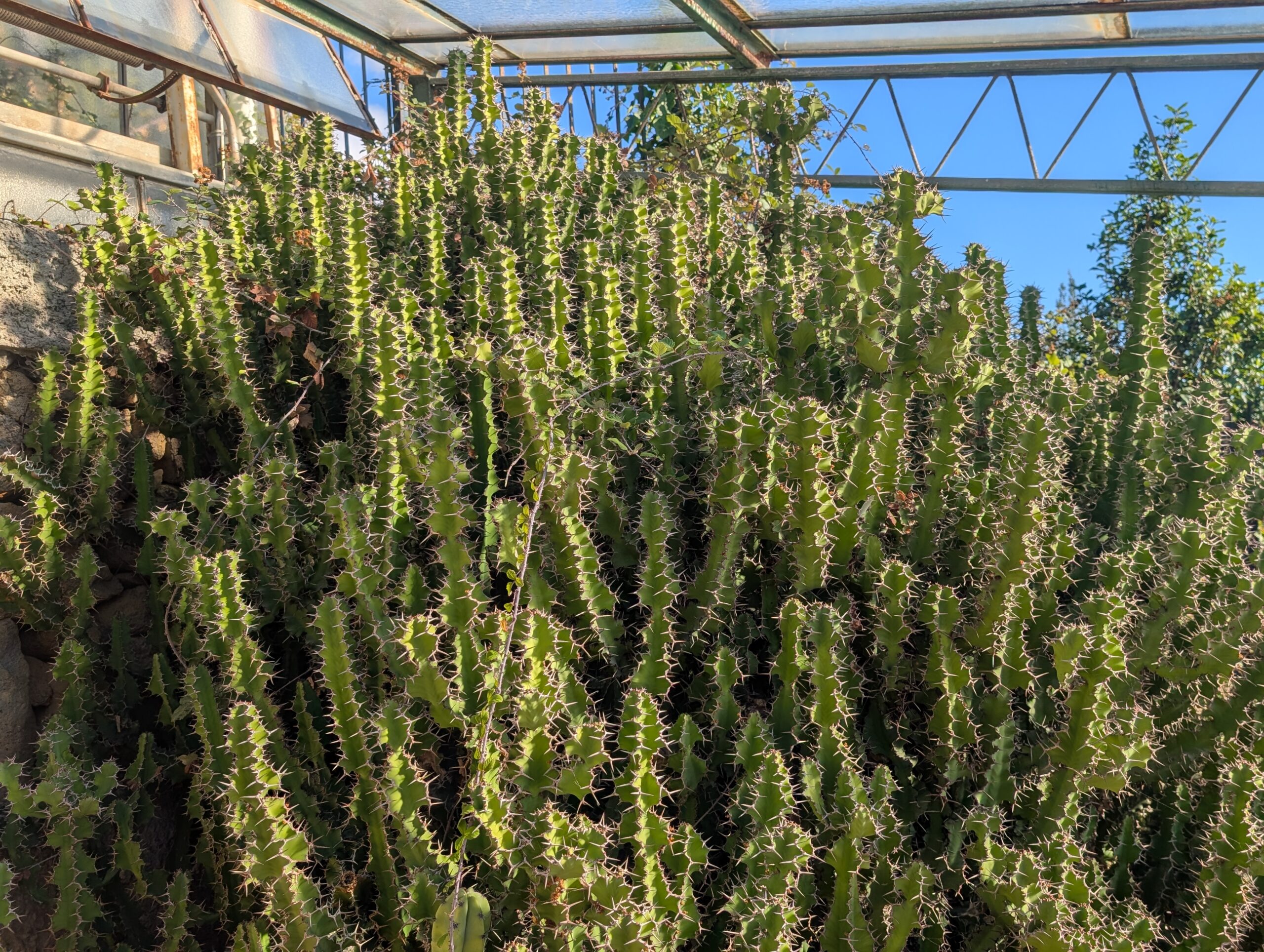
The stems are erect, rarely branching again, up to 5 cm thick, with four to six angles, and above all constricted at regular intervals every 4 to 8 cm, which divides them into clearly marked segments. Colour is the most immediate character: a deep grey-blue, sometimes shading to green or yellowish green depending on exposure and on the origin of the clone. With age the base of the stems turns pale grey and rough.
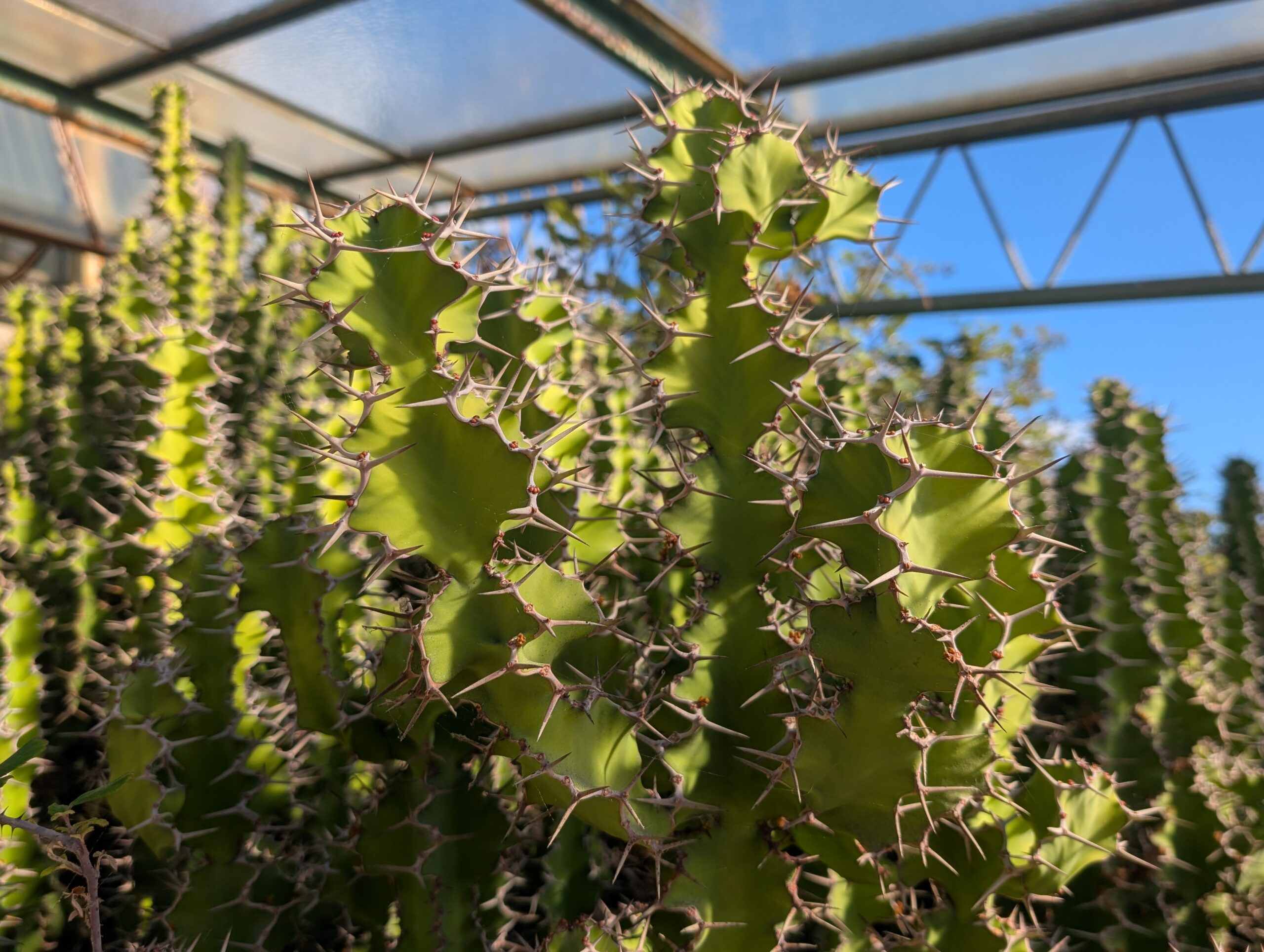
The spines are paired, borne on the ridges of the ribs, a little over 1 cm long and variable in colour from white to dark brown.
The leaves are tiny and short-lived, present only on young shoots. The yellow cyathia appear at the tips of the stems in spring and summer; they are small, about 5 mm across. The fruit is a three-lobed capsule, pinkish to reddish.
As in all euphorbias, the slightest wound releases an abundant white latex that irritates the skin and is dangerous to the eyes.
Hybrids and cultivars
No hybrid is recorded for this species, and no cultivar is recognised. Plants in the trade are wild forms propagated vegetatively, which explains the variation in colour from one plant to another: not all the clones in circulation are equally blue.
As in many cactus-like euphorbias, crested forms are met with in collections; they result from a growth anomaly, not from hybridisation.
Confusion with other species
The most consequential confusion is historical. Berger proposed in 1907 to treat Euphorbia caerulescens as a mere variety of Euphorbia virosa, and the name Euphorbia virosa still appears on that basis among the synonyms listed by the South African Red List for this species. The two plants are now clearly separated, and the safest criterion is geographical: Euphorbia virosa occurs in Namibia, southern Angola and the north-west Cape, whereas Euphorbia caerulescens is confined to the south of the Eastern Cape and the east of the Western Cape. Their ranges do not overlap.
Euphorbia avasmontana raises a similar problem. It is larger, reaching 2 to 2.5 m, with stems 6 to 7 cm in diameter and much wider constrictions, 10 to 15 cm apart against 4 to 8 cm in Euphorbia caerulescens. Here too the range differs: Namaqualand, Bushmanland and Namibia.
Euphorbia ledienii deserves a special mention, because the name still circulates in the trade and in older collections. It is not a distinct species: POWO treats it, together with its variety dregei, as a synonym of Euphorbia caerulescens. A plant labelled Euphorbia ledienii is therefore, in principle, a blue euphorbia of the Noorsveld.
Finally, in the Noorsveld itself the vernacular name noors does not refer only to this species: it is applied to several local euphorbias, including Euphorbia ferox and Euphorbia horrida, which are very different, forming low clumps of short, globular, densely spiny stems. A popular text speaking of “noors” without naming the species should therefore be read with caution.
Taxonomy
Euphorbia caerulescens was described by Adrian Hardy Haworth in 1827, in the periodical that POWO cites as Philos. Mag. Ann. Chem., n.s., 1: 276. The spelling coerulescens, very common in the trade and in older horticultural literature, is a graphic variant of the same name; POWO retains caerulescens. The epithet, from the Latin caerulescens, refers to the bluish tint of the stems.
POWO accepts the name and records only two synonyms, both heterotypic: Euphorbia ledienii A.Berger, published in 1907 in Sukkulente Euphorbien, and Euphorbia ledienii var. dregei N.E.Br., published in 1915 in the Flora Capensis.
The current treatment rests on Bruyns’ work on the nomenclature and typification of southern African euphorbias, then on his 2022 monograph, as well as on the field guide by Möller and Becker.
The Afrikaans vernacular names are numerous and instructive: noors, noorsdoring, noorspol, vaalnoors, but also soetnoorsdoring and suurnoors, literally sweet noors and sour noors, a distinction that refers directly to palatability for livestock. The term noorsheuning, noors honey, also indicates that the plant is a local source of nectar. In English the names blue euphorbia and sweet noors are found.
In the wild
The species is endemic to South Africa, where it occupies a belt from Calitzdorp to Klipplaat and Jansenville, straddling the Eastern Cape and the east of the Western Cape. POWO also records an introduction in French Guiana, a curiosity that testifies to its spread through horticulture.
It grows on stony karroid slopes and plateaux, mainly on rocky outcrops and north-facing slopes, more occasionally on hilltops. It belongs to the great Nama Karoo and Succulent Karoo vegetation units. In these habitats it is accompanied by a rich suite of succulents, while grasses are scarce.
Its most remarkable ecological trait is its dominance. Over vast areas it is the dominant or co-dominant species of a vegetation that covers practically the whole landscape, forming stands of impressive density. This physiognomy gave the region its name, Noorsveld. The plant also acts as a nurse plant: its spiny clumps shelter grasses and seedlings from livestock.
In conservation terms, the South African national Red List classes it as Least Concern, the assessment holding that it is widespread and at no risk of extinction. Like all succulent euphorbias, however, it is listed in CITES Appendix II, which regulates its international trade.
Outdoor and in-ground cultivation
This is an easy, robust species that establishes quickly, which makes it one of the most recommendable cactus-like euphorbias for a dry Mediterranean-climate garden or an outdoor collection.
Full sun is needed for the blue colouring to develop; in shade the stems turn green and etiolate. As always in the genus, the move from shade to full sun must be gradual to avoid burns, which are permanent on the stems.
The soil must be frankly well drained, essentially mineral, along the lines of cactus mixes. The plant is not demanding about the chemical nature of the soil. Watering is spaced out during growth, allowing the substrate to dry out completely, and suspended in winter.
One management point should be anticipated: suckering. In the ground the species spreads by rhizomes and forms colonies that gradually gain ground. This is an asset for building a mass or a low defensive hedge, a drawback in a collector’s rockery where each plant is meant to stay in its place.
Because the plant is spiny, irritant and destined to widen, its position should be chosen away from narrow paths. Gloves, glasses and long sleeves are essential for any intervention.
Container cultivation
In a pot, choose a wide container rather than a deep one, and plan on regular division, since the rhizomes quickly fill the available space. The substrate is the same mineral, free-draining mix; watering is limited to the growing season, with the compost left to dry between waterings.
A bright, dry, frost-free winter position is best. Plants that spent the winter under cover should be brought back into full sun gradually in spring.
Propagation
There are three routes, all effective.
Division of suckers is the simplest and most natural with this species: rooted offsets arising from the rhizomes separate easily at the start of the growing season and establish without difficulty.
Stem cuttings also work. Take a segment or a whole stem, rinse the cut with water to stop the latex flow, leave it to callus in a dry, shaded place for one to two weeks, then plant in a dry, very free-draining substrate, waiting for roots to appear before watering again.
Sowing is possible but little practised, vegetative propagation being both faster and more reliable.
In every case, the abundant latex and the spines call for thick gloves and eye protection, and a tool disinfected with alcohol before and after the operation.
Pests and diseases
The species is little troubled by pests. Mealybugs, root mealybugs included, remain the main problem under cover; detecting them is complicated by the deep grooves between the ribs.
Basal rots almost always result from excess water or a poorly drained substrate, particularly during the cold season. Once established, they require the clone to be saved by taking cuttings from healthy parts.
Brown, corky marks on the stems come from sunburn, mechanical knocks or splashes of hard water. They are irreversible but harmless to the plant.
Hardiness
Euphorbia caerulescens is among the more cold-tolerant cactus-like euphorbias, without being hardy in the strict sense.
Horticultural databases place it in USDA zone 10a, a limit of around −1 °C, while other compilations taken up by French-speaking growers give a somewhat lower threshold, of the order of −4 °C. The gap corresponds to the difference between a safety value, chosen so that the plant stays unmarked, and a survival limit observed during brief episodes.
Exchanges between growers on the French-language forum Au Cactus Francophone add a decisive nuance. A grower in Marseille reports keeping almost all his euphorbias outdoors all year on a south-facing balcony without damage, while the consensus of the thread remains clear for rainy, poorly sunlit regions that are cold by day for several months: it is better to overwinter everything frost-free. It is also pointed out that a plant that survives a frost may keep irreversible spots and scars, which on so graphic a plant is real damage.
In practice, on Mediterranean coasts, planting in the ground is feasible in a sheltered, perfectly drained position with protection from winter rain. Elsewhere, pot cultivation with bright, dry, frost-free overwintering remains the sensible solution. Here again, it is the combination of cold, damp and low light that kills, more than minimum temperature alone.
Traditional uses
Use as fodder is what makes this species unique, and it deserves precise description.
The fresh latex is caustic and livestock do not browse the plant spontaneously. But when the stems are cut into lengths and left to wilt for a few days, the latex dries, the burning taste fades and the plant becomes edible. Farmers in the Noorsveld have long exploited this mechanism: in drought they top the clumps, chop the stems and feed the result to sheep and Angora goats, on which the region’s mohair production depends.
The effect on carrying capacity is considerable. Local sources claim that Noorsveld farms support three to four times more animals than neighbouring karroid areas without noors. This figure comes from regional documentation and not from a published scientific study, and should be taken as an order of magnitude; it remains true that the presence of this euphorbia structures the whole local pastoral economy. The vernacular distinction between soetnoors and suurnoors, sweet and sour noors, also reflects a fine empirical judgement of how palatable the different euphorbias of the area are.
The name noorsheuning, noors honey, attests to local honey production. Caution is called for on this point: in several succulent euphorbias of southern Africa, honey from their nectar is described as causing a burning sensation and as unfit for consumption; no reliable source consulted establishes that honey from Euphorbia caerulescens is in that case or, on the contrary, safe to eat without reservation.
Finally, none of this makes the plant harmless. The fresh latex remains irritant to the skin, dangerous to the eyes and toxic if swallowed. Prior wilting is a stock-farmer’s practice suited to livestock, in no way a detoxification method to be copied.
FAQ
What is the difference between Euphorbia caerulescens and Euphorbia coerulescens? None: it is the same name with a spelling variant. POWO retains caerulescens, while coerulescens remains very common in the trade.
I bought an Euphorbia ledienii. What is it? An Euphorbia caerulescens. This name, published by Berger in 1907, is now treated as a synonym.
Can it be planted in the ground in a Mediterranean climate? Yes, in a sheltered, full-sun position on a very well-drained substrate, bearing in mind that it is at the limit of its hardiness and fears winter damp more than cold itself. Allow also for its spread by rhizomes.
Why are my stems not blue? Most often a lack of light, but also clonal variation: not all are equally blue, some staying green or yellowish green.
Is it really edible for livestock? After the cut stems have wilted, yes, and it is an established farming practice in the Noorsveld. That is no reason to handle the fresh latex carelessly, nor to try the experiment on other animals.
Is it threatened? No. The South African national Red List classes it as Least Concern. Its international trade is nonetheless governed by CITES Appendix II, like that of all succulent euphorbias.
Reference sites
Plants of the World Online (Kew) — https://powo.science.kew.org/taxon/urn:lsid:ipni.org:names:345889-1 Nomenclatural authority followed here: accepted name, Haworth’s protologue, two synonyms and distribution, including the introduction in French Guiana.
Red List of South African Plants (SANBI) — https://redlist.sanbi.org/species.php?species=574-62 National conservation assessment, Least Concern status, precise range and habitat. Also records the old synonymy with Euphorbia virosa, a trace of the historical confusion between the two species.
Cactus Art — https://www.cactus-art.biz/schede/EUPHORBIA/Euphorbia_coerulescens/Euphorbia_coerulescens/Euphorbia_coerulescens.htm Detailed collector’s page, source of the habitat data, of the species’ dominance in the landscape and of the description of wilting stems for livestock feed.
World of Succulents — https://worldofsucculents.com/euphorbia-caerulescens-blue-euphorbia/ Source of the stem, spine and cyathium measurements used here, and of the stated hardiness figures. A well-kept amateur site, to be treated as a horticultural rather than a botanical source.
Garden Explorer, Stellenbosch University Botanical Garden — https://sun.gardenexplorer.org/taxon-2064.aspx List of Afrikaans vernacular names, including the distinction between sweet and sour noors, with a reminder of the conservation status and of fodder use after drying.
Daily Maverick, report on Jansenville — https://www.dailymaverick.co.za/article/2023-03-22-this-is-mohair-country-home-of-the-beautiful-angora-goat/ South African press report on the Jansenville area, source of the link between noors, Angora goat farming and the mohair industry, and of the nurse-plant role for grasses. A journalistic source: the text also states that the species grows only around Jansenville, which the published distribution contradicts.
Au Cactus Francophone forum — https://www.cactuspro.com/forum/read.php?1,826979 Thread on overwintering euphorbias; feedback from French growers on temperature thresholds, including a Marseille report of permanent outdoor cultivation, useful for placing real hardiness according to climate.
Bibliography
Haworth A. H. (1827). Philosophical Magazine and Annals of Chemistry, n.s., 1: 276. [Protologue of the species, retained as the valid publication reference by POWO.]
Berger A. (1907). Sukkulente Euphorbien: 80. [Publication of Euphorbia ledienii, now a synonym; this work is also where Berger proposed attaching the species to Euphorbia virosa.]
Brown N. E. (1915). Flora Capensis 5(2): 366. [Publication of Euphorbia ledienii var. dregei, the second synonym retained by POWO.]
Bruyns P. V. (2012). Nomenclature and typification of southern African species of Euphorbia. Bothalia 42: 217-245. [Reference nomenclatural revision for southern African euphorbias, followed by POWO for the acceptance of the name.]
Bruyns P. V. (2022). Euphorbia in Southern Africa, volume 2: 475-985. Springer. [Recent monograph of the group, basis of the current taxonomic treatment.]
Möller A. & Becker R. (2019). Field guide to the succulent Euphorbias of Southern Africa. Briza. [Modern field guide, useful for telling the southern African columnar species apart.]
von Staden L. Euphorbia caerulescens Haw. National Assessment: Red List of South African Plants, SANBI. [National assessment concluding Least Concern status: a widespread species at no risk of extinction.]