Dioon angustifolium is a cycad from north-eastern Mexico, endemic to a few rocky canyons of the Sierra Madre Oriental in the states of Nuevo León and Tamaulipas. This species of the genus Dioon was described by Miquel in 1847, then long treated as a variety of Dioon edule, under the name Dioon edule var. angustifolium, before being recognised again as a species in 2003. It is a low plant with a short trunk and leaves set with very narrow, flat, widely spaced leaflets, whose axis tends to twist. Listed as Vulnerable by the IUCN, it is rare in cultivation, and many plants sold under this name in Europe are in fact Dioon edule.
Key facts about Dioon angustifolium
- Accepted name: Dioon angustifolium Miq. (1847), accepted by The World List of Cycads (version 2026.08.15), GBIF and Species+, and by Kew’s World Checklist of Vascular Plants, the database behind POWO (June 2026 version, published on GBIF)
- Former names and synonyms: Dioon edule f. angustifolium (Miq.) Miq. (1861), Dioon edule var. angustifolium (Miq.) Miq. (1868), Dioon edule subsp. angustifolium (Miq.) A.E.Murray (1983); Dioon aculeatum Lem. (1846)
- Family: Zamiaceae, order Cycadales
- Common names: no English name is attested; chamal in Nuevo León and Tamaulipas (NOM-059-SEMARNAT-2010)
- Natural range: Mexico, Nuevo León and Tamaulipas; known populations between about 500 and 1,300 m (1,600 to 4,300 ft)
- IUCN status: Vulnerable (VU A2cd+4cd), assessment by J. Chemnick and T. Gregory dated July 2020 and published in 2022
- CITES and other protection: CITES Appendix II (annotation #4); Annex B in the European Union; “in danger of extinction” (category P) in Mexico under the standard NOM-059-SEMARNAT-2010
- Documented hardiness: in France, a young plant in the ground lost at −12 °C (10.4 °F) under passive protection (Paris suburbs, winter 2008–2009); plants in the ground without protection through a mild winter on the Côte Bleue near Marseille (2014–2015); nurseries estimate it at roughly −5 to −8 °C (23 to 17.6 °F) (see Cold hardiness)
- Light and soil: full, hot sun (Jungle Music); in the wild, thin, rocky canyon soils
- Habit and adult size: a low plant; in the wild, trunk 17 cm (6.7 in) across on average (up to 34 cm) and leaves 63 cm long on average (up to about 1 m), according to measurements published in 2020
- In the UK, US and Australia: Montgomery Botanical Center (Florida, three accessions, one from 2014) and the Fairchild Tropical Botanic Garden (Miami); declared to BGCI by Birmingham Botanical Gardens, about fifteen American gardens and two Australian ones (Brisbane, Cairns)
- Toxicity: no analysis for the species; to be treated as toxic, like all cycads (see Toxicity and precautions)
How to recognise Dioon angustifolium
Dioon angustifolium is recognised by its very narrow leaflets, less than 6 mm wide, flat, with entire margins in adult plants and clearly spaced along the axis, and by its leaves, whose tip tends to twist. The key of Gregory, Haynes and Chemnick (2008) separates it from Dioon edule by this width alone: under 6 mm in Dioon angustifolium, over 7 mm in Dioon edule, whose leaflets may also have strongly rolled margins.
Miquel described the species in 1847 from a plant in the Amsterdam botanic garden, which he compared directly with plants of Dioon edule:
- Trunk: oblong, 37 cm tall and 14 to 15 cm across in the plant described, more elongated than that of Dioon edule, with smaller leaf scars; apex covered in scales and greyish-brown down.
- Leaves: shorter than in Dioon edule, with a very short petiole (5 to 6 cm); axis 80 to 85 cm long, hairy at the base and then smooth.
- Leaflets: opposite or alternate, linear-lanceolate, sharp-tipped, sometimes slightly wavy or gently curved, dark green above and paler beneath, with about eight veins; those in the middle of the leaf 8 cm long and 5 to 6 mm wide.
- Young plants: even narrower leaflets, carrying a few spines towards the tip, which disappear with age.
In the wild the plants stay small. Rubio-Méndez and colleagues (2020), who measured three populations, give an average trunk 17 cm across (up to 34 cm) and 21 cm tall (up to 55 cm), about twenty leaves, some eight per flush, averaging 63 cm in length (up to 103 cm): the slimmest trunks and the shortest leaves of all the forms of the complex they studied. The Californian nursery Jungle Music describes a plant with a single trunk or several stems, with a crown about four feet (1.2 m) across, and notes that a caudex of 12 to 18 inches (30 to 45 cm) already indicates a very old plant.
Hybrids
No natural or garden hybrid of Dioon angustifolium has been described. In San Luis Potosí, between the ranges of Dioon angustifolium and Dioon edule, Rubio-Méndez and colleagues (2020) found populations with intermediate characters, which they place in Dioon edule (the “rioverde” and “tamasopo” forms); almost 40% of the plants they measured in the populations of angustifolium shared characters with the “tamasopo” form.
Possible confusion
With Dioon edule
This is by far the most frequent confusion, and on a young plant of unknown origin it often cannot be settled. According to Jones (1993), quoted by The Gymnosperm Database, the leaflets of Dioon angustifolium measure 6 to 11 cm by 4 to 6 mm, against 6 to 10 mm wide in Dioon edule; they are glaucous on young leaves and set on the axis at an acute angle, and the seeds are smaller. The specialist nursery Cycadales.eu, which compares plants of known origin grown at Nong Nooch Tropical Garden in Thailand, adds that the axis of Dioon angustifolium tends to twist, giving the adult plant a more “tousled” look than Dioon edule, with its straight leaves. It reports that many plants sold in Europe as angustifolium, notably those of one Spanish grower, are really Dioon edule, and that only a precise geographical origin makes a plant’s identity certain. The two species do not meet in the wild (González-Astorga et al., 2005).
With Dioon sonorense
Dioon sonorense, from north-western Mexico, also has narrow, glaucous leaflets. Its leaflets are slightly curved and often carry one to three small spines, whereas those of Dioon angustifolium are flat and entire in adult plants. The two species grow on opposite sides of the country and belong to different lineages of the genus.
Taxonomy
Dioon angustifolium was described in 1847 by the Dutch botanist Friedrich Anton Wilhelm Miquel, in the first volume of the Tijdschrift voor de Wis- en Natuurkundige Wetenschappen of the Royal Netherlands Institute, from a plant of Mexican origin grown in the Amsterdam botanic garden; the lectotype, designated by De Luca and colleagues in 1982, is kept at Kew (The World List of Cycads). Miquel admitted that the plant was so close to Dioon edule that he would not have dared to separate it had he not been able to compare the two side by side. In the same article he placed the Dioon aculeatum of Belgian nurserymen among the young plants of the species; The World List of Cycads gives Dioon aculeatum Lem. (1846) as a synonym.
Its classification went through several stages:
- 1847: description as a species, Dioon angustifolium, by Miquel.
- 1855: Lemaire places it in the synonymy of Dioon edule (according to González-Astorga et al., 2005).
- 1861 and 1868: Miquel himself turns it into a form, then a variety of Dioon edule.
- 1982: De Luca, Sabato and Vázquez Torres, studying the distribution and variation of Dioon edule, treat it as a variety.
- 1983: Murray makes it a subspecies, Dioon edule subsp. angustifolium.
- 2003: González-Astorga, Vovides, Ferrer and Iglesias, after a genetic study of eight populations covering the whole range of Dioon edule (Biological Journal of the Linnean Society) and a morphological study published the same year, recognise Dioon angustifolium as a species for the isolated northernmost populations.
- 2005: a genetic study of the three populations then known confirms this choice (González-Astorga et al., Annals of Botany).
Since then the species has been accepted by The World List of Cycads, by the revision of the genus published in 2020 by Hernández-Tapia, Jiménez-Ramírez and Vovides, by the IUCN Red List and by the Mexican standard NOM-059-SEMARNAT-2010, which lists it separately from Dioon edule while citing Dioon edule var. angustifolium as a synonym. Kew’s World Checklist of Vascular Plants also accepts it, with the 1861, 1868 and 1983 combinations as synonyms. The varietal name therefore now refers only to an earlier stage of the classification. Genetic studies trace the origin of the species to the isolation of the northern populations of Dioon edule during the climatic cycles of the Pleistocene (González-Astorga et al., 2003, 2005). For the reader, a plant labelled “Dioon edule var. angustifolium” or “Dioon edule angustifolium” is Dioon angustifolium, provided its identity is correct.
Etymology and history
The epithet angustifolium comes from the Latin angustus, “narrow”, and folium, “leaf”, referring to the narrow leaflets of the juvenile leaves (The World List of Cycads, after Haynes, 2022). The generic name comes from the Greek dis, “two”, and ōon, “egg”, for the two seeds on each scale of the female cone; it was in the very article of 1847 describing Dioon angustifolium that Miquel announced he would henceforth write Dioon, rather than Lindley’s Dion, a spelling he considered more correct.
The species thus entered science through cultivation: in 1847 the type plant was growing in the Amsterdam botanic garden, alongside plants of Dioon edule of various ages. Its seeds also have a very long human history. According to the archaeological table published by Bonta and colleagues (2019), based on MacNeish’s excavations in the rock shelters of Tamaulipas, remains of Dioon, attributed to Dioon angustifolium, make up about 41% of the food remains found in the Cueva de la Perra for the period 3000 to 2200 BC; remains of the species (leaf bases, cone scales, seeds) were also found in the Ojo de Agua cave (about AD 260–960) and in Romero’s cave (about AD 1100–1500).
Common names
No English common name is attested. The Mexican standard NOM-059-SEMARNAT-2010 gives chamal for Nuevo León and Tamaulipas; the same name is used for Dioon edule, and Bonta and colleagues (2019) apply “chamal” to both of these very similar species in north-eastern Mexico. Species+ gives no common name. Trade names such as “Dioon edule angustifolium” are not common names but former botanical names.
In the wild
Dioon angustifolium grows at the northern end of the genus’s range in eastern Mexico, in the Sierra Madre Oriental of Nuevo León and in central Tamaulipas; its populations are isolated from those of Dioon edule, further south (González-Astorga et al., 2005). In 2005, González-Astorga and colleagues knew only three populations, each covering about a hectare:
- San Carlos (Tamaulipas), at about 524 m: some 150 adult plants, in thorn scrub with oaks.
- Álamos (Nuevo León), at about 560 m: some 50 adults scattered along a valley, in remnants of pine and oak forest, with about twenty seedlings.
- Iturbide-Linares (Nuevo León), at about 815 m: some 100 adults in oak woodland.
Rubio-Méndez and colleagues (2020) measured three populations, at 570 and 800 m in Nuevo León and at 1,314 m in Tamaulipas. They describe plants confined to rocky canyons, at the transition between piedmont scrub and tropical dry forest or oak woodland, on very thin soils (lithosols less than 15 cm deep), clayey and close to pH 7.5. The “angustifolium” form of Whitelock (2004), which they cite, occupies 450 to 1,075 m, and Jones (1993) gave 200 to 1,500 m for these populations, which he treated as a variety (The Gymnosperm Database).
Little is known of its biology. No pollination study has been made, but weevils have been found in open male cones, which suggests insect pollination as in other cycads; in Dioon, the seeds fall mostly at the foot of the parent plant (González-Astorga et al., 2005). The gene flow measured between the three populations is low, comparable to that of species with gravity-dispersed seeds, and the study detected a recent genetic bottleneck, without a large loss of diversity.
Conservation status and regulation
Dioon angustifolium is listed as Vulnerable (VU) on the IUCN Red List under criteria A2cd+4cd: a population reduction of at least 30% over three generations, past and continuing, linked to habitat degradation and exploitation. The assessment, by J. Chemnick and T. Gregory, is dated 2 July 2020 and was published in 2022 (The World List of Cycads, GBIF and Crossref); an earlier assessment had been published in 2010. González-Astorga and colleagues (2005) name habitat destruction and the removal of cycads by ranchers, because they poison livestock, as the main threats.
Like the whole genus since 4 February 1977, the species is listed in CITES Appendix II, with annotation #4 in the version adopted at CoP20, in force since 5 March 2026, which exempts seeds and pollen in particular; international trade in live plants requires a permit. In the European Union it falls under Annex B of Regulation (EC) No 338/97, whose annexes are now set by Regulation (EU) 2026/1383, applicable since 29 June 2026. In Mexico, the standard NOM-059-SEMARNAT-2010 lists it as “in danger of extinction” (category P), according to the text published in the Diario Oficial de la Federación.
Databases checked on 26 October 2026 (Species+, GBIF, The World List of Cycads, Crossref). This information does not replace the official texts: check the regulations in force before any purchase, and prefer seed-grown plants of known origin.
Growing Dioon angustifolium
Dioon angustifolium is grown like Dioon edule: full sun, summer heat and a very free-draining soil. The published advice comes from nurseries:
- Jungle Music (California) recommends full, hot sun and considers it a good sun-loving cycad for colder climates and for small gardens, since it stays low.
- Cycadales.eu describes it as easy to grow “as long as it is given warmth and water in summer”, preferably with a slow-release fertiliser and protection from cold, and notes very slow growth and high drought tolerance.
Outdoor and in-ground cultivation
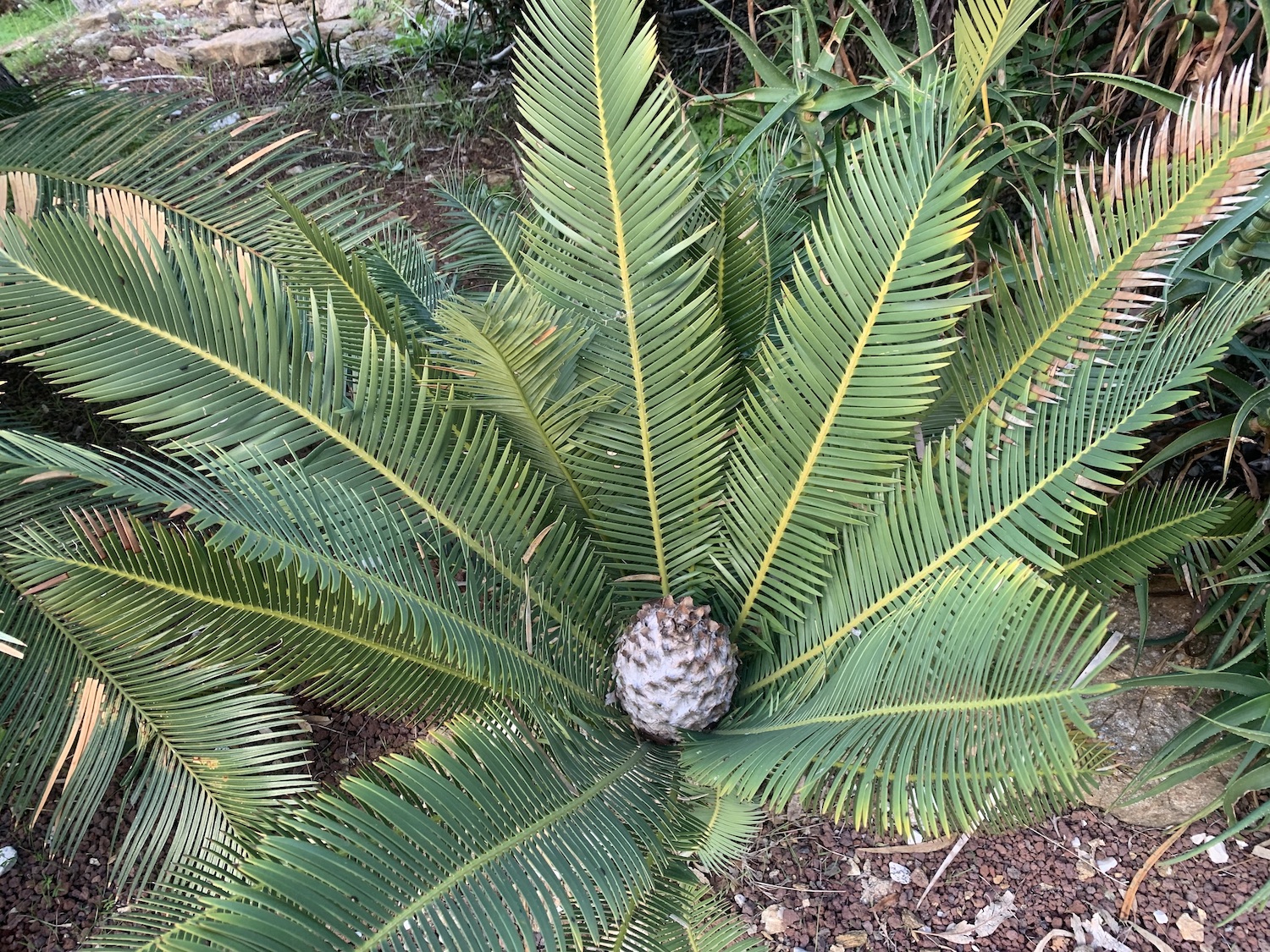
In the wild it grows on very thin, rocky canyon soils (Rubio-Méndez et al., 2020): a mineral, well-drained soil with no standing water in winter follows the same logic. Plant it in the sunniest, best-drained position available, ideally on a slope or a raised bed. A plant grown at La Londe-les-Maures, in the Var (southern France), illustrates this page (photo published on the site in December 2022); no cold or growth data have been published for it.
Container cultivation
Its small size makes it one of the easiest Dioon to keep in a pot for many years. Use a very open, mostly mineral mix, water freely in summer and keep it almost dry in winter, and bring it into a frost-free, bright place wherever winters are cold or wet. This is general advice for the genus, consistent with the nurseries’ recommendations; no trial specific to the species has been published.
In cultivation in the UK, US and Australia
- United Kingdom: Birmingham Botanical Gardens declares the species to BGCI PlantSearch; no planting in the open ground is documented in Britain.
- United States: the Montgomery Botanical Center (Coral Gables, Florida) lists three accessions in its online catalogue, one of them from 2014 (accession 20140656); the Fairchild Tropical Botanic Garden (Miami) lists the species in its online catalogue, and a plant labelled Dioon edule var. angustifolium was photographed there in 2007 (Wikimedia Commons). BGCI PlantSearch also lists the Huntington, Lotusland, San Diego Botanic Garden, the San Diego Zoo, the Missouri Botanical Garden, Naples Botanical Garden, UC Berkeley, the United States Botanic Garden, the Chicago Botanic Garden and the Houston Botanic Garden among others. A BGCI listing is a declaration by the garden, not proof that the plant is alive today.
- Australia: Brisbane Botanic Gardens Mount Coot-tha and the Cairns Botanic Gardens declare the species to BGCI.
Propagation
Dioon angustifolium is propagated from seed; Jungle Music also describes plants that form offsets at the base. Like all cycads it is dioecious: a male and a female plant are needed to obtain fertile seed. Seed freshness matters: a French grower reports on the Fous de palmiers forum in December 2009 that he obtained only about 20% germination from 50 seeds he had bought, which he put down to old seed. Since seeds are exempt from CITES permits, sowing seed of known provenance is the best way to avoid confusion with Dioon edule.
Pests and diseases
No disease or pest specific to the species is documented. As with other Dioon, the main danger in cultivation is root and trunk rot in cold, waterlogged soil, and scale insects can settle on plants brought indoors for the winter.
Cold hardiness
Dioon angustifolium is often said to be hardier than Dioon edule, but no published measurement shows it, and the few reports from growers concern young plants. Nurseries give cautious figures: USDA zone 9a, with possible leaf damage at milder temperatures, for Cycadales.eu (a commercial rating); for Jungle Music, cold tolerance “definitely into the low 20’s F”, about −5 to −7 °C (23 to 19.4 °F), and “perhaps” into the upper teens °F, about −8 °C (17.6 °F).
Mediterranean and European experience
The reports below come from the French Fous de palmiers forum; they are amateur observations of indicative value, useful to readers with comparable climates.
- Paris suburbs (Île-de-France): a grower reports losing a young Dioon angustifolium, smaller than his Dioon edule, planted in a very exposed and very free-draining black rockery under passive protection, during the “particularly cold and long” winter of 2008–2009, with a minimum of −12 °C (10.4 °F); the plant had nevertheless stayed alive longer than his Dioon edule, which also died (posts of December 2009, April and November 2010).
- Provence: the same grower, who later moved to the Côte Bleue (Bouches-du-Rhône, near Marseille), reports in October 2015 that he had planted his whole Dioon collection, including Dioon angustifolium, and that all his plants came through a winter without protection and without damage; he added in 2018 that the temperature there had not fallen below −1 or −2 °C (30.2 or 28.4 °F) in five years.
No dated report is documented for Atlantic France, Brittany or mountain areas. The only known failure concerns a small plant exposed to −12 °C (10.4 °F); no source says what cold an adult plant can stand. Claims of −12 °C (10.4 °F) or lower made by some sellers for “Dioon edule angustifolium” rest on no published trial. In Italy, the species grows at the Orto Botanico in Palermo, Sicily (photo dated February 2023 on Wikimedia Commons), and Italian growers discussed the identity of young plants sold under this name on the Tropicamente forum in 2009, without any cold report. For readers in Mediterranean-type climates such as coastal California or southern Australia, these observations suggest that established plants on a well-drained site cope with light frosts; for south-west England and other mild but wet climates, the losses recorded on wet soils in the genus argue for a pot or a very sheltered, raised position.
United Kingdom, United States and Australia
No dated, quantified report from a British, American or Australian grower has been found for this species. In California, Jungle Music recommends it for colder climates, in full sun. In the wild, the populations live between about 500 and 1,300 m; no temperature data from their sites are available in a verifiable source.
Toxicity and precautions
Yes, Dioon angustifolium should be treated as toxic, like all cycads. Cycads contain toxic glycosides (cycasin, macrozamin), from which methylazoxymethanol is derived, a toxin affecting the liver and the nervous system; the seeds are the most dangerous part. No analysis is documented for this species, but González-Astorga and colleagues (2005) report that ranchers remove the cycads of north-eastern Mexico because they poison livestock, and the seeds of “chamal” are eaten only after lengthy detoxification.
Wear gloves to handle the seeds, and keep plants and seeds out of reach of children and animals, especially dogs. If any part has been eaten, contact a poison centre, a doctor or a vet without delay.
Traditional uses
Chamal seeds have been eaten in north-eastern Mexico for thousands of years, after detoxification. The remains found in the rock shelters of Tamaulipas, attributed to Dioon angustifolium, show that its seeds were an important food as early as 3000 BC (Bonta et al., 2019). Bonta and colleagues also report, in recent times, tortillas made from a flour of the dried fleshy seed coats in south-eastern Nuevo León, without naming the species. These preparations depend on traditional know-how: never try to eat the seeds.
Frequently asked questions
Is it a species or a variety of Dioon edule?
It is a species. Described as a species by Miquel in 1847, it was treated as a variety of Dioon edule for more than a century, then recognised again as a species in 2003 by González-Astorga and colleagues. The World List of Cycads, Kew’s World Checklist of Vascular Plants, the IUCN and the Mexican standard NOM-059 all accept it as Dioon angustifolium.
How can it be told from Dioon edule?
Mainly by its leaflets and by its origin. Dioon angustifolium has leaflets less than 6 mm wide, flat and widely spaced, and an axis that tends to twist; those of Dioon edule are usually more than 7 mm wide. On a young plant without provenance, identification remains uncertain.
Is it hardier than Dioon edule?
Nothing proves it. It grows further north, hence its reputation, but no measurement has been published. In the Paris suburbs a young plant died during the winter of 2008–2009, at −12 °C (10.4 °F), at the same time as a Dioon edule. Nurseries put its limit at roughly −5 to −8 °C (23 to 17.6 °F).
Why is it so hard to find?
Because the species is rare in the wild and many plants sold under this name are Dioon edule. Ask for the geographical origin of the seeds or plants: it is the only way to be sure of the identity.
Can it be grown outdoors in the UK?
Only with great caution. No planting in the open ground is documented in Britain, and the only cold report from Europe is a loss at −12 °C (10.4 °F). In the mildest coastal gardens, try it in a very free-draining raised bed with winter protection from rain; elsewhere, keep it in a pot and bring it into a cool, bright, frost-free place in winter.
Is it poisonous?
Yes, like all cycads, especially its seeds. It is dangerous for children, dogs and livestock; call a poison centre or a vet if any part has been eaten.
Is it endangered?
Yes. It is listed as Vulnerable by the IUCN (assessment published in 2022) and as in danger of extinction in Mexico. Its three populations known in 2005 each had only 50 to 150 adult plants.
Further reading on Succulentes
- How to Grow Cycads from Seed: Germination, Seedling Care and Propagation Setup
- Watering Cycads: Common Mistakes and How to Avoid Them
- Is Sago Palm Toxic to Dogs, Cats & Children? What to Know
Sources
Reference sites
- The World List of Cycads (version 2026.08.15), Dioon angustifolium: https://cycadlist.org/scientific_name/244 — publication (1847), lectotype (K), synonyms and combinations of 1861, 1868 and 1983, range, IUCN status (VU A2cd+4cd), etymology. The reference list of the IUCN Cycad Specialist Group; checked on 26 October 2026.
- World Checklist of Vascular Plants (WCVP, Royal Botanic Gardens, Kew), June 2026 version published on GBIF: https://www.gbif.org/species/207874363 — accepted name and synonyms. Kew checklist on which POWO is based; reliable.
- The Cycad Society, Miquel’s original description (1847) (PDF copy): https://www.cycad.org/documents/descriptions/Dioon/Dioon-angustifolium.pdf — Latin description, comparison with Dioon edule, plant grown in Amsterdam, Dioon aculeatum. Primary source.
- Universitat de València, copy of González-Astorga et al. (2005): https://www.uv.es/~aguilel/docencia/biol%20cons%20teoria/material/Conferencia%20Mexic/Dioon%20angustifolium%20Ann%20Bot%202005.pdf — three populations, numbers, altitudes, habitats, threats, taxonomic history. Peer-reviewed article.
- SciELO, Rubio-Méndez et al. (2020): https://www.scielo.org.mx/scielo.php?script=sci_arttext&pid=S1870-34532020000100308 — measurements of three populations, habitats, soils, Whitelock’s forms. Peer-reviewed article.
- Species+ (UNEP-WCMC), Dioon angustifolium: https://speciesplus.net/species#/taxon_concepts/65531/legal — CITES Appendix II, EU Annex B, synonyms. Official database; checked on 26 October 2026.
- Diario Oficial de la Federación, NOM-059-SEMARNAT-2010: https://dof.gob.mx/normasOficiales/4254/semarnat/semarnat.htm — category P, synonym, common name. Official text.
- GBIF, Dioon angustifolium: https://www.gbif.org/species/4000194 — accepted name and IUCN category (VU). International database; checked on 26 October 2026.
- The Gymnosperm Database, Dioon edule: https://www.conifers.org/za/Dioon_edule.php — leaflet width after Jones (1993). Reference database, second-hand data.
- Cycadales.eu, “Reconnaître les différences entre Dioon edule et Dioon angustifolium” (2021): https://cycadales.eu/2021/02/16/reconnaitre-les-differences-entre-dioon-edule-et-dioon-angustifolium/ ; product page: https://cycadales.eu/produit/dioon-angustifolium/ — distinguishing features, mislabelling, cultivation, zone 9a. Specialist nursery: practical experience.
- Jungle Music, Dioon angustifolium (2024): https://junglemusic.com/2024/03/dioon-angustifolium-thin-leaflet-greent-to-blue-green-cycad-like-sun-and-heat/ — habit, exposure, offsets, claimed cold tolerance. Nursery: commercial assessment.
- Montgomery Botanical Center, BG-BASE catalogue (cycad collection): https://websites.rbge.org.uk/cgi-bin/nph-readbtree.pl/dataset=CYCADS/filename=n132_cyc/firstval=1?ETI=dioon%20angustifolium* — accessions 81126, 81130 and 20140656. Garden catalogue; checked on 26 October 2026.
- BGCI PlantSearch, Dioon angustifolium: https://plantsearch.bgci.org/ — gardens declaring the species. International database of botanic gardens; declarations without dates.
- Wikimedia Commons, dated photographs: https://commons.wikimedia.org/wiki/File:Dioon_angustifolium_2023-02-24_01.jpg (Orto Botanico di Palermo, 2023) and https://commons.wikimedia.org/wiki/File:Dioon_edule_var._angustifolium_2zz.jpg (Fairchild Tropical Botanic Garden, 2007). Photographs with botanic garden labels.
- Fous de palmiers, French growers’ forum: https://www.fousdepalmiers.fr/html/forum/viewtopic.php?p=74304, https://www.fousdepalmiers.fr/html/forum/viewtopic.php?p=87931 and https://www.fousdepalmiers.fr/html/forum/viewtopic.php?p=111421 (Paris suburbs, 2009–2010); https://www.fousdepalmiers.fr/html/forum/viewtopic.php?p=385117 (Côte Bleue, 2015); https://www.fousdepalmiers.fr/html/forum/viewtopic.php?p=74326 (sowing, 2009). Dated reports, quoted anonymously.
- Tropicamente, Italian growers’ forum: https://www.tropicamente.it/forums/topic/dioon-edule-var-angustifolium/ — 2009 discussion on identification. Quoted anonymously.
Bibliography
- Miquel, F.A.W. (1847). Over eenige nieuwe of zeldzame Cycadeën in den Hortus Botanicus te Amsterdam. Eerste gedeelte. Tijdschrift voor de Wis- en Natuurkundige Wetenschappen, uitgegeven door de Eerste Klasse van het Koninklijk-Nederlandsche Instituut 1(1): 33–43. [Original description (pp. 37–38); copy published by The Cycad Society.]
- De Luca, P., Sabato, S. & Vázquez Torres, M. (1982). Distribution and variation of Dion edule (Zamiaceae). Brittonia 34(3): 355–362. doi:10.2307/2806710 [Treatment as a variety, lectotypification; cited after The World List of Cycads and González-Astorga et al. (2005).]
- González-Astorga, J., Vovides, A.P., Ferrer, M.M. & Iglesias, C. (2003). Population genetics of Dioon edule Lindl. (Zamiaceae, Cycadales): biogeographical and evolutionary implications. Biological Journal of the Linnean Society 80: 457–467. doi:10.1046/j.1095-8312.2003.00257.x [Recognition of Dioon angustifolium as a species.]
- González-Astorga, J., Vovides, A.P. & Iglesias, C. (2003). Morphological and geographical variation of the cycad Dioon edule Lindl. (Zamiaceae): ecological and evolutionary implications. Botanical Journal of the Linnean Society 141: 465–470. [Associated morphological study; cited after González-Astorga et al. (2003, 2005).]
- González-Astorga, J., Vovides, A.P., Cruz-Angón, A., Octavio-Aguilar, P. & Iglesias, C. (2005). Allozyme variation in the three extant populations of the narrowly endemic cycad Dioon angustifolium Miq. (Zamiaceae) from north-eastern Mexico. Annals of Botany 95: 999–1007. doi:10.1093/aob/mci106 [Populations, habitats, threats, genetics.]
- Rubio-Méndez, G., Yáñez-Espinosa, L. & Leija, E.G. (2020). Are the Dioon edule (Zamiaceae) forms from San Luis Potosí proposed by Whitelock (2004) recognizable? Morphological evidence. Revista Mexicana de Biodiversidad 91: e913167. doi:10.22201/ib.20078706e.2020.91.3167 [Measurements, habitats, soils, intermediate forms.]
- Gregory, T., Haynes, J. & Chemnick, J. (2008). Key to the species of Dioon. The Cycad Newsletter 31: 16–17. [Leaflet-width criterion.]
- Bonta, M., Pulido-Silva, M.T., Diego-Vargas, T., Vite-Reyes, A., Vovides, A.P. & Cibrián-Jaramillo, A. (2019). Ethnobotany of Mexican and northern Central American cycads (Zamiaceae). Journal of Ethnobiology and Ethnomedicine 15: 4. doi:10.1186/s13002-018-0282-z [Archaeological remains from Tamaulipas, the name chamal, food uses; open-access article (Europe PMC).]
- Hernández-Tapia, J.E., Jiménez-Ramírez, J. & Vovides, A.P. (2020). Taxonomic revision of the genus Dioon (Zamiaceae). Phytotaxa 442(4): 267–290. doi:10.11646/phytotaxa.442.4.2 [Acceptance of the species and history of its classification, after the introduction and table published on Plazi.]
- Chemnick, J. & Gregory, T. (2022). Dioon angustifolium. The IUCN Red List of Threatened Species 2022: e.T178868A69829750. doi:10.2305/IUCN.UK.2022-1.RLTS.T178868A69829750.en [Vulnerable; reference checked on Crossref.]
- Haynes, J.L. (2022). Etymological compendium of cycad names. Phytotaxa 550(1): 1–31. doi:10.11646/phytotaxa.550.1.1 [Etymology, as given by The World List of Cycads.]
- Calonje, M., Stevenson, D.W. & Osborne, R. (2026). The World List of Cycads, version 2026.08.15. Montgomery Botanical Center, Coral Gables. doi:10.5281/zenodo.21958524 [Reference checklist.]