There are big cycads, and then there is Encephalartos laurentianus. No other cycad — in any genus, anywhere in the world — approaches its dimensions. Trunks extend to 15 m or more. Individual stems can reach 1 m in diameter. Fronds sweep outward for 4 to 7 m, sometimes approaching 8 m in cultivation, topping the plant with a crown of dark green leaves that can span the width of a small house. When old, shaded specimens grow so heavy that their trunk reclines and creeps along the ground like a colossal serpent, the effect is less “ornamental garden Encephalartos” and more “Mesozoic-era forest giant.” This is a plant from another age, improbably alive in the twenty-first century, clinging to the sandstone cliffs and gallery forests of the Kwango River in the heart of central Africa.
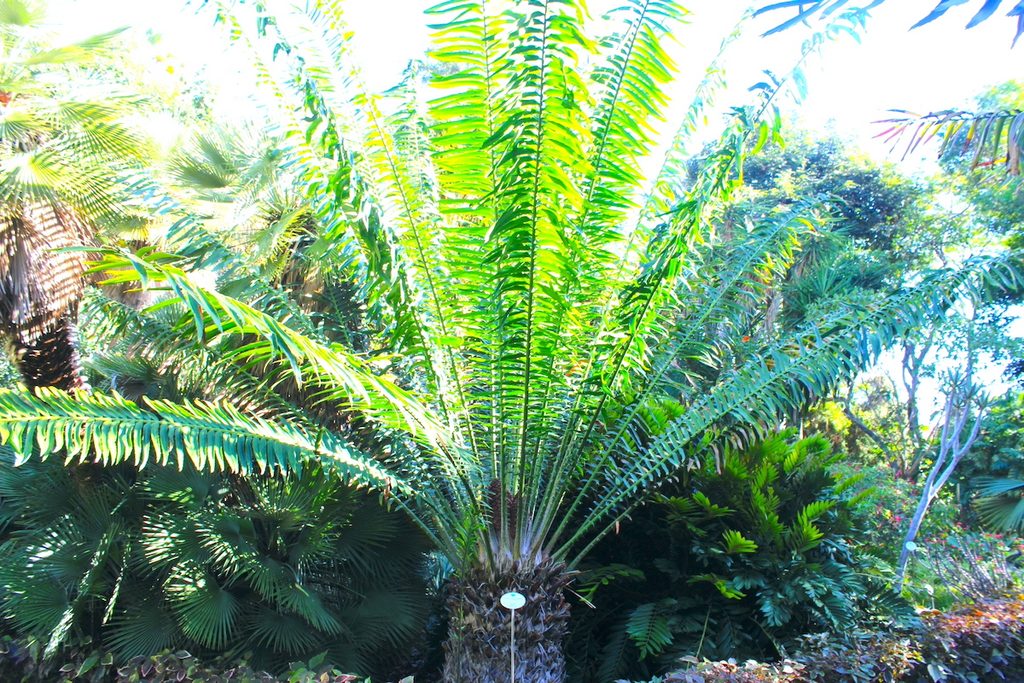
Encephalartos laurentianus is the undisputed heavyweight champion of the Cycadales — the largest species in a genus already renowned for size, and arguably the fastest-growing cycad known, capable of producing up to five flushes of new leaves per year. It is also one of the most poorly documented large plants in the world. Its entire wild range lies along the Angola–DRC border in a region that has been rendered almost inaccessible by decades of armed conflict, political instability, and extreme remoteness. For most of the twentieth and early twenty-first centuries, the Kwango River valley has been, in the words of multiple sources, “impenetrable to outsiders.”
Taxonomy and nomenclature
Encephalartos laurentianus De Wild. was first published in 1903 in the Annales du Musée du Congo Belge, Botanique (series 5, volume 1(1): 10, plate 25), by the Belgian botanist Émile Auguste Joseph De Wildeman (1866–1947). The species was based on material collected by Gentil (collection number 98) at Kasongo on the Kwango River, in September 1902. The holotype is deposited at the National Botanic Garden of Belgium in Meise (BR).
The epithet laurentianus honours Émile Laurent (1861–1904), a Belgian botanist and plant collector who was instrumental in introducing this species into European cultivation at the turn of the twentieth century. Laurent was a prolific collector in the Congo Free State, and his specimens formed the basis for many of De Wildeman’s descriptions. He died in the Congo in 1904, barely a year after the species named in his honour was formally published.
Encephalartos laurentianus has no taxonomic synonyms. It is so morphologically distinctive — vastly larger than any congener, with a unique combination of enormous fronds, bifurcate leaflet apices, and a long petiole armed with sharp prickles — that no confusion with other species has ever arisen. The species was placed by Vorster (2004) in the central African complex of Encephalartos alongside Encephalartos ituriensis and Encephalartos equatorialis, with which it shares the bifurcate or trifurcate leaflet apex character. However, as the LLIFLE encyclopedia notes, “the morphological and geographical discontinuities probably indicate a considerable evolutionary divergence from all the other Encephalartos species.” In terms of sheer size, there is no close relative: Encephalartos laurentianus occupies a category of its own.
Common names: Kwango giant cycad (English); malele (local Kikongo name).
Morphological description
Habit and caudex: Encephalartos laurentianus is the largest species in the entire order Cycadales. The trunk is cylindrical, erect when young but often becoming procumbent (reclining) in old specimens, reaching 4–15 m in length and 40–100 cm in diameter. Some sources cite trunk lengths exceeding 15 m and diameters up to 120 cm, making this the thickest-trunked cycad in the world. The trunk is closely covered near the crown with 5–7 alternating cataphylls (scales) and persistent leaf bases arranged in an imbricate pattern; lower down, it becomes pale and shaggy, marked by the scars of fallen scales and leaves.
The species suckers vigorously from the base, and mature plants often develop multiple stems — some erect, others leaning or fully prostrate. In gallery-forest conditions, where humidity is high and light is filtered, the trunks elongate dramatically and may eventually recline under their own weight, growing along the ground in a sinuous, almost reptilian manner. On exposed red sandstone cliffs above the gallery forest, the same species produces shorter, upright trunks — a striking example of phenotypic plasticity in response to habitat.
Leaves: The fronds are the longest of any cycad. Published measurements range from 4 to 7 m, with some cultivated specimens reportedly reaching 8 m. Each frond is 70–100 cm broad and flat (without the pronounced keel seen in Encephalartos equatorialis). The petiole is long (up to 30–40 cm) and remarkably thick — up to 8 cm at the junction with the stem — making it one of the most robust leaf attachments in the plant kingdom. The petiole is armed with sharp spines and prickles, and the basal leaflets are reduced to a series of sharp prickles along the rachis.
The leaflets are the largest in the genus: median leaflets measure 35–50 cm long and 4–7 cm wide — broad, flat, lanceolate blades with serrated upper margins bearing more than three teeth. The leaflets do not overlap (unlike Encephalartos equatorialis) and are set in a flat plane along the rachis, giving each frond a remarkably broad, open, palm-like appearance. Despite their size, the leaflets are described as pliable rather than rigidly stiff — armed but not aggressively spiny to the touch.
The leaflet apices are bifurcate or trifurcate — the diagnostic character linking Encephalartos laurentianus to the central African complex (Encephalartos ituriensis, Encephalartos equatorialis). This divided tip is visible on the median and upper leaflets and serves as a reliable field character for identifying the species.
Reproductive structures: The cones are lateral (produced along the stem, not terminally), yellowish green, and covered with a persistent short russet-brown indumentum (felt-like hair). The scale apices are wrinkled. Male cones are 17–35 cm long, numerous, long-stalked, and emerge in succession — an unusual feature suggesting a prolonged pollen-release season. Female cones are ovoid, 35–40 cm long and 18–20 cm in diameter. Seeds are ovoid, 40–50 mm long and 25–30 mm wide, with a red sarcotesta. The production of 2–6 cones per stem has been reported.
Distribution and natural habitat
Encephalartos laurentianus is native to northern Angola (Uíge Province) and the southern Democratic Republic of the Congo (formerly Bandundu Province, now Kwango Province). The confirmed range is restricted to the Kwango (Cuango) River valley, in the vicinity of Kasongo-Lunda and between the Fufu and Kikasu tributaries of the Kwango. Populations occur at altitudes of 450–550 m above sea level.
A historical record from near the southeastern base of the Ruwenzori Mountains in Uganda — cited by Johnston in the early twentieth century and repeated in the Flora of Tropical Africa (Prain 1917) — has been treated with caution by modern authorities. The World List of Cycads lists the distribution as Angola and the DRC only. POWO gives the native range as “Angola to DR Congo.” If the Ruwenzori record is valid, it would represent a remarkable disjunction of several hundred kilometres from the core Kwango River populations. It is possible that the Ruwenzori plants were a different species — perhaps Encephalartos whitelockii, which occurs in the Mpanga Gorge south of the Ruwenzori — or that the record was based on a misidentification or a cultivated specimen.
The confirmed habitat comprises two distinct environments along the Kwango River:
Gallery forest: Closed, humid, riparian forest along the river banks and in deeply shaded valleys. In this environment, the cycads grow among tall trees in filtered light, and the trunks elongate enormously — becoming sinuous and eventually reclining under their own weight. The plants grow in dense colonies on humus-rich red sandstone substrates. This is where the largest specimens develop.
Open sandstone cliffs: Exposed red sandstone slopes and cliff faces above the gallery forest. On these exposed surfaces, where soil is thin and sunlight is direct, the trunks remain shorter and upright. The plants are often rooted in crevices in the bare rock.
The vegetation type across this range is classified as Congolian forest–savanna mosaic — a transitional zone between the dense equatorial rainforest of the Congo Basin to the north and the dry savanna of the Angolan plateau to the south. The climate is hot and humid, with a pronounced wet season, total annual rainfall of approximately 1200–1500 mm, and mean temperatures of 24–28 °C year-round. Frost does not occur at 450–550 m near the equator.
The Kwango River — a cycad’s fortress
The Kwango River forms the border between Angola and the DRC for much of its length. It flows northward from the Angolan highlands to join the Kasai River, which in turn feeds the Congo. The valley through which it passes is deeply incised into red sandstone — a geological formation that creates a landscape of cliffs, gorges, and narrow forested ravines. This terrain has shaped the ecology of Encephalartos laurentianus and, paradoxically, has also provided the species with its most effective protection.
Throughout the twentieth century, the Kwango River valley has been one of the most inaccessible inhabited regions in Africa. The Angolan Civil War (1975–2002) and the successive Congo wars (1996–2003) devastated the surrounding provinces, displacing millions and destroying infrastructure. Even in periods of relative peace, the absence of roads, the density of the vegetation, and the rugged sandstone topography make access to the core Encephalartos laurentianus populations extraordinarily difficult. As Jungle Music nursery notes, the region is “considered impenetrable to outsiders, due to its remoteness and danger.”
This inaccessibility has served as de facto conservation. Unlike the South African Encephalartos species, which are systematically targeted by poachers with chainsaws and flatbed trucks, Encephalartos laurentianus has been largely protected by the simple impossibility of reaching it and transporting a multi-tonne plant out through hundreds of kilometres of roadless terrain. Reports indicate that “large numbers” of plants occur in the Kasongo-Lunda districts and that seed set is occurring — suggesting a viable, reproducing population, though no formal census has been attempted.
Conservation status
Encephalartos laurentianus is assessed as Near Threatened (NT) on the IUCN Red List, under criterion B1a — indicating a restricted extent of occurrence. The World List of Cycads confirms this assessment. The species is listed on CITES Appendix I, which prohibits international commercial trade.
The Near Threatened status — relatively reassuring compared to the Critically Endangered assessments of many South African and East African congeners — reflects the apparently large wild population, the continued seed production, and the natural protection afforded by the remoteness and inaccessibility of the habitat. However, this assessment carries significant uncertainty: no formal population census has ever been conducted, and the security situation in the Kwango River valley has prevented systematic monitoring for decades.
Potential threats include deforestation (charcoal production, slash-and-burn agriculture), artisanal mining (alluvial diamond and gold mining along the Kwango), and the slow encroachment of subsistence farming into previously inaccessible areas as conflict diminishes. The species is reportedly targeted by collectors, but the logistical barriers to extraction remain formidable. Climate change poses an uncertain long-term risk: changes in rainfall patterns in the Congolian forest–savanna mosaic could alter the moisture regime of the gallery forests on which the largest specimens depend.
Cold hardiness
The equatorial location (approximately 5–7°S) and low altitude (450–550 m) of the natural habitat indicate a uniformly warm, frost-free climate. Nighttime temperatures rarely drop below 18–20 °C. The species has no evolutionary exposure to frost or cold stress.
Jungle Music (Phil Bergman, San Diego): “This species requires filtered light or shade. In the tropics or exceptionally humid areas, you can get away with growing this species in sun. They are susceptible to burn in drier areas and are not very frost tolerant — truly a tropical species of Encephalartos.” He further advises an area “where you don’t see much below a freeze.”
BabyPalms (European nursery): Rates the species as Zone 9a (−1 °C).
Rarepalmseeds: “Adapts easily to warm temperate and most tropical climates.”
Practical cold hardiness estimate: USDA Zone 10a–10b (+2 to −1 °C) as a conservative estimate for established plants. Brief, light frost (to −2 °C) may be tolerated by mature specimens if conditions are dry, but sustained cold or repeated frost events are almost certainly lethal. This is a genuinely tropical cycad — one of the least frost-tolerant species in the genus. In Mediterranean climates with mild, wet winters (Côte d’Azur, coastal California), outdoor cultivation requires a warm, sheltered microclimate with reliable frost protection. In cooler climates, a heated greenhouse or large conservatory is essential.
Cultivation guide
Difficulty: 2/5 for cultural requirements — the species is described as adaptable, fast-growing, and responsive to cultivation. The real difficulty lies in obtaining legitimate material and providing the space the plant demands. This is not a windowsill cycad. It is a landscape tree that will eventually dominate any garden it is planted in.
Light: Filtered sun to partial shade in most climates. In its natural gallery-forest habitat, the species grows under the canopy of tall trees, in dappled light. In cultivation, it performs best in bright indirect light or morning sun with afternoon shade. In tropical or very humid environments (Florida, northern Queensland, Southeast Asia), full sun is tolerated. In drier Mediterranean or arid climates (southern California, southern Europe), direct sun causes leaf burn — shade or filtered light is essential.
Soil: Moist, well-drained, rich. The gallery-forest habitat has deep, humus-rich soil derived from red sandstone, with excellent drainage on the slopes but high ambient moisture. In cultivation, a fertile mix of loam, coarse sand, composted bark, and some organic matter works well. The species tolerates a wider range of soil conditions than most Encephalartos: it is not as demanding of perfect drainage as the South African dry-habitat species, but it does not tolerate waterlogging.
Watering: Generous and regular during the growing season. This is one of the most moisture-loving species in the genus, adapted to 1200–1500+ mm of annual rainfall with high ambient humidity. In cultivation, water freely and consistently. Phil Bergman at Jungle Music confirms: “It likes lots of water in the growing season.” Reduce watering during winter dormancy, but do not allow the root zone to dry out completely.
Feeding: Responds vigorously to regular fertilisation. A balanced NPK with trace elements, applied every 4–6 weeks during the growing season, promotes the extraordinary leaf production that defines this species. The capacity for up to five flushes per year places significant nutrient demands on the soil — regular feeding is not optional but essential for healthy growth.
Growth rate: Extraordinary — the fastest-growing cycad known. PACSOA describes it as “an extremely fast grower, putting out up to five flushes a year.” Rarepalmseeds notes that “seedlings can easily reach 1 m tall in a year.” Phil Bergman at Jungle Music reports that “before this plant ever makes a foot of trunk, leaves will streak into the air, dwarfing much around them.” Once established (after the initial 2–3 year seedling phase), growth is rapid and sustained, with visible progress at each flush. In tropical climates with year-round warmth and moisture, the species may produce new leaves almost continuously.
Container culture: Practical only for the first few years. The growth rate and eventual size (trunk to 15 m, fronds to 7 m) make long-term container culture entirely impractical. Even young plants rapidly fill large pots — a 4-year-old seedling with a 5 cm caudex will already be producing leaves of impressive length. For temperate-climate growers, a large heated conservatory or subtropical greenhouse is the only realistic long-term option.
Landscape use: In frost-free tropical and subtropical gardens (USDA zones 10b–12), Encephalartos laurentianus is one of the most spectacular landscape plants available to the gardener. Its palm-like silhouette, massive crown of dark green fronds, and vigorous suckering habit create an effect that is closer to a small tropical forest than an individual plant. Mature specimens are routinely mistaken for palms. The species is displayed in several major botanical gardens, including the Botanic Garden of Puerto de la Cruz (Tenerife), the Munich Botanical Garden (Germany), and Joe’s Jurassic Cycad Gardens (Katherine, Northern Territory, Australia). Phil Bergman describes it accurately: “There are no cycads that become larger or more impressive than this rapid-growing species.”
Comparison with the central African Encephalartos complex
| Character | E. laurentianus | E. ituriensis | E. equatorialis |
|---|---|---|---|
| Distribution | Angola / DRC (Kwango River) | NE DRC (Ituri inselbergs) | SE Uganda (Lake Victoria) |
| Altitude | 450–550 m | 1100–1200 m | ~1000 m |
| Trunk | Erect → prostrate, 4–15 m × 40–100 cm (largest in genus) | Erect, to 6 m × 50 cm | Erect, 3.5–4 m × 35–45 cm |
| Leaf length | 4–7 m (longest in genus) | 3.6–4.3 m (reported) | 3–4 m |
| Leaf width | 70–100 cm (broadest in genus) | Not well documented | 30–40 cm |
| Leaf keel | Flat (not keeled) | Moderate | Strongly keeled (diagnostic) |
| Leaflet size | 35–50 cm × 4–7 cm (largest in genus) | To 25 cm × 3 cm | 20–25 cm × ~2 cm |
| Leaflet apex | Bifurcate/trifurcate | Bifurcate/trifurcate | Bifurcate/trifurcate + pungent |
| Leaflet arrangement | Flat, not overlapping | Curved, tapering | Succubous → imbricate (unique) |
| Petiole | 30–40 cm, up to 8 cm thick (stoutest in genus) | ≤ 5 cm | ≤ 13 mm (extremely short) |
| Suckering | Vigorous, multi-stemmed | Not well documented | Predominantly single-stemmed |
| Growth rate | Fastest in genus (up to 5 flushes/year) | Vigorous | Not well documented |
| Light requirement | Filtered sun / shade (burns in dry climates) | Full sun to partial shade | Full sun to partial shade |
| Cold hardiness | Zone 10a–10b (least hardy in complex) | Zone 9b–10a (estimated) | Zone 10a–10b (estimated) |
| IUCN status | NT (large but unquantified population) | VU (population unknown) | CR (~300 plants) |
Propagation
Seed: The species produces ovoid seeds, 40–50 mm × 25–30 mm, with a red sarcotesta. Seed set is reportedly occurring in the wild, and seed has been exported in limited quantities for specialist nurseries. In the early days of cycad collecting, a single seed sold for US$25–50 — a reflection of the species’ extreme rarity in cultivation. Germination follows standard Encephalartos protocols: clean the sarcotesta (gloves — all parts toxic), sow on a free-draining medium at 27–30 °C. Germination is reportedly reliable and fast by cycad standards, consistent with the species’ generally vigorous growth habit. Rarepalmseeds confirms that seedlings can reach 1 m in their first year.
Offsets: Mature plants sucker vigorously, and offsets can be separated once they have developed an adequate root system. Given the species’ vigorous growth habit, offset production is likely to be more reliable than for slower-growing species. However, access to mature offset-producing plants remains the limiting factor for most growers.
Superlatives — what makes Encephalartos laurentianus exceptional
It is worth pausing to appreciate the scale of this organism. Encephalartos laurentianus holds multiple records within the Cycadales:
Longest trunk: Up to 15–18 m — longer than most palm trees and vastly exceeding any other cycad. The next-largest Encephalartos species (hildebrandtii, altensteinii, transvenosus) rarely exceed 6–8 m.
Thickest trunk: Up to 100–120 cm in diameter — a trunk circumference exceeding 3 m. For comparison, Encephalartos transvenosus, one of the larger South African species, reaches approximately 30–40 cm in diameter.
Longest leaves: Up to 7–8 m — a single frond taller than a two-storey building. The next-longest leaves in the genus are those of Encephalartos ituriensis at approximately 4 m.
Largest leaflets: Up to 50 cm long and 7 cm wide — individual leaflets the size of a large kitchen knife.
Stoutest petiole: Up to 8 cm thick at the base — thicker than a human wrist.
Fastest growth rate: Up to five flushes of new leaves per year, with seedlings reaching 1 m in their first year.
These dimensions place Encephalartos laurentianus not merely at the top of the cycad size range but in a different category altogether. It is as large in proportion to a typical Encephalartos as a redwood is to a typical conifer. The species’ existence in one of the most inaccessible corners of central Africa — largely unseen, unstudied, and unprotected by formal conservation law — only adds to its mystique.
Authority websites
POWO — Plants of the World Online: https://powo.science.kew.org/…
IUCN Red List: https://www.iucnredlist.org/species/41949/10609195
World List of Cycads: https://cycadlist.org
Bibliography
De Wildeman, É. (1903). Encephalartos laurentianus. Annales du Musée du Congo Belge, Botanique, sér. 5, 1(1): 10, t. 25. [Original description]
Prain, D. (1917). Encephalartos laurentianus. In: Flora of Tropical Africa, vol. 6, part 2: 344.
Robyns, W. (1948). Flore du Congo Belge et du Ruanda-Urundi: Cycadaceae.
Melville, R. (1957). Encephalartos in Central Africa. Kew Bulletin 12: 237–257.
Goode, D. (1989). Cycads of Africa. Tien Wah Press, Singapore.
Whitelock, L.M. (2002). The Cycads. Timber Press, Portland. 374 pp.
Jones, D.L. (2002). Cycads of the World. 2nd ed. Smithsonian Institution Press, Washington. 456 pp.
Donaldson, J.S. (ed.) (2003). Cycads: Status Survey and Conservation Action Plan. IUCN/SSC Cycad Specialist Group, IUCN, Gland.
Vorster, P. (2004). Classification concepts in Encephalartos (Zamiaceae). In: Walters, T. & Osborne, R. (eds.), Cycad Classification: Concepts and Recommendations, pp. 69–83. CABI Publishing, Oxfordshire.
Bösenberg, J.D. (2010). Encephalartos laurentianus. The IUCN Red List of Threatened Species 2010: e.T41949A10609195.
Figueiredo, E. & Smith, G.F. (2008). Plants of Angola. Strelitzia 22: 1–279. National Botanical Institute, Pretoria.
Haynes, J.L. (2022). Etymological compendium of cycad names. Phytotaxa 550(1): 1–31.