
In the misty hills of southern Kenya, where isolated inselbergs rise from the flat, sun-baked savanna of the Tsavo hinterland like islands from a sea of thorn scrub, a cycad grows that defies the landscape around it. Encephalartos kisambo is a giant — barrel-trunked, broad-crowned, with fronds that can exceed 3.5 m in length, each bearing nearly a hundred pairs of long, falcate leaflets that give the plant an architectural presence unmatched by any other East African cycad. It is a cloud-forest species, clinging to the steep, mist-drenched slopes of the Maungu, Sagala, Kasigau, and Nyangala Hills, straddling the border of Kenya and Tanzania. And it is Endangered — declining under the combined pressures of habitat destruction, charcoal production, agricultural expansion, and the relentless demand of the international cycad trade.
For the collector and the gardener, Encephalartos kisambo offers something that few cycads can: genuine size, genuine vigour, and genuine adaptability. It is one of the fastest-growing Encephalartos, one of the most rewarding in cultivation, and one of the most spectacular as a landscape specimen. But its size — the same quality that makes it magnificent in a garden — is the quality that limits its appeal to those with the space to accommodate a crown spread of 5+ metres and a trunk that may eventually reach 3.5 m in height. This is not a pot plant. This is a landscape tree.
Taxonomy and nomenclature
Encephalartos kisambo Faden & Beentje was formally described in 1989, based on material collected by Robert Faden and colleagues in 1971 on the Maungu (Nyangala) Hills in the Taita-Taveta District of southern Kenya, at an altitude of 1025 m. The holotype is deposited at Kew (K), with isotypes at numerous herbaria worldwide (BR, EA, MO, PRE, UPS, US, WAG).
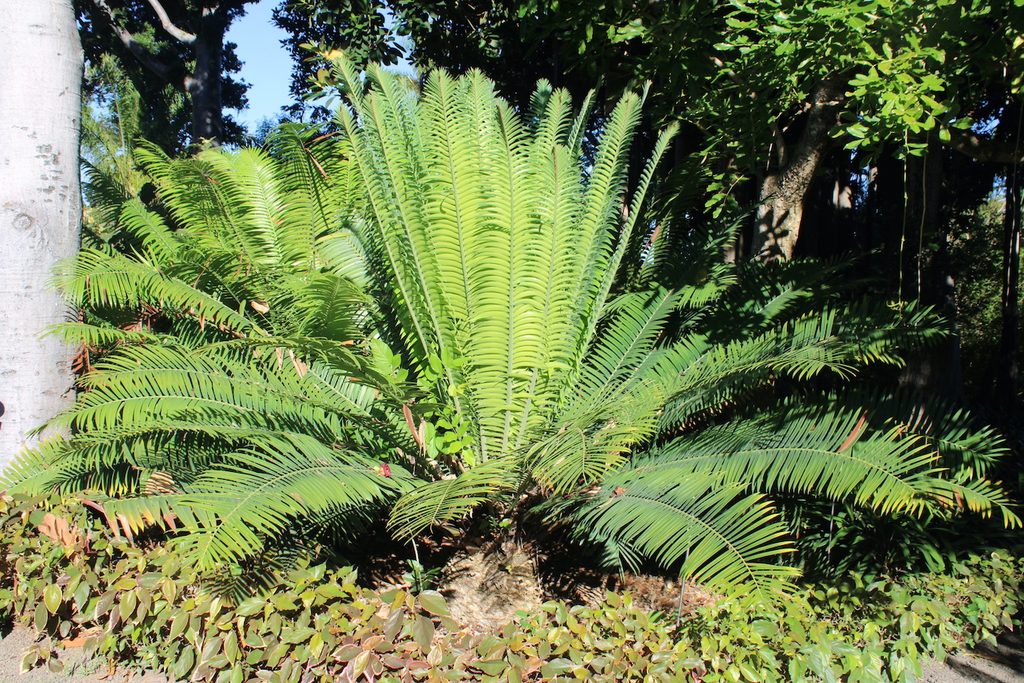
The epithet kisambo is not Latin but a vernacular name in the Taita language — the indigenous language of the Taita people of the Taita Hills region of southern Kenya, where the species is endemic. This is one of the few Encephalartos with a common-language rather than classical epithet — a fitting choice, as the species has been known to the Taita people for far longer than it has been known to Western botany.
The taxonomic history of Encephalartos kisambo is tangled. The species has two recognised synonyms:
Encephalartos voiensis A.Moretti, D.W.Stev. & Sclavo (1989) — described in the same year as kisambo, based on material from near Voi, Kenya. Moretti, Stevenson, and Sclavo (the same team that described Encephalartos sclavoi) described their plant as a new species, but subsequent analysis established that voiensis and kisambo are the same entity. Since both names were published in 1989, the question of priority was resolved in favour of kisambo. The name Encephalartos voiensis persists in some older collections and nursery catalogues.
Encephalartos kanga Pócs & Q.Luke (2007) — described from Mount Kanga in the Nguru Mountains of Tanzania (Morogoro region). Haynes (2009) argued that the Tanzanian populations fall within the morphological range of Encephalartos kisambo, and kanga is now treated as a synonym. This synonymy extends the species’ known range significantly southward, from Kenya into Tanzania — though whether the Kenyan and Tanzanian populations represent a continuous or disjunct distribution remains unclear.
Encephalartos kisambo belongs to a cluster of large, green-leaved East African Encephalartos that also includes Encephalartos hildebrandtii, Encephalartos sclavoi, Encephalartos tegulaneus, and Encephalartos whitelockii. It is most closely related to Encephalartos hildebrandtii, the coastal giant of Kenya and Tanzania, with which it shares the large trunk, long fronds, and green foliage. However, kisambo is distinguished by its montane habitat (800–1800 m vs sea level to 350 m for hildebrandtii), its barrel-shaped, pachycaulous trunk (vs the more columnar trunk of hildebrandtii), its shorter petiole (2.5–5 cm vs absent or very short in hildebrandtii), and its subfalcate to falcate leaflets that are distinctly longer (24–37 cm) and more curved than those of hildebrandtii.
Common names: Voi cycad (English); kisambo (Taita).
Morphological description
Habit and caudex: Encephalartos kisambo is one of the largest Encephalartos of East Africa — a true arborescent giant. The trunk is erect, sometimes becoming decumbent (reclining) in older specimens, reaching 1.2–2.5 m in height and 45–52 cm (sometimes to 70 cm) in diameter. The trunk shape is characteristically pachycaulous — barrel-shaped, thickest in the middle, tapering somewhat toward the crown. This barrel silhouette is distinctive and immediately distinguishes kisambo from the more columnar hildebrandtii. The trunk may be solitary or produce a few suckers from the base, though suckering is infrequent compared to the freely suckering South African species. A large taproot anchors the plant in the rocky montane substrate.
Leaves: The fronds of Encephalartos kisambo are among the longest in the genus. They are 2.4–3.6 m long in mature specimens, silvery-green to bluish-green, upright to spreading, creating a dense, architectural crown that can span 5+ m. The overall effect is majestic — a massive, palm-like crown of dark green to silvery fronds rising from a barrel trunk on a misty hillside. The petiole is short (2.5–5 cm — much shorter than in the central African species Encephalartos laurentianus, which has petioles to 30–40 cm). Leaflets are arranged in 89–96 pairs per frond, oblong-lanceolate, subfalcate to falcate (slightly sickle-shaped), 24–37 cm long and 2.9–3.7 cm wide — among the longest leaflets in the genus. The upper margin of median leaflets typically bears 4–6 distinct spines, with 3–4 of these concentrated near the basal attachment; the lower margin is entire (smooth) or with up to 2 smaller spines. The under-surface is clearly striate, with 30–45 parallel nerves visible — a diagnostic character.
A notable ecological observation: plants growing in open, full-sun positions reach only about two-thirds the size (both trunk and leaf dimensions) of those growing in partial shade under forest canopy. This indicates that the species’ maximum development is achieved in its preferred cloud-forest habitat, where humidity and diffuse light promote larger fronds and trunks. In cultivation, this has implications: the largest, most impressive specimens will be grown in conditions that provide some shelter from desiccating wind and intense direct sun.
Reproductive structures: Male cones are produced 2–3 per stem (occasionally up to 5–6), cylindrical-conical or fusiform, creamy yellow, 49–64 cm long and 10–12 cm in diameter — among the largest male cones in the genus. Female cones are ovoid, 42–60 cm long and 15–20 cm in diameter, yellow-orange, impressive in scale and colour. Seeds are ovoid to oblong, 30–39 mm long and 20–25 mm wide, with a yellow to orange sarcotesta. Female cones take approximately 12 months to develop and may appear only every other year. Seeds are toxic, as in all Encephalartos.
Regeneration in the wild is reported as good: “there are lots of young plants and seedlings, so regeneration is good” (LLIFLE). This is an encouraging sign for a declining species, but it does not offset the ongoing removal of adults by collectors and the destruction of habitat.
Distribution and natural habitat
Encephalartos kisambo is found in southern Kenya and northern Tanzania, in the chain of isolated hills and mountains that form part of the Eastern Arc system and its geological relatives:
Kenya: The main populations are on the slopes of the Maungu (Marungu) Hills near Voi, and on the Mulilonyi, Nyangala, Sagala, Rukinga, and Kasigau Hills — all isolated inselbergs rising from the semi-arid Tsavo lowlands in the Taita-Taveta District. These hills are surrounded by flat, dry savanna dominated by Acacia–Commiphora bushland, making the moist, forested hilltops into ecological islands — “sky islands” that harbour relic montane vegetation in a sea of aridity.
Tanzania: The species is also recorded from Kisima Hill in the Mkomazi Game Reserve (northern Tanzania). If the synonymy of Encephalartos kanga is accepted, the range extends further south to Mount Kanga in the Nguru Mountains (Mvomero District, Morogoro) — a significant southward extension into the heart of the Eastern Arc.
The species is known from only four locations (IUCN criterion) and is severely fragmented. The total population is estimated at approximately 5000 mature individuals — a larger number than most CR Encephalartos, but one that is declining.
The altitude range is 800–1800 m. The habitat is closed to open evergreen cloud forest on steep mountain slopes — the species occurs as scattered populations or individuals on the moist, well-wooded slopes of inselbergs, surrounded by dry savanna at lower elevations. Frequent mist is a defining feature of the habitat. Some populations grow on drier rocky cliffs and promontories in the open, where they are smaller than their forest counterparts. The substrate is rocky (granite, gneiss), well-drained but with moisture supplied by orographic mist and rainfall.
The climate of the Voi region at low elevation is hot and semi-arid, but the hills where kisambo grows are cooler and wetter due to altitude and orographic effects. Temperature minima on the hilltops can reach approximately 10 °C or slightly below during cool episodes — not freezing, but significantly cooler than the lowland savanna. Rainfall on the forested slopes is higher than in the surrounding lowlands, though precise figures for the cycad sites are not well documented. The mist-belt climate creates conditions that are fundamentally different from the dry, hot savanna visible from the same hilltop.
Conservation status
Encephalartos kisambo is listed as Endangered (EN) on the IUCN Red List. The population is estimated at approximately 5000 mature individuals across four known locations, severely fragmented. The threats are direct and accelerating:
Habitat destruction: Forest clearance for charcoal production is a major threat at two of the four known locations. The hills near Voi are close to road access, making them vulnerable to exploitation. Agricultural expansion — particularly by squatter settlements on the forested slopes — is converting cloud forest to cropland. Two subpopulations are under acute threat from these combined pressures.
Illegal collection: The species is highly sought after in the international cycad trade. Its large size, architectural form, and relative ease of cultivation make it desirable, and the ongoing illegal targeting of plants and seeds by collectors is documented. The remoteness of some populations provides partial protection, but determined poachers can reach any site with a road.
Slow recovery: Like all Encephalartos, kisambo takes many years to reach reproductive maturity. Adult plants removed from the wild represent decades of irreplaceable growth. The presence of seedlings and juveniles in the wild is encouraging but does not compensate for the rate of adult removal.
The species is protected under CITES Appendix I. All international trade in wild-collected material is prohibited; artificially propagated plants require CITES permits. Kenya and Tanzania both have national legislation protecting cycads, though enforcement in remote hill areas is challenging.
Cold hardiness — the cloud-forest equation
Encephalartos kisambo presents the same equatorial-montane paradox as Encephalartos sclavoi — a species from near the equator that experiences cool conditions due to altitude. But kisambo occurs at a lower elevation (800–1800 m) than sclavoi (1800–2100 m) and in a warmer microclimate overall.
The available cold hardiness data:
LLIFLE: “Even though the habitat of Encephalartos kisambo is close to the equator, the high elevation at which it occurs gives it a remarkable degree of cold tolerance, but is unlikely to handle frost.”
Tree SA: “Plant this cycad in light shade, preferably out of a frost environment.”
Succulentes.net (detailed analysis): Station data from Voi (Kenya) indicate minima around 10 °C; cliff-edge microhabitats may experience cooler temperatures from nocturnal radiative cooling, but the species is not a “frost cycad” — below 0 °C, survival depends on duration, humidity, and protection of the growing point.
Practical cold hardiness estimate: USDA Zone 10a (−1 to 0 °C) is the safe minimum for outdoor cultivation. Zone 9b (−1 to −4 °C) is possible in very sheltered, dry microclimates with radiant heat from a wall or paving — brief, light frosts may be survived, but the species has no evolutionary exposure to sustained freezing. In Mediterranean climates (Côte d’Azur, coastal California), outdoor cultivation in the warmest, most sheltered positions is plausible but involves risk. In climates with regular frost, protected cultivation (greenhouse, large conservatory) is mandatory.
One important nuance: kisambo is described as “more moisture-tolerant than most South African cycads” (LLIFLE). The cloud-forest habitat, with its frequent mist and humidity, means the species is less sensitive to ambient moisture than the dry-habitat species. This makes it potentially better adapted to humid subtropical gardens (southeastern USA, coastal eastern Australia, southern Japan) than the arid-habitat South African blues, which struggle in persistent humidity.
Cultivation guide
Difficulty: 2/5 — genuinely easy and rewarding, provided space and climate requirements are met.
Multiple sources converge on the same message: Encephalartos kisambo is one of the finest Encephalartos for garden use. LLIFLE describes it as “one of the most spectacular and rewarding species for the home garden,” “a pleasure to grow,” and notes that it “seems to compete with Encephalartos tegulaneus in vigour and growth rate.” Cycad Gardens of Eudlo (Australia) considers it “highly recommended.” Aloes in Wonderland (California) describes it as “a large, very attractive species.” The only caveat is its eventual size — this is a plant that will dominate any space it is given.
Light: Full sun to partial shade. The species performs well in both conditions, but the wild observation that forest plants are significantly larger than open-grown plants suggests that light shade produces the most impressive specimens in cultivation. In practice, a position with morning sun and afternoon filtered shade, or dappled shade throughout the day, is ideal. Full sun is also acceptable and produces more compact, stiffer fronds — a matter of aesthetic preference.
Soil: Well-drained, gritty, and fertile. The cloud-forest habitat has rich, organic montane soil — unlike the mineral-poor substrates of the arid South African species. In cultivation, a mix of quality loam, coarse sand, and compost (roughly equal parts) provides the ideal growing medium. The species responds extremely well to organic enrichment: a heavy mulching of compost and well-rotted manure during drier periods provides nutrients that fuel vigorous growth during the rainy season and periods of new leaf development. pH: slightly acidic to neutral (5.5–7.0).
Watering: Generous. This is a cloud-forest species adapted to frequent mist and regular rainfall. In cultivation, water regularly and generously throughout the growing season. The species is more moisture-tolerant than the South African species — it appreciates consistent moisture and does not require the dry rest periods that the arid-habitat blues demand. Once established, it shows some drought tolerance, but consistent moisture produces the best growth. Drainage must be maintained (no waterlogging), but the substrate can remain moderately moist without risk of rot.
Feeding: Heavy feeders. The species responds very well to regular fertilisation — growth rate improves dramatically with balanced NPK supplemented by trace elements. Apply granular fertiliser in early spring and supplement with liquid feeding through the growing season. Compost mulch is beneficial year-round.
Growth rate: Fast for an Encephalartos — one of the fastest in the genus. In cultivation, established plants produce new frond flushes regularly and develop trunk mass at a rate that is visible year-on-year. Vigorous specimens in suitable conditions (warm, moist, well-fed) can put on 3–5 cm of trunk height per year and produce fronds exceeding 2.5 m within 10–15 years from a well-established offset.
Container culture: Possible when young, but this is ultimately a landscape plant. Seedlings and young plants grow well in deep pots (to accommodate the large taproot), but the eventual size — trunk to 2.5 m, crown spread to 5+ m, fronds to 3.5 m — means that container culture is a temporary phase. In climates where outdoor planting is not possible, a very large container (100+ litres) in a bright conservatory or atrium is the only realistic long-term option. Raised beds in the garden provide extra root depth and drainage that the species appreciates.
Landscape use: In frost-free subtropical or warm-temperate gardens, Encephalartos kisambo is one of the most spectacular cycads for landscape planting. It makes a commanding focal point, a gateway specimen, or an avenue planting (if you have the space and the budget for multiple plants). Its scale is comparable to a small palm tree, but its texture — the massive, upright fronds with their long, curved, spiny leaflets — is entirely different and more dramatic. Plant where it has room to develop its full crown without obstruction, in a position that allows the architectural silhouette to be appreciated from a distance.
Comparison with related East African species
| Character | Encephalartos kisambo | Encephalartos hildebrandtii | Encephalartos sclavoi |
|---|---|---|---|
| Distribution | S. Kenya / N. Tanzania (hills) | Kenya / Tanzania coast | W. Usambara, Tanzania |
| Altitude | 800–1800 m (cloud forest hills) | Sea level to 350 m (coastal) | 1800–2100 m (montane) |
| Trunk | Barrel-shaped, 1.2–2.5 m × 45–70 cm | Columnar, 8–10 m × 40–60 cm | Subterranean to 1 m × 35 cm |
| Leaf length | 2.4–3.6 m | 3–6 m | 1.7–2 m |
| Leaflet length | 24–37 cm (longest in complex) | 15–25 cm | Thick, broad, revolute, cupped |
| Leaflet character | Subfalcate to falcate, 4–6 spines upper margin | Broadly lanceolate, few spines | Very thick, strongly revolute |
| Petiole | 2.5–5 cm (short) | Short or absent | To 20 cm |
| Male cones | 49–64 cm (among largest in genus) | 40–60 cm | Short, yellow, stalked |
| Female cones | 42–60 cm, yellow-orange | 40–50 cm, orange | 30–40 cm, yellow |
| Growth rate | Fast (competes with tegulaneus) | Fast | Vigorous |
| Cold hardiness | Zone 10a (frost-sensitive) | Zone 10b (strictly tropical) | Zone 9b (equatorial montane) |
| Moisture tolerance | High (cloud forest) | High (coastal humidity) | Moderate (xeric promontories) |
| Suckering | Infrequent | Limited | Clumps of 2–6 |
| Wild population | ~5000 (EN) | Declining (NT) | ~50 (CR) |
Propagation
Seed: Easily germinated. Sow fresh seeds in a freely draining medium (river sand or sandy gravel), half-buried on their sides, with bottom heat at 27–28 °C. Germination begins within a few weeks. Young roots are brittle and grow rapidly — pot up seedlings promptly into deep containers to accommodate the taproot. Gloves should be worn when handling seeds (toxic).
Offsets: Produced infrequently. When available, detach with a clean cut, allow to callus for 1–2 weeks, and root in warm, moist, well-drained medium. Offset propagation is not the primary means of multiplying this species — seed is more practical and more reliable.
Pests and diseases
Scale insects are the primary pest concern. The long fronds with numerous leaflet pairs create a large surface area that requires regular inspection. Root rot is a risk in poorly drained substrates, but the species’ tolerance for moisture means the risk is lower than for the arid-habitat species, provided basic drainage standards are met. No specific pathogens are documented, but standard cycad hygiene (removal of dead fronds, treatment of trunk wounds, monitoring for fungal issues in humid conditions) is advisable.
The sky-island biogeography of Encephalartos kisambo
The distribution of Encephalartos kisambo illustrates a biogeographic phenomenon known as the “sky island” effect. The hills where it grows — Maungu, Sagala, Kasigau, Nyangala, and others — are isolated montane forest fragments rising from a matrix of semi-arid lowland savanna. Each hill is, in ecological terms, an island: connected by geology but separated by climate. The moist cloud forest on the hilltops is fundamentally different from the dry Acacia–Commiphora scrub at the base, and species adapted to the cool, moist hilltop environment — including Encephalartos kisambo — cannot survive in the intervening lowland.
This sky-island isolation has profound implications for conservation. Each hilltop population of kisambo is effectively a separate conservation unit, connected to other populations only by seed dispersal (presumably by birds or mammals that can traverse the lowland matrix). If a hilltop population is destroyed — by deforestation for charcoal, by agricultural encroachment, or by poaching — it will not be recolonised from neighbouring hills within any human-relevant timeframe. The species’ presence on isolated hilltops is both its survival strategy (the hills provide moisture and cloud cover in an otherwise arid landscape) and its vulnerability (each hilltop is a single point of failure).
The potential synonymy of Encephalartos kanga from the Nguru Mountains of central Tanzania with kisambo extends this sky-island pattern even further — suggesting that the species (or a very closely related entity) occurs on multiple isolated montane fragments across a distance of several hundred kilometres. If confirmed, this would make kisambo the most widespread East African Encephalartos, though “widespread” is relative — each population remains a tiny, isolated, cloud-forest fragment on a single hilltop.
Authority websites
POWO — Plants of the World Online: https://powo.science.kew.org/…
IUCN Red List: https://www.iucnredlist.org/species/41893/121559770
World List of Cycads: https://cycadlist.org
Bibliography
Faden, R.B. & Beentje, H.J. (1989). Encephalartos kisambo (Zamiaceae): a new species from Kenya. Kew Bulletin 44(2): 239–246. [Original description]
Moretti, A., Stevenson, D.W. & Sclavo, J.P. (1989). Encephalartos voiensis. Annals of the Missouri Botanical Garden 76(3): 934–938. [Synonym]
Pócs, T. & Luke, Q. (2007). Encephalartos kanga. Journal of East African Natural History 96(2): 193–201. [Synonym from Tanzania]
Haynes, J.L. (2009). Taxonomic notes on Encephalartos kisambo and related species. The Cycad Newsletter 32(1). [Synonymy of kanga with kisambo]
Whitelock, L.M. (2002). The Cycads. Timber Press, Portland. 374 pp.
Jones, D.L. (2002). Cycads of the World. 2nd ed. Smithsonian Institution Press, Washington. 456 pp.
Donaldson, J.S. (ed.) (2003). Cycads: Status Survey and Conservation Action Plan. IUCN/SSC Cycad Specialist Group, IUCN, Gland.
TRAFFIC East/Southern Africa (2003). Review of Significant Trade: Cycads. Report PC14 Doc. 9.2.2.
Haynes, J.L. (2022). Etymological compendium of cycad names. Phytotaxa 550(1): 1–31.