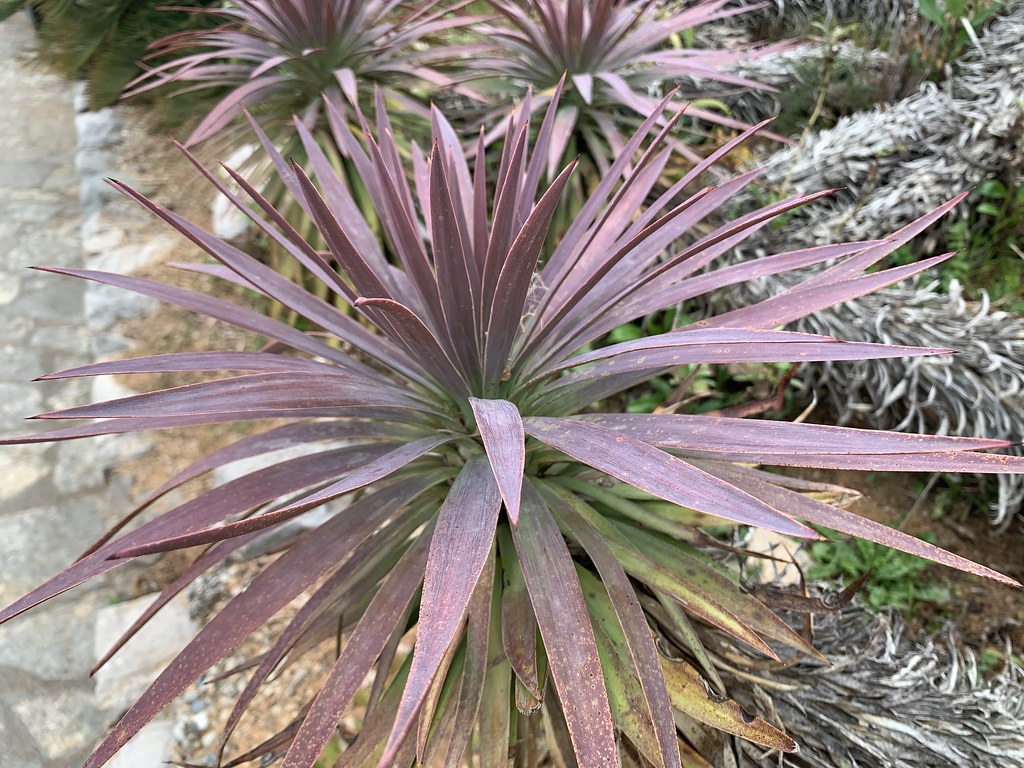
There is no yucca in the world quite like Yucca desmetiana. Where most species in the genus Yucca conform to the archetype of stiff, green, sword-like leaves bristling with sharp spines, this enigmatic Mexican species breaks every rule: its soft, leathery, harmlessly tipped leaves arch gracefully outward in a columnar rosette, and their color shifts from silvery blue-grey in youth to a deep, moody burgundy-purple as they mature — particularly during winter’s cool nights and short days. The effect is so unlike anything else in the genus that Trelease himself, in 1902, remarked that it was “quite unlike any other Yucca, and perhaps not of this genus.” More than a century later, the identity, origin, and even the flowering behavior of Yucca desmetiana remain partially shrouded in mystery — making it one of the most fascinating and least understood species in a genus of fifty.
Quick Facts
| Scientific name | Yucca desmetiana Baker |
| Family | Asparagaceae (subfamily Agavoideae) |
| Origin | Northern Mexico (Chihuahua to Aguascalientes, San Luís Potosí, Tamaulipas) — known primarily from cultivation; wild provenance uncertain |
| Adult size | 0.3–1.8 m tall (stem included); rosette width ~50–80 cm |
| Hardiness | −7 to −9 °C (20 to 15 °F) / USDA zones 8a–11 |
| IUCN | Not assessed |
| Cultivation difficulty | 2/5 |
Taxonomy and Nomenclature
Yucca desmetiana was described by John Gilbert Baker in 1870 in the Gardeners’ Chronicle & Agricultural Gazette (page 1217), based on cultivated plants. Baker’s original publication gave the name as “Yucca De Smetiana” — honoring a person named De Smet (likely the Belgian nurseryman or a related figure). Under the International Code of Nomenclature (ICN Article 60.9, Recommendation 60C.5c), the correct modern spelling is desmetiana, without hyphen, space, or capital D. Some references still use the hyphenated form “de-smetiana.”
Origin and wild status. This is the most unusual aspect of Yucca desmetiana‘s taxonomy: no habitat location was recorded in the original description. The species was described entirely from cultivated material. POWO lists the native range as northeastern Mexico (Mexico Northeast), and Wikipedia extends this to Chihuahua, Aguascalientes, San Luís Potosí, and Tamaulipas. However, it remains debated whether the species truly exists as a wild population or whether it is a garden-origin hybrid that was subsequently attributed to Mexico. Trelease (1902) noted that plants cultivated at the Missouri Botanical Garden were “believed to have come from northern Mexico, many years ago through Dr. Parry,” but he added that the species was “quite unlike any other Yucca.”
Hybrid hypothesis. Several authors have speculated that Yucca desmetiana is a natural or artificial hybrid. Proposed parents include Yucca aloifolia × Yucca filamentosa, Yucca aloifolia × Yucca recurvifolia (= Yucca gloriosa var. tristis), or even a purple-leaved form of Yucca aloifolia alone. The long-cultivated UK growers at Hardy Tropicals UK note the strong resemblance to certain Yucca aloifolia seedlings that develop purple coloring. Some nurseries sell what appears to be the same plant under the name Yucca aloifolia ‘Purpurea’ or Yucca ‘Blue Boy’. The taxonomic question is unresolved and awaits molecular analysis.
Classification. The infrageneric placement is uncertain. The species does not fit neatly into any of the established sections or series, which is consistent with the possibility of a hybrid origin. POWO accepts it as a species.
Family and subfamily. Asparagaceae, subfamily Agavoideae (APG IV, 2016).
Synonyms
POWO lists no synonyms. The names Yucca ‘Blue Boy’, Yucca ‘Purpurea’, and Yucca aloifolia ‘Purpurea’ are trade names applied to plants that may or may not be the same entity as true Yucca desmetiana. The nomenclatural tangle is considerable.
Common Names
English: no established standard common name. Trade names include “soft-leaf yucca” and “purple yucca.” The cultivar ‘Blue Boy’ is sometimes treated as a selection of Yucca desmetiana, though some authors consider it a form of Yucca aloifolia.
Infraspecific Taxa
None recognized. The species is monotypic — if it is indeed a species rather than a hybrid.
Morphological Description
Habit and Stem
Yucca desmetiana is a slow-growing, initially single-stemmed plant that develops a columnar rosette of arching leaves. With age, it becomes multi-stemmed and can reach 0.3–1.8 m in total height, though most garden plants remain below 1 m for many years. The stem is slender (4–5 cm diameter), eventually developing a short trunk clad in the skirt of old, pendant, dried leaves — a silhouette that gives mature specimens an almost palm-like appearance in miniature.
Leaves
The leaves are the defining glory of this species. A mature rosette carries 150–200 leaves in an open, columnar arrangement. Each leaf is sword-shaped, leathery (rather than succulent), 30–40 cm long and 16–18 mm wide at the middle, narrowing to 9 mm above the base. All leaves are more or less recurved (arching downward), giving the rosette a soft, flowing silhouette utterly unlike the rigid, erect rosettes of most yuccas.
The most remarkable feature is the color. Young leaves emerge blue-grey to silvery green. As they mature — and especially during winter or in response to full sun and cool temperatures — they develop a striking burgundy to deep purple tone that intensifies progressively from the leaf tips downward. The winter coloration of a well-grown specimen is dramatic: a cascade of purple-bronze foliage that has no parallel in the genus.
The leaf tips are not pungent — there is no sharp terminal spine. The margins are faintly denticulate toward the base but essentially smooth. This makes Yucca desmetiana one of the safest yuccas to plant near pathways, play areas, and high-traffic zones.
Inflorescence and Flowers
Here lies the species’ greatest botanical mystery: flowering has almost never been documented in cultivation. The species has been grown in European and American gardens for over 150 years, and yet flowers remain extraordinarily rare. The RHS Dictionary (1st edition, 1952) records that an old plant flowered for the first time at Monserrate, Sintra, Portugal, in 1928 — apparently the only confirmed European flowering event. The inflorescence was described as a drooping, pyramidal panicle approximately 90 cm long and 30–45 cm wide. Beyond this single record, flowering data are essentially absent from the literature.
The absence of flowering strongly supports the hybrid hypothesis: many interspecific hybrids in Agavoideae are vegetatively vigorous but reproductively sterile or nearly so. If Yucca desmetiana is a hybrid, the overwhelmingly vegetative propagation pathway (offsets and stem cuttings) and extreme rarity of flowering are exactly what would be expected.
Fruits and Seeds
Unknown in practice. The Monserrate flowering in 1928 may have produced fruit, but no data appear in accessible literature.
Similar Species and Frequent Confusions
The trade in purple-leaved yuccas is rife with nomenclatural confusion. Several entities are frequently sold under overlapping names:
Yucca aloifolia ‘Purpurea’ / Yucca ‘Blue Boy’
The most common source of confusion. Many growers and some authors believe that plants sold as Yucca desmetiana, Yucca ‘Blue Boy’, and Yucca aloifolia ‘Purpurea’ are all the same entity — or at least very closely related. The gardening blogger Gerhard Bock has argued that ‘Blue Boy’ is actually a purple-leaved dwarf form of Yucca aloifolia, not Yucca desmetiana. True Yucca aloifolia has stiff, sharply spine-tipped leaves and a rough leaf surface, while Yucca desmetiana has soft, leathery, non-pungent leaves with a smooth surface. In practice, however, the distinction is blurred by intermediate forms and tissue-cultured clones of uncertain provenance.
Yucca ‘Magenta Magic’
A more compact cultivar discovered at Briggs Nursery (Washington, USA) in a batch of tissue-cultured ‘Blue Boy’. It remains more upright than ‘Blue Boy’ (which tends to topple with age) and is marketed as a distinct selection.
Yucca gloriosa / Yucca recurvifolia
Both species – Yucca desmetiana and Yucca gloriosa – produce green foliage that can develop reddish or purplish tints in cold weather, but neither matches the intense, persistent burgundy coloring of Yucca desmetiana. Their leaves are also wider, stiffer, and sharply spine-tipped.
Comparative Table
| Character | Yucca desmetiana | Yucca aloifolia | Yucca gloriosa |
|---|---|---|---|
| Leaf color | Blue-grey → burgundy-purple | Green (some forms purplish) | Blue-green to green |
| Leaf tip | Not pungent (soft) | Sharply spine-tipped | Sharply spine-tipped |
| Leaf texture | Soft, leathery, arching | Stiff, rough-surfaced | Stiff to semi-flexible |
| Flowering | Virtually unknown in cultivation | Regular | Regular |
| Cold hardiness | USDA zones 8a–11 | USDA zones 8–11 | USDA zones 7–11 |
| Max. height | ~1.8 m | Up to 6 m | Up to 5 m |
Distribution and Natural Habitat
The wild distribution of Yucca desmetiana is uncertain. POWO lists northeastern Mexico. Wikipedia and other references cite a range extending from Chihuahua south to Aguascalientes and east to San Luís Potosí and Tamaulipas. However, the species was described from cultivated material, and Trelease noted in 1902 that no positive record existed of the source of the plants at the Missouri Botanical Garden — they were merely believed to have been collected in northern Mexico “many years ago through Dr. Parry.”
No detailed habitat description from wild-collected material is available in the accessible literature. If the species does occur wild in the Sierra Madre Oriental and adjacent ranges of northern Mexico, it likely grows in semi-arid to arid scrubland at moderate elevations, on rocky or gravelly substrates — consistent with POWO’s categorization as a plant of “desert or dry shrubland.”
The possibility that Yucca desmetiana is a cultivated hybrid with no truly wild populations cannot be ruled out.
Conservation
Yucca desmetiana has not been assessed by the IUCN Red List and is not listed under CITES. Given the uncertainty around its wild provenance, a meaningful conservation assessment is difficult. If wild populations exist in the Sierra Madre Oriental, they face the standard threats affecting Mexican dry scrubland: overgrazing, habitat conversion, and development. However, the species is widely and successfully propagated in cultivation worldwide (primarily from offsets and tissue culture), so extinction in the horticultural sense is not a risk.
Cultivation
| Parameter | Value |
|---|---|
| Hardiness | −7 to −9 °C (20 to 15 °F) / USDA zones 8a–11 |
| Light | Full sun (essential for purple coloring) |
| Soil | Well-drained; sandy loam, gravel, standard garden soil |
| Watering | Low to moderate; drought-tolerant once established |
| Adult size | 0.3–1.8 m (H) × 0.5–0.8 m (W) |
| Growth rate | Moderate (fairly rapid for a yucca) |
| Difficulty | 2/5 |
Light
Full sun is essential. The burgundy-purple leaf coloring — the primary ornamental attraction of this species — develops only under strong, direct sunlight and cool temperatures. In partial shade, the leaves revert to a dull green, losing the signature color effect entirely. If you grow Yucca desmetiana in shade, you will have a pleasant but unremarkable plant; in full sun, you will have a showstopper.
Soil and Drainage
Fast-draining soil is preferred. Sandy loam, gritty garden soil, or any well-drained substrate is suitable. The species adapts to a wider range of soil types than many desert yuccas but does not tolerate waterlogged conditions. In humid climates, a raised bed or gravel mound improves drainage and reduces the risk of crown rot.
Watering
Less water is better. Yucca desmetiana is drought-tolerant once established but grows faster with occasional deep watering during the warm season. Avoid watering the crown directly — the rosette’s columnar architecture can trap water in the leaf bases, promoting rot. In winter, keep the plant dry.
Cold Hardiness — Documented Experiences
Yucca desmetiana is one of the less cold-hardy yuccas. Published estimates range from USDA zones 8a (−12 °C) to 9a (−7 °C), with most experienced growers converging on a practical limit of approximately −7 to −9 °C (15 to 20 °F) for outdoor survival without protection.
Documented experiences:
- UK (Hardy Tropicals forum): Plants survive −7 to −8 °C if kept dry in winter, but are prone to “spear pull” (the central growing point detaches from the stem) when exposed to the combination of cold and wet. Most experienced UK growers keep the species as a pot plant, overwintered in a cold greenhouse.
- Portugal (Monserrate, Sintra): An old specimen grew large enough to flower in 1928, suggesting that mild maritime Mediterranean climates (frost-free to −5 °C) are ideal for outdoor cultivation.
- Dave’s Garden (southern California): Trouble below 25 °F (−4 °C); not considered very cold-hardy.
- Pacific Northwest (The Garden Corner): Hardy to about 10 °F (−12 °C) with protection.
Key vulnerability: Cold combined with winter wet is the primary killer. Dry cold is tolerated significantly better than wet cold. In borderline areas, overhead rain protection (a simple glass pane, a porch overhang, or a cold greenhouse) makes a dramatic difference.
Container Growing
Yucca desmetiana is an outstanding container plant — arguably its best horticultural use in climates outside USDA zones 9–11. The columnar rosette, manageable size, harmless leaf tips, and spectacular winter coloring make it ideal for patios, terraces, entranceways, and conservatories. Use a heavy terracotta or concrete pot with drainage holes, filled with a well-drained gritty mix. Move indoors to a cool, bright, frost-free position (unheated greenhouse, conservatory, or bright garage) in winter. Avoid heated indoor rooms, which produce etiolated, green-leaved growth.
Growth Rate
Moderate — fairly rapid for a yucca. The species responds well to summer irrigation and warmth, putting on noticeable growth each season. LLIFLE describes it as growing “fairly rapidly for a Yucca.”
What to Know Before Buying
Availability. Yucca desmetiana (or plants sold under that name) is increasingly available thanks to tissue culture. It can be found in garden centers, online succulent suppliers, and specialist nurseries. The cultivars ‘Blue Boy’ and ‘Magenta Magic’ are also widely distributed.
Naming confusion. This is the single biggest pitfall. Plants labeled Yucca desmetiana, Yucca ‘Blue Boy’, Yucca ‘Purpurea’, Yucca aloifolia ‘Purpurea’, and Yucca ‘Magenta Magic’ are all related and may or may not be the same genetic entity. For practical gardening purposes, the differences between these names matter less than the shared ornamental qualities (purple foliage, soft leaves, moderate size). For a botanical collection aiming for taxonomic accuracy, the uncertainty is a genuine issue. The safest approach is to verify the plant’s characteristics against the original Baker description: soft, leathery, non-pungent leaves; faintly denticulate margins near the base; and a columnar, arching rosette.
Seeds vs. plants. Since the species almost never flowers in cultivation, seed is essentially unavailable. All commercially available plants are propagated vegetatively — from basal offsets or, increasingly, from tissue culture. This means that the entire global horticultural stock may derive from a very small number of original clones.
Propagation
Offsets
The primary propagation method. Basal offsets appear at the base of the stem, especially after the plant has been growing for several years. Detach with a clean, sharp knife, allow the cut to callus for 2–3 days, and pot in a gritty, well-drained substrate. Water sparingly until establishment is confirmed.
Stem Cuttings (Truncheons)
An effective method. Cut a section of stem, allow both ends to callus for several days, then insert the base into moist, sandy compost. Roots and new rosettes will emerge from the nodes. This technique is standard for caulescent yuccas and works well for Yucca desmetiana.
Tissue Culture
Commercially, Yucca desmetiana is increasingly propagated by tissue culture, which accounts for the recent surge in availability and the proliferation of cultivar names (‘Blue Boy’, ‘Magenta Magic’). Home growers will not typically use this method.
Seeds
Not a practical option. Flowering is virtually unknown in cultivation, and seed is not commercially available.
Pests and Diseases
Yucca desmetiana is relatively trouble-free regarding common garden pests, but faces one major biological threat that makes long-term cultivation genuinely challenging in certain regions.
Agave snout weevil (Scyphophorus acupunctatus): This is the single greatest threat to Yucca desmetiana in regions where the weevil is established — including the entire Mediterranean basin, southern California, the Gulf Coast, Mexico, and anywhere else that agavoids are cultivated outdoors. The soft stem tissue, relatively slow offset production, and columnar rosette architecture of Yucca desmetiana make it particularly vulnerable: an adult female can bore into the stem base and lay eggs undetected, and by the time the plant shows external symptoms — sudden wilting, a foul smell from the base, or the rosette detaching from the trunk — the larval damage is already fatal. In areas infested by Scyphophorus acupunctatus, maintaining Yucca desmetiana over the long term without a proactive pest management program is extremely difficult. Effective prophylaxis includes preventive applications of systemic insecticides (imidacloprid or similar neonicotinoids applied as soil drench in spring and autumn), regular inspection of the stem base for frass or entry holes, and removal and destruction of any nearby agavoids showing signs of infestation. Growers in weevil-free areas (northern Europe, much of the UK) have a significant advantage — but should remain vigilant, as the pest continues to expand its range.
Spear pull / crown rot: The most common and most serious problem. When exposed to cold, wet winter conditions, the central growing point can detach from the stem (“spear pull”), effectively killing the main rosette. This occurs when water accumulates in the crown during cold weather. Prevention: keep the crown dry in winter; provide overhead protection or grow as a pot plant moved under cover.
Root rot (Fusarium, Phytophthora): Caused by waterlogged soil. Ensure excellent drainage and reduce watering in cool weather.
Mealybugs: Occasionally colonize the leaf bases. Treat with rubbing alcohol or systemic insecticide.
Scale insects: Can occur on the stems and leaf surfaces. Remove manually or treat with horticultural oil.
Slugs and snails: May damage soft young leaves in humid climates — unusual for a yucca but consistent with this species’ untypically soft foliage.
Deer and rabbits: The foliage is generally deer-resistant, though the soft, non-pungent leaves may be tested more readily than those of spiny-tipped species.
Landscape Use
Yucca desmetiana is one of the most ornamentally versatile yuccas available, precisely because it breaks the yucca mold.
Color accent: The signature use. The burgundy-purple winter foliage provides extraordinary contrast against silver-leaved plants (Artemisia, Senecio, Centaurea), blue agaves, and green succulents. Plant in full sun for maximum coloring.
Safe garden zones: The harmless, non-pungent leaf tips make Yucca desmetiana one of the only yuccas suitable for planting near pathways, children’s play areas, pool surrounds, and doorways — situations where stiffer, spine-tipped species would be hazardous.
Container specimen: Arguably the species’ strongest horticultural role. A well-grown pot specimen, displayed on a sun-drenched terrace in winter, is a conversation piece of the highest order.
Mediterranean and subtropical gardens: In frost-free to mildly frost-prone climates (USDA zones 9–11), Yucca desmetiana thrives as a permanent garden plant. Pair with Agave spp., Aloe spp., Dasylirion, ornamental grasses, and other succulents for a contemporary xeriscape palette.
Tropical-effect gardens in temperate climates: The soft, arching foliage and purple tones evoke an exotic, almost tropical atmosphere. Use alongside cannas, phormiums, cordylines, and palms for a bold mixed planting.
Frequently Asked Questions
Is Yucca desmetiana a real species or a hybrid?
This is an open question. The species was described in 1870 from cultivated plants of uncertain wild origin. Several authors suspect it is a hybrid — possibly involving Yucca aloifolia — because it resembles no other wild yucca, has never been convincingly documented in the wild, and virtually never flowers in cultivation. POWO accepts it as a species with a native range in northeastern Mexico. Molecular phylogenetic studies are needed to settle the matter.
Why doesn’t my Yucca desmetiana flower?
You are in excellent company — almost no cultivated Yucca desmetiana has ever flowered, anywhere, in over 150 years of cultivation. The sole documented exception is a specimen that flowered at Monserrate, Sintra (Portugal), in 1928. The near-total absence of flowering in cultivation is consistent with hybrid sterility. Do not expect flowers; grow this species for its extraordinary foliage.
Is Yucca desmetiana the same as Yucca ‘Blue Boy’?
Possibly. ‘Blue Boy’ is widely sold as a selection of Yucca desmetiana, but some authors (notably Gerhard Bock) consider it a purple-leaved dwarf form of Yucca aloifolia. ‘Magenta Magic’ appears to be a more compact sport of ‘Blue Boy’ discovered in tissue culture. For practical gardening purposes, all of these plants offer similar ornamental qualities: soft, arching, purple-toned foliage on a columnar rosette.
How cold-hardy is Yucca desmetiana?
Less cold-hardy than most yuccas commonly grown outdoors. Reliable outdoor survival requires USDA zones 8b–9 or warmer (above −9 °C / 15 °F). The critical vulnerability is cold combined with wet: dry freezes are tolerated better. In borderline zones, grow as a container plant and overwinter under cover, or provide overhead rain protection.
Why are my purple leaves turning green?
Insufficient light. The burgundy-purple coloring requires full, direct sun. In partial shade or indoors, the leaves revert to green. Move the plant to the sunniest position available to restore the color.
Reference Databases and Online Resources
Bibliography
- Baker, J.G. (1870). The known forms of Yucca. Gardeners’ Chronicle & Agricultural Gazette 1870: 1217.
- Baker, J.G. (1880). Yucca. Journal of the Linnean Society, Botany 18: 222.
- Trelease, W. (1902). The Yucceae. Report (Annual) Missouri Botanical Garden 13: 27–133.
- McKelvey, S.D. (1938–1947). Yuccas of the Southwestern United States. 2 volumes. Arnold Arboretum, Harvard University.
- Molon, G. (1914). Le Yucche. Ulrico Hoepli Editore, Milano. 247 pp.
- Albano, P.-O. (2003). La Connaissance des Plantes Exotiques. Édisud, Aix-en-Provence. 324 pp.
- Espejo Serena, A. & López-Ferrari, A.R. (1993). Las Monocotiledóneas Mexicanas: una Sinopsis Florística 1(1): 1–76. Consejo Nacional de la Flora de México.