The golden barrel cactus, Echinocactus grusonii Hildm., is a solitary, slow-growing globular cactus covered in golden-yellow spines, and one of the most widely grown cacti in the world. This species of the genus Echinocactus, published in 1886, comes from a small part of east-central Mexico, where it is endangered after part of its original valley was flooded by the Zimapán reservoir and after years of illegal collecting. Plants of the World Online (Kew) now accepts it as Kroenleinia grusonii, but Echinocactus grusonii remains the name used by nurseries, by the IUCN assessment and by two Mexican checklists, and it is the one kept on this site (see Taxonomy and names).
Key facts about Echinocactus grusonii
- Name used here: Echinocactus grusonii Hildm. (1886).
- Name accepted by POWO: Kroenleinia grusonii (Hildm.) Lodé (2014).
- Family: Cactaceae, subfamily Cactoideae.
- Common names: golden barrel cactus, golden ball, mother-in-law’s cushion, mother-in-law’s seat.
- Origin: Mexico. The historical population grows in the Río Moctezuma valley near Zimapán (Querétaro); a larger population was found later in Zacatecas.
- Habitat: medium to steep slopes of volcanic rock, in semi-desert scrub, at about 1,400 to 1,900 m.
- Size: a stem up to about 90 cm high and wide, exceptionally more (LLIFLE gives 180 cm).
- Flowers: yellow, in a ring around the crown, only on large old plants (about 40 to 50 cm in diameter, often quoted as around twenty years).
- IUCN status: Endangered (assessment published in 2013).
- CITES: Appendix II.
- Cold: frost-tender. Sources disagree on the limit (see Hardiness).
How to recognise Echinocactus grusonii
A young plant is a pale green, ribbed ball. Seedlings, like those of other Echinocactus and Ferocactus, have prominent tubercles and no visible ribs, so they look a little like a Mammillaria. With age the stem becomes barrel-shaped and, according to LLIFLE, tends to lean towards the south or south-west.
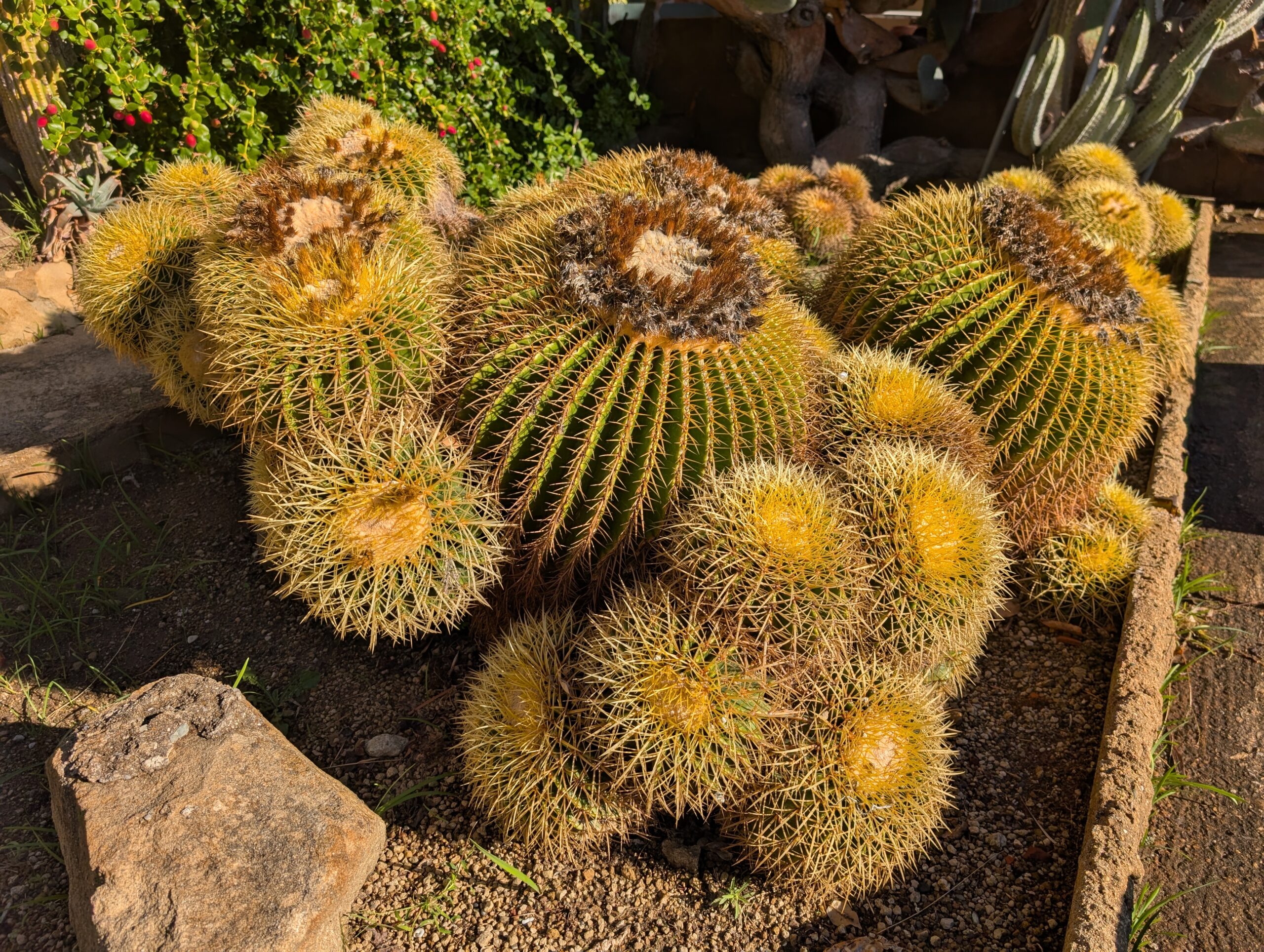
Mature plants carry roughly 20 to 40 ribs depending on the source (Wikipedia gives 21 to 35). The areoles are large and woolly, yellow when young, then whitish and finally greyish. The spines are strong and golden yellow: Wikipedia describes 8 to 10 radial spines longer than 3 cm and 3 to 5 central spines of about 5 cm. The top of the stem is covered with dense cream wool, in which the flowers sit. They open by day, are bright yellow and 4 to 5 cm wide, and form a ring that is small compared with the size of the plant. The fruits are small, woolly and about 1.2 to 2 cm long, and contain tiny brown seeds.
Varieties, forms and cultivars
Most infraspecific names come from horticulture rather than from botanical revisions. LLIFLE lists, among others:
- var. albispinus Y.Itô: spines glassy white instead of yellow;
- var. subinermis Y.Itô (also sold as “inermis” or “brevispinus”): very short spines;
- var. intermedius: spines of intermediate length;
- var. intertextus Y.Itô (the cultivar ‘Krauskopf’): sparse, flattened, curved spines;
- forms cristata (crested), monstruosa (small, freely offsetting, with short spines) and setispinus (thin spines).
Wikipedia also mentions a teal-blue cultivar called ‘Blue barrel’. I found no documented hybrid involving the species in the sources consulted, although the species itself is suspected to come from an ancient hybridisation (see below).
Possible confusions
The name “golden ball” is shared with Parodia leninghausii, a South American cactus with soft, harmless spines (Wikipedia). Other large Echinocactus are covered on the genus page; none has the same golden spination.
Taxonomy and names
Echinocactus grusonii was first published by Hildmann in the Deutsche Gärtner-Zeitung 1886(3): 27 (POWO). LLIFLE also cites a later description in the Monatsschrift für Kakteenkunde 1: 4 (1891), which explains why some sources give 1891 for the description.
Why the new genus? Recent phylogenetic work, as summarised by Wikipedia, suggests that the species is probably polyphyletic with respect to the rest of Echinocactus and may descend from a hybridisation between Echinocactus and Ferocactus. To correct this, Lodé (2014) created the genus Kroenleinia for it. POWO follows the World Checklist of Vascular Plants (Govaerts et al., 2021) in accepting Kroenleinia grusonii (Hildm.) Lodé, and the GBIF backbone does the same. POWO also notes that Echinocactus grusonii is accepted under an alternative taxonomy by Hernández and Gómez-Hinostrosa (2015) and by Villaseñor (2016), two Mexican references.
This is an editorial choice: POWO remains this site’s nomenclatural reference, but the page keeps the name Echinocactus grusonii because it is the one under which gardeners, nurseries and the IUCN assessment know the plant, and it keeps the species with its better-known relatives in the genus silo. Older names also seen in databases include Echinocereus grusonii (Hildm.) Von Zeisold and Ferocactus grusonii (Hildm.) Guiggi (Wikipedia).
Etymology and history
The epithet honours Hermann Gruson (1821 to 1895), an engineer and industrialist from Magdeburg who built one of the largest cactus collections in Europe. According to the Magdeburg newspaper Volksstimme, the species was named by Heinrich Hildmann, a nurseryman from Birkenwerder near Berlin. On his death in 1895 Gruson left the collection to the city, and the Gruson greenhouses opened to the public in 1896. Their staff records mention a golden barrel about 150 years old, which Gruson may have known himself. The greenhouse director quoted by the paper could not say where the German nickname “Schwiegermutterstuhl” (mother-in-law’s chair) comes from, and I found no documented origin for the English nickname either.
In the wild
According to the IUCN assessment as summarised by LLIFLE, the historical population lives in the Río Moctezuma valley around Zimapán and Mesa de León (Querétaro), on volcanic rock, in an area of about 25 km² (less than 10 km² actually occupied) and with fewer than 1,000 plants, most of them mature. A second population was found at San Rafael de las Tablas in Zacatecas, about 500 km to the north-west, on volcanic rock or calcareous soil. It is much larger, with probably close to 10,000 mature plants. The two populations are severely fragmented, and exchange between them is very unlikely. The overall extent of occurrence is about 4,500 km² in two to four locations.
The decline has two main causes. Wikipedia, citing the IUCN, reports that wild populations suffered in the 1990s from poaching and from the creation of the Zimapán dam and reservoir in Hidalgo. LLIFLE adds that a Mexican botanical garden hurried to remove rare plants before the flooding, and that illegal collecting still causes a continuing decline. Note that POWO gives the native range as “Zacatecas to San Luis Potosí”, which does not match the historical valley in Querétaro and Hidalgo; I have not resolved this discrepancy.
Conservation and regulation
Echinocactus grusonii is listed as Endangered by the IUCN (Guadalupe Martínez, Sánchez and Gómez-Hinostrosa, 2013; I could not open the assessment itself, so I cannot quote its criteria). It is in CITES Appendix II, as are cacti in general. Kew’s CITES guide for cacti presents it as a top seller propagated by the million, so nursery-grown plants are plentiful. The pressure on the wild population comes from illegal collecting, not from legal nursery stock. Buy only plants propagated in nurseries, and check the rules of your country before importing seeds or plants. In Mexico, researchers have also tested in vitro propagation of the species as a conservation tool: a study held in the repository of the Universidad Autónoma del Estado de Hidalgo found that explants on a medium with benzyladenine produced the most shoots, although about half of them were abnormal.
Outdoor and in-ground cultivation
Outside the tropics, in-ground cultivation is realistic only in frost-free or almost frost-free climates with dry winters. LLIFLE recommends a full sun position and a rich, very well-drained soil, and suggests planting several plants close together among large rocks. A sloping bed, a gravel mound or a rock garden suits it better than a flat, heavy soil. Plants that have grown in shade must be hardened off slowly: moved suddenly into full sun, they scorch. Databases give USDA zones from 9a to 11 depending on the source, a range that reflects the lack of measured data rather than a real tolerance (see Hardiness). In a Mediterranean climate, winter rain is a greater danger than moderate cold.
Container cultivation
This is how most collectors grow it. LLIFLE describes a summer-growing, fairly easy plant.
- Light: full sun or half shade in summer if the site is very hot or bright; bright light and some direct sun indoors.
- Substrate: a rich, well-drained mix such as clay, pumice and lava grit with only a little peat or leaf mould, in a pot with good drainage.
- Watering: regular in the summer growth cycle but never constant, letting the soil dry between waterings. Avoid wetting the body of the plant in sunlight: a wet cactus in the sun can scar or develop a fungal infection. Keep it rather dry in winter, with no water standing around the roots.
- Feeding: a high-potassium fertiliser in summer.
- Repotting: in spring, when the roots are cramped, roughly every other year to renew the soil, not always in a larger pot. Do not water for a week or more afterwards.
- Winter: bright, cool and frost-free. Sources suggest from 5 to 10 °C up to an average minimum of 12 °C.
Propagation
Seed is the usual method. LLIFLE says the plant produces hundreds of fruits each season. Collect them several months after the flower has died, scrape out the tiny reddish-brown seeds and sow them on a fine, drained mix under filtered sun, covered with glass, keeping the soil moist. Germination takes about 2 to 6 weeks, and the seedlings are small red spheres. Move them to individual pots when they start to produce spines. That is one grower’s protocol; other mixes work. Old plants may offset (LLIFLE), and a Canadian database mentions division and stem cuttings, but I found no documented protocol for either. Flowering needs large, old plants, so patience is the main requirement.
Pests and diseases
Rot at the base of the stem caused by excess moisture is the main threat (a Canadian database lists basal stem rot and soft rot). LLIFLE warns of mealybugs, scale insects and spider mites. Water on the body of a plant in strong sun also invites scars and infections.
Hardiness: what the sources say
The data are scattered and none comes from a multi-winter trial:
- LLIFLE: light frost protection required; the plant tolerates sporadic light frost.
- Wikipedia, drawing on a University of Arizona extension page (archived 2013): an average winter minimum of 12 °C, with brief lower temperatures tolerated under cover; in some climates about −8 °C for short periods.
- Retailers: about −5 °C (a French-language nursery giving USDA zones 9 and 10) to −10 °C in dry conditions (a Spanish seller of the white-spined form). These are commercial claims.
- A Canadian database gives RHS rating H1c, which corresponds to a heated glasshouse kept at 5 to 10 °C.
- Cactiguide forum: in northern California, a grower in a cold pocket reports that plants died despite being covered (year not stated); in England, another reports plants surviving repeated lows of about −4 °C and several days around freezing (year not stated). A participant suggests that dry air, strong winter sun and a wall that re-radiates heat make the difference.
The common thread is that a dry plant tolerates much more than a wet one. This is consistent with general cactus physiology, but no source measures it for this species. Prefer to treat brief light frost as a limit, not a target.
Field reports from specialist forums and reference sites
I searched specialist forums (Cactiguide, the University of British Columbia Botanical Garden forum, the Infojardín archive, Dave’s Garden PlantFiles) and reference or extension sites. Searches in Japanese and Chinese returned cultivation notes but no usable hardiness figures. The accounts below are individual reports, grouped by what they show.
- Survived light to moderate frost outdoors or in the ground: Dave’s Garden PlantFiles, Lake Elsinore (southern California), 2007: more than 20 plants of various sizes survived a freeze to about −7 °C (19 °F), and did better with some shade when young. Dave’s Garden, Sochi (Russia, zone 9b), 2017: a plant grown outdoors for two years, covered against rain in winter, unharmed by light frosts. Cactiguide, thread of January 2009 (location not stated): a plant in the ground showed damage on its north side after a frost; other participants report survival at about −4 to −3 °C (24 to 26 °F) and at lows in the low 20s °F (about −6 °C), and one gives at least 20 °F (−7 °C) as a reasonable limit, probably lower for short periods.
- Pots kept dry: Infojardín (Spain), Madrid, thread of January 2015: plants in pots kept dry passed a test of −6 °C, with the grower promising further reports.
- Losses: UBC Botanical Garden forum (west coast of Canada, thread opened in 2006): a plant grown outdoors for over fifteen years in a sandy, fast-draining mix died after a mild winter with a lot of rain. The poster says hard frost may deform a plant but water is the real killer, and that an umbrella-type cover would have saved it. Cactiguide (northern California cold pocket): losses despite covers. Infojardín (Mediterranean Spain): a grower with cacti left outdoors, with lows of −5 to −6 °C for short periods, reports losses when rain was followed by frost; this concerns cacti in general, not this species alone.
- Reference and extension sites give “hardy to” values for short periods of about −10 to −7 °C: Desert-Tropicals 14 °F (−10 °C); Southern Nevada Water Authority (Las Vegas) 14 °F; Arizona Municipal Water Users Association (Phoenix) 18 °F (about −8 °C); University of Arizona Arboretum 20 °F (about −7 °C), zones 9a to 11; Brigham Young University greenhouse 20 °F for a short time. Dave’s Garden lists zones 9a to 11, whereas Oklahoma State University Extension lists zone 8. A UK nursery says about −8 °C briefly and advises a container where winters are wet and cold.
Three patterns emerge. First, most accounts of survival below −5 °C involve dry roots (covers, pots kept dry, dry-climate gardens), while accounts of losses cite winter rain or a cold pocket. Second, the figures from reference sites cluster around −7 to −10 °C for short periods and come mostly from desert regions where such lows are brief and dry; they should not be applied to a humid winter. Third, I found no report documenting several winters in the ground in a humid temperate climate.
Mediterranean climates and European experience
At the Jardin Zoologique Tropical de La Londe-les-Maures (Var, France), the author keeps cacti dry in winter under a translucent roof from November to March, and observed plants grown under rain protection go through −6 °C during the 2012 cold wave. Conversely, unprotected plants were lost at milder temperatures after wet winters: on this site, winter wetness did more damage than cold alone. This is one site’s observation, not a controlled trial, and the −6 °C reading was taken with a non-standard thermometer.
Toxicity and handling
The University of Arizona Arboretum database lists the plant’s toxicity as benign. The real hazard is mechanical: the spines are rigid and cause painful wounds, so wear thick gloves and handle with folded cardboard or a towel. Wikipedia, citing Anderson and Eggli (2005), reports that the fruits are edible, but I found no traditional use documented.
Uses
The species is grown as an ornamental in containers, rock gardens, desert-style plantings and conservatories. In the United Kingdom it holds the Royal Horticultural Society’s Award of Garden Merit (Wikipedia). Its popularity is part of the story of its conservation: wild plants are rare, but millions of nursery-grown plants exist.
FAQ
How big does a golden barrel cactus get?
Typically up to about 90 cm in height and width, and exceptionally more, but only after many years. Cultivated plants are often 30 cm or less.
When does it flower?
Only on large plants, from about 40 to 50 cm in diameter, which many sources equate with about twenty years. Flowers appear from late spring to summer, in full sun.
Why is it called Kroenleinia grusonii in some places?
Because some authorities, including POWO, place it in the separate genus Kroenleinia created by Lodé in 2014. Others, including two Mexican checklists, keep Echinocactus grusonii.
Is it still found in the wild?
Yes, in two populations in Mexico, but it is Endangered, and illegal collecting continues.
Can it stay outdoors in winter?
Only in climates without hard frost, and with dry roots. Elsewhere, grow it in a pot and bring it into a bright, frost-free place.
How often should I water it?
No fixed frequency applies. Water regularly in summer once the soil has dried, keep it rather dry in winter, and never leave water around the roots.
Reference websites
- Plants of the World Online (Kew), Echinocactus grusonii: https://powo.science.kew.org/taxon/87403-2 — status as a synonym, place of publication, Mexican checklists that keep the name. Reliable; consulted on 7 November 2026.
- Plants of the World Online (Kew), Kroenleinia grusonii: https://powo.science.kew.org/taxon/77164085-1 — accepted name, publication of the combination, native range. Reliable; consulted on 7 November 2026.
- LLIFLE, Echinocactus grusonii: https://llifle.com/Encyclopedia/CACTI/Family/Cactaceae/3345/Echinocactus_grusonii — description, forms, population data summarised from the IUCN, cultivation and propagation. Collaborative encyclopedia, to be cross-checked; consulted on 7 November 2026.
- Wikipedia, Kroenleinia grusonii: https://en.wikipedia.org/wiki/Kroenleinia_grusonii — spine and rib counts, taxonomic background, hardiness figures, Award of Garden Merit. Collaborative encyclopedia, used with caution; consulted on 7 November 2026.
- Kew, CITES and Cacti: a user’s guide (copy on Scribd): https://www.scribd.com/document/624939686/CITESandCacti-Full — CITES Appendix II and the species as a propagated top seller. Institutional document hosted on a third-party site; consulted on 7 November 2026.
- Volksstimme, Magdeburg: https://www.volksstimme.de/lokal/magdeburg/stuhl-fur-die-schwiegermutter-2001214 — naming after Hermann Gruson, the 150-year-old specimen. Regional daily newspaper; consulted on 7 November 2026.
- Volksstimme, Magdeburg: https://www.volksstimme.de/varia/rauber-bestehlen-prominentengrab-1038583 — Gruson’s collection and its bequest to the city. Regional daily newspaper; consulted on 7 November 2026.
- Universidad Autónoma del Estado de Hidalgo, repository: https://repository.uaeh.edu.mx/bitstream/handle/123456789/11085 — in vitro propagation of the species. Abstract only; consulted on 7 November 2026.
- University of Arizona Arboretum: https://apps.cals.arizona.edu/arboretum/taxon.aspx?id=833 — toxicity entry. Institutional database; consulted on 7 November 2026.
- Cactiguide forum: https://www.cactiguide.com/forum/viewtopic.php?p=277082 — northern California cold-pocket report. Individual accounts; consulted on 7 November 2026.
- Cactiguide forum: https://cactiguide.com/forum/viewtopic.php?p=29247 — England report and discussion of dry air and re-radiated heat. Individual accounts; consulted on 7 November 2026.
- Promesse de Fleurs: https://www.promessedefleurs.ie/perennials/cacti-and-succulents/echinocactus-grusonii-golden-barrel-cactus.html — nursery’s hardiness claim. Commercial source; consulted on 7 November 2026.
- Desert Store: https://desertstore.es/en/products/kroenlenia-echinocactus-grusonii-var-albispinus-s-y-m — seller’s hardiness claim for the white-spined form. Commercial source; consulted on 7 November 2026.
- World Plants (Canada): https://worldplants.ca/display.php?id=1314 — hardiness figures and pests. Commercial database; consulted on 7 November 2026.
- Cactiguide forum, frost damage thread (January 2009): https://www.cactiguide.com/forum/viewtopic.php?t=10802 — reports of survival and damage in frosts of the low 20s °F. Individual accounts; consulted on 7 November 2026 through search extracts only.
- Botanical Garden forum, University of British Columbia, winter care thread: https://forums.botanicalgarden.ubc.ca/threads/echinocactus-grusonii-winter-care.18787/ — loss of a long-established outdoor plant after a wet winter. Individual accounts; consulted on 7 November 2026.
- Infojardín archive, thread on very cold-resistant cacti: https://archivo.infojardin.com/tema/cactus-muy-resistentes-al-frio.428058/page-2 — plants in dry pots at −6 °C in Madrid; losses when rain is followed by frost. Individual accounts; consulted on 7 November 2026.
- Dave’s Garden PlantFiles: https://davesgarden.com/guides/pf/go/53101 — zone ranges and gardeners’ notes from California and Sochi. Member contributions; consulted on 7 November 2026.
- Desert-Tropicals: https://desert-tropicals.com/Plants/Cactaceae/Echinocactus_grusonii.html — frost tolerance for short periods. Specialist website; consulted on 7 November 2026.
- Southern Nevada Water Authority plant list: https://www.snwa.com/landscapes/plants/?id=14839 — cold tolerance figure. Public agency; consulted on 7 November 2026.
- Arizona Municipal Water Users Association plant list: https://www.amwua.org/plant/golden-barrel — hardiness figure. Public association; consulted on 7 November 2026.
- Brigham Young University greenhouse: https://pws.byu.edu/greenhouse/golden-barrel-cactus — hardiness for a short time. University collection; consulted on 7 November 2026.
- Oklahoma State University Extension: https://extension.okstate.edu/programs/plant-id/plant-profiles/golden-barrel-cactus — USDA zone given. University extension; consulted on 7 November 2026 through search extracts only.
- Palm Centre (UK): https://palmcentre.co.uk/products/outdoor-plants/arid/echinocactus-grusonii/ — short-term cold limit and container advice. Commercial source; consulted on 7 November 2026.
Bibliography
Hildmann, H. (1886). [Echinocactus grusonii]. Deutsche Gärtner-Zeitung 1886(3): 27. [Original publication of the name, as cited by POWO; not consulted.]
Lodé, J. (2014). Kroenleinia gen. nov. J. Lodé: a new genus for a well-known cactus: Echinocactus grusonii. Cactus-Aventures International 102: 25-29. [Creation of the genus; the combination is on p. 27 according to POWO; not consulted.]
Guadalupe Martínez, J., Sánchez, E. & Gómez-Hinostrosa, C. (2013). Echinocactus grusonii. The IUCN Red List of Threatened Species 2013: e.T40962A2947851. doi:10.2305/IUCN.UK.2013-1.RLTS.T40962A2947851.en. [Endangered; population data as summarised by LLIFLE and Wikipedia; assessment not opened.]
Govaerts, R., Nic Lughadha, E., Black, N., Turner, R. & Paton, A. (2021). The World Checklist of Vascular Plants, a continuously updated resource for exploring global plant diversity. Scientific Data 8: 215. doi:10.1038/s41597-021-00997-6. [Cited by POWO as the basis for accepting Kroenleinia grusonii.]
Hernández, H.M. & Gómez-Hinostrosa, C. (2015). Mapping the cacti of Mexico part II. Mammillaria. Succulent Plant Research 9: 1-189. [Cited by POWO as using the name Echinocactus grusonii; not consulted.]
Villaseñor, J.L. (2016). Checklist of the native vascular plants of Mexico. Revista Mexicana de Biodiversidad 87: 559-902. [Cited by POWO as using the name Echinocactus grusonii; not consulted.]
Vargas-Luna, M.D., Hernández-Ledesma, P., Majure, L.C., Puente-Martínez, R., Hernández Macías, H.M. & Bárcenas Luna, R.T. (2018). Splitting Echinocactus: morphological and molecular evidence support the recognition of Homalocephala as a distinct genus in the Cacteae. PhytoKeys 111: 31-59. doi:10.3897/phytokeys.111.26856. [Cited by Wikipedia for the taxonomy of the genus; not read.]
Anderson, E.F. & Eggli, U. (2005). Das grosse Kakteen-Lexikon. Ulmer, Stuttgart, p. 188. [Cited by Wikipedia for the description of the fruits; not consulted.]