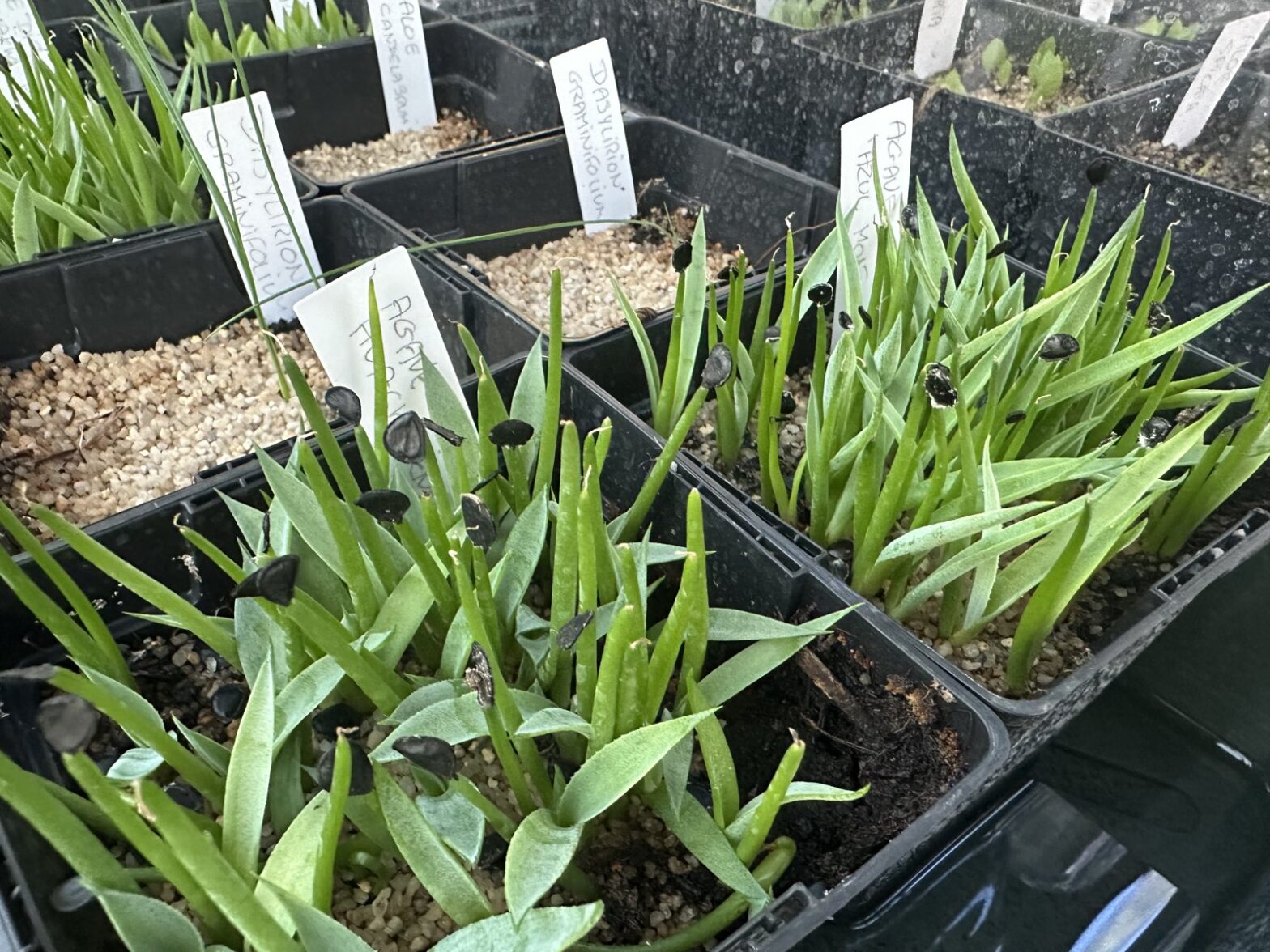
Growing from seed is the only practical way to obtain some agaves, especially solitary species that produce few or no offsets, such as Agave victoriae-reginae. It is also an inexpensive way to raise dozens of plants from a single packet. The good news is that agave seed germinates readily: it has no significant dormancy, needs no pre-treatment and sprouts within days at the right temperature. The real challenges lie elsewhere: sourcing reliable seed, preventing seedling rot and accepting slow growth during the first few years.
This guide walks you through the whole process, from buying seed to planting out. For an overview of the species themselves, see our page on the genus Agave.
Sourcing agave seed
Agaves bear their seed in dry, three-chambered capsules along the flower stalk. Each capsule holds stacks of flat, black, half-moon-shaped seeds. A viable seed is black and slightly plump where the embryo sits. Empty seeds are very common: they are paler (whitish to light brown), papery and completely flat. Sort them out before sowing.
Freshness and storage
Agave seed tolerates drying and keeps reasonably well if stored cool and dry. Quality still declines with age: trials on Agave americana showed that aged seed germinates more slowly and less completely. Buy seed from the most recent harvest, ideally dated by the supplier, and keep it in a paper envelope away from heat and humidity until sowing.
Garden-collected seed and hybrids
Agaves are monocarpic: each rosette flowers once and then dies (see our article on agave flowering). Collecting seed from a plant that has bloomed in your garden is tempting, but agaves hybridize freely. If another agave was flowering nearby at the same time, some of the seed may be hybrid, and the seedlings may look quite different from the mother plant. In addition, many agaves set little viable seed without cross-pollination between two genetically different plants, so an isolated specimen often produces mostly empty capsules. Named cultivars and hybrids do not come true from seed; propagate them from offsets instead.
CITES regulations
Most agaves are not covered by CITES. Two species are listed: Agave parviflora in Appendix I, and Agave victoriae-reginae in Appendix II with annotation #4, which exempts seeds. For Agave parviflora, the Appendix I listing covers seed as well, so buy only from suppliers who comply with the regulations and check national rules before importing seed across borders.
When to sow agave seed
Spring is the best time, roughly March to May indoors or under cover, so that seedlings have the whole growing season before their first winter. In warm, frost-free climates (roughly USDA zones 9b and above), sowing outdoors in light shade in early summer also works, as nights stay warm enough. With a heat mat and a grow light you can sow year-round, but autumn sowings produce very small seedlings going into winter, which must then be kept warm and well lit.
Seed-starting mix and containers
The mix should be free-draining, airy and lean while still holding a little moisture. A simple recipe suits most species: one third sifted potting mix (seed-starting or cactus mix) and two thirds fine mineral material (pumice or lava rock of 2 to 4 mm / about 1/8 inch, perlite, coarse sand). Avoid fine sand, which clogs, and fertilized potting soils. Sterilizing the moist mix for a few minutes in the oven or microwave reduces the risk of damping-off; let it cool completely before use.
Use pots or trays 6 to 10 cm (2.5 to 4 inches) deep with drainage holes. Young agaves quickly develop a fleshy main root that is cramped in shallow trays. Deep cell trays let you sow one to three seeds per cell and transplant without disturbing the roots. Label every pot with species, source and date: all seedlings look alike at first.
Sowing step by step
- Sort the seed: keep only the black, plump seeds.
- Soaking is optional and not required. If you do soak, a few hours in room-temperature water (20 to 25 °C / 68 to 77 °F) is enough; do not use hot water.
- Prepare the pots: fill to about 1 cm (1/2 inch) below the rim, then water from below by standing them in a tray of water until the surface darkens. Let them drain.
- Lay the seeds flat on the surface, about 1 cm (1/2 inch) apart.
- Cover very lightly with 2 to 3 mm (about 1/8 inch) of coarse sand or fine grit, roughly the thickness of the seed. This mineral top layer keeps the seedlings’ bases dry and discourages moss and algae.
- Cover the pots with a clear lid, propagator or plastic bag, and air them briefly every day.
Temperature, light and humidity
Temperature is the key factor. Studies of several Mexican species place the optimum around 25 °C (77 °F). In Agave americana, germination is best between about 21 and 31 °C (70 to 88 °F) and fastest near 26 °C (79 °F); it becomes slow below about 15 °C (59 °F) and drops off above 35 °C (95 °F). Aim for a steady 22 to 28 °C (72 to 82 °F) day and night, using a heat mat if the room is cooler.
Light is not essential for germination, but total darkness slows it, and seedlings need light as soon as they emerge. Keep the pots in a bright spot out of direct sun, which would overheat a closed container.
Moisture: keep the mix just moist, never soggy. Under a lid, watering is rarely needed before germination; if the surface dries, water from below or mist.
How long agave seeds take to germinate
In laboratory tests at 25 °C (77 °F), seeds of several species began germinating within three to four days, with most germination complete in under two weeks. At home, with less constant temperatures, expect one to three weeks; old seed or cool conditions take longer. If nothing has emerged after a month at the right temperature, the seed was probably not viable.
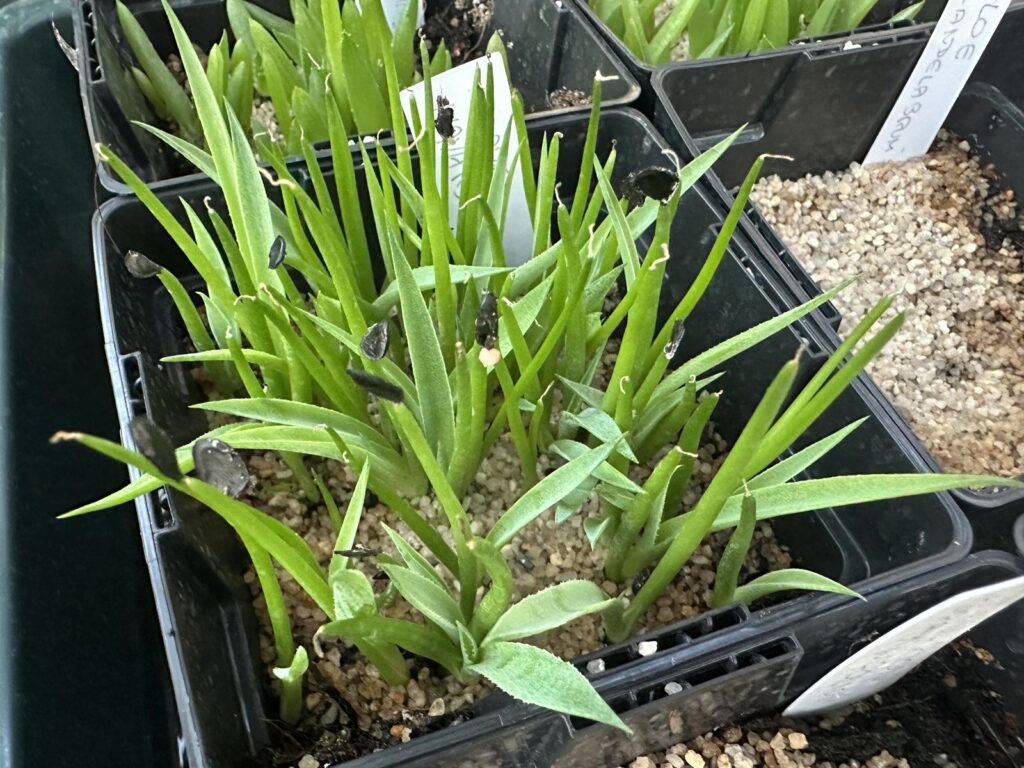
Agaves are monocots: the seedling first appears as a thin green hook that straightens into a single leaf, the cotyledon, often still capped by the black seed coat. Let it fall off on its own. The first true leaf, broader, follows a few weeks later.
Seedling care
Ventilation and watering. Once most seeds have sprouted, prop the lid open and remove it gradually over one to two weeks. Then water from below when the surface starts to dry. Seedlings have no reserves and should not stay dry for long, but constantly saturated mix will kill them.
Gradual light. Without enough light, seedlings stretch and flop. Give bright indirect light for the first month, then morning sun, and acclimatize them to full sun over several weeks; sudden exposure scorches young leaves.
Damping-off. Soil-borne fungi (Pythium, Rhizoctonia) attack the base of seedlings, which turn brown at soil level and collapse. Overwatering, poor air flow and cool conditions encourage it. Remove affected seedlings at once, increase ventilation and let the surface dry between waterings. Fungus gnat larvae, common in moist organic mixes, can also damage roots.
First transplant. There is no rush: seedlings can stay together for several months, often until the following spring. Prick them out when they have two or three true leaves into individual 6 to 8 cm (2.5 to 3 inch) pots, using a slightly grittier mix. Lift the whole clump, tease the roots apart gently and wait a few days before watering. Once established, they can receive a very dilute, low-nitrogen cactus fertilizer during the growing season.
The first years and planting out
Growth rates vary greatly between species: large agaves such as Agave americana form a small rosette fairly quickly, while compact species such as Agave victoriae-reginae stay tiny for several years. Pot on each spring into a slightly larger container; the advice in our guide to growing agaves in pots applies from this stage.
Young agaves are more sensitive to cold and winter wet than mature plants of the same species. During their first winters, keep them frost-free, dry and in good light, even if the species is rated hardy. Plant them out in spring after the last frost, once the rosette is large enough not to be smothered by weeds, usually after two to three years in pots. Choose a sunny, very free-draining spot; for species suited to your climate and USDA zone, see our guide on how to grow and care for agaves.
Common mistakes
- Sowing too deep: seed buried more than about 5 mm (1/4 inch) germinates poorly.
- Sowing too cool: germination drags on for weeks and fungi take over.
- Leaving the lid on too long after germination.
- Using plain all-purpose potting soil, which is too rich and stays too wet.
- Moving seedlings into full sun abruptly, especially behind glass.
- Planting out tiny rosettes too early.
Quick reference table
| Stage | Recommendation |
|---|---|
| Timing | March to May under cover; year-round with heat and grow lights |
| Seed | Black and plump, from a recent harvest |
| Pre-treatment | None needed; optional soak of a few hours in water at 20-25 °C (68-77 °F) |
| Mix | 1/3 sifted potting mix, 2/3 mineral (pumice, lava rock, perlite, coarse sand) |
| Covering | 2-3 mm (about 1/8 inch) of coarse sand or grit |
| Temperature | Steady 22-28 °C (72-82 °F), optimum around 25 °C (77 °F) |
| Light | Bright, no direct sun |
| Germination | A few days to three weeks |
| Transplanting | At two or three true leaves |
| Planting out | In spring, after two to three years in pots |
Frequently asked questions
How long does agave seed take to germinate?
Usually between a few days and three weeks at around 25 °C (77 °F). In cooler conditions it can take several weeks and be uneven.
Should I soak agave seeds before sowing?
It is not necessary: agave seed germinates without pre-treatment. If you wish, soak for a few hours in room-temperature water (20-25 °C / 68-77 °F).
Can I grow seed from an agave that flowered in my garden?
Yes, if the capsules contain black, plump seeds. Collect them when the capsules turn brown and begin to split. Seedlings may be hybrids if other agaves were flowering nearby.
Why are my agave seedlings rotting at the base?
This is almost always damping-off, caused by excess moisture, poor air flow or an overly organic mix. Remove affected seedlings, take off the lid and let the surface dry between waterings.
How long until a seed-grown agave flowers?
Many years: generally more than a decade for most cultivated species, sometimes much longer depending on the species and climate.
Is seed better than offsets?
Offsets are identical to the mother plant and reach a decorative size sooner, so they are the method of choice for cultivars. Seed is the answer for solitary species or when you want many plants. Other techniques are covered in our guide on how to propagate succulents.
Sources
- Pritchard, H. W. and Miller, A. P. (1995). The effects of constant temperatures, light and seed quality on the germination characteristics of Agave americana. Botanical Sciences, 57, 11-14. doi.org/10.17129/botsci.1472
- Ramírez-Tobías, H. M. et al. (2014). Seed germination of Agave species as influenced by substrate water potential. Biological Research, 47, 11. doi.org/10.1186/0717-6287-47-11
- Ramírez-Tobías, H. M. et al. (2012). Seed germination temperatures of eight Mexican Agave species with economic importance. Plant Species Biology, 27(2), 124-137.
- CITES, Appendices I, II and III valid from 7 February 2025 (Agavaceae, annotation #4).