Beaucarnea gracilis is a xerophytic plant from Mexico, endemic to the Puebla and Oaxaca region. Like all Beaucarnea, it forms a swollen trunk base (caudex) that stores water, topped by stems carrying rosettes of slender leaves. It differs from the common ponytail palm (Beaucarnea recurvata) by its upright, glaucous leaves, and it is often described as somewhat more cold-tolerant, though no published measurement supports this. It can be grown in sheltered gardens in the warmest parts of Europe.
Key facts
- Accepted name: Beaucarnea gracilis Lem. (1861)
- Family: Asparagaceae, subfamily Nolinoideae
- Origin: Mexico, states of Puebla and Oaxaca (Tehuacán Valley)
- Habit: arborescent, usually 3 to 5 m, up to 12 m reported
- Leaves: slender, upright, glaucous, about 30 to 60 cm long and 4 to 7 mm wide
- Sexuality: dioecious (separate male and female plants)
- Hardiness: about −5 °C for short periods according to growers; −6 °C well tolerated at La Londe-les-Maures in 2012
- Status in Mexico: threatened species (NOM-059-SEMARNAT-2010); genus listed in CITES Appendix II
Taxonomy and nomenclature
Beaucarnea gracilis was described by Charles Lemaire in 1861 in L’Illustration horticole. The specific name gracilis (“slender”) refers to its thin leaves. The species has long circulated under other names, still found in nurseries and older literature:
- Nolina gracilis (Lem.) Cif. & Giacom.
- Dasylirion gracile (Lem.) J.F.Macbr. (illegitimate name)
- Beaucarnea oedipus Rose
- Nolina histrix Trel.
These names are synonyms: there is no separate plant called Nolina gracilis. The study by Rojas-Piña and colleagues (2014, Taxon) confirmed with DNA that Beaucarnea is a genus distinct from Nolina, which Plants of the World Online (Kew) follows. See the page on the genus Beaucarnea.
Description
The trunk base is strongly swollen, often almost globose and largely visible above ground. With age it becomes covered in grey to brown corky bark, fissured into polygonal plates. From this base rise relatively slender stems that branch moderately, giving the plant the look of a tree yucca.
The leaves form open rosettes at the tips of the stems. They are long and thin, rough along the margins, green to bluish-green and glaucous, and above all upright, whereas those of Beaucarnea recurvata droop like a ponytail.
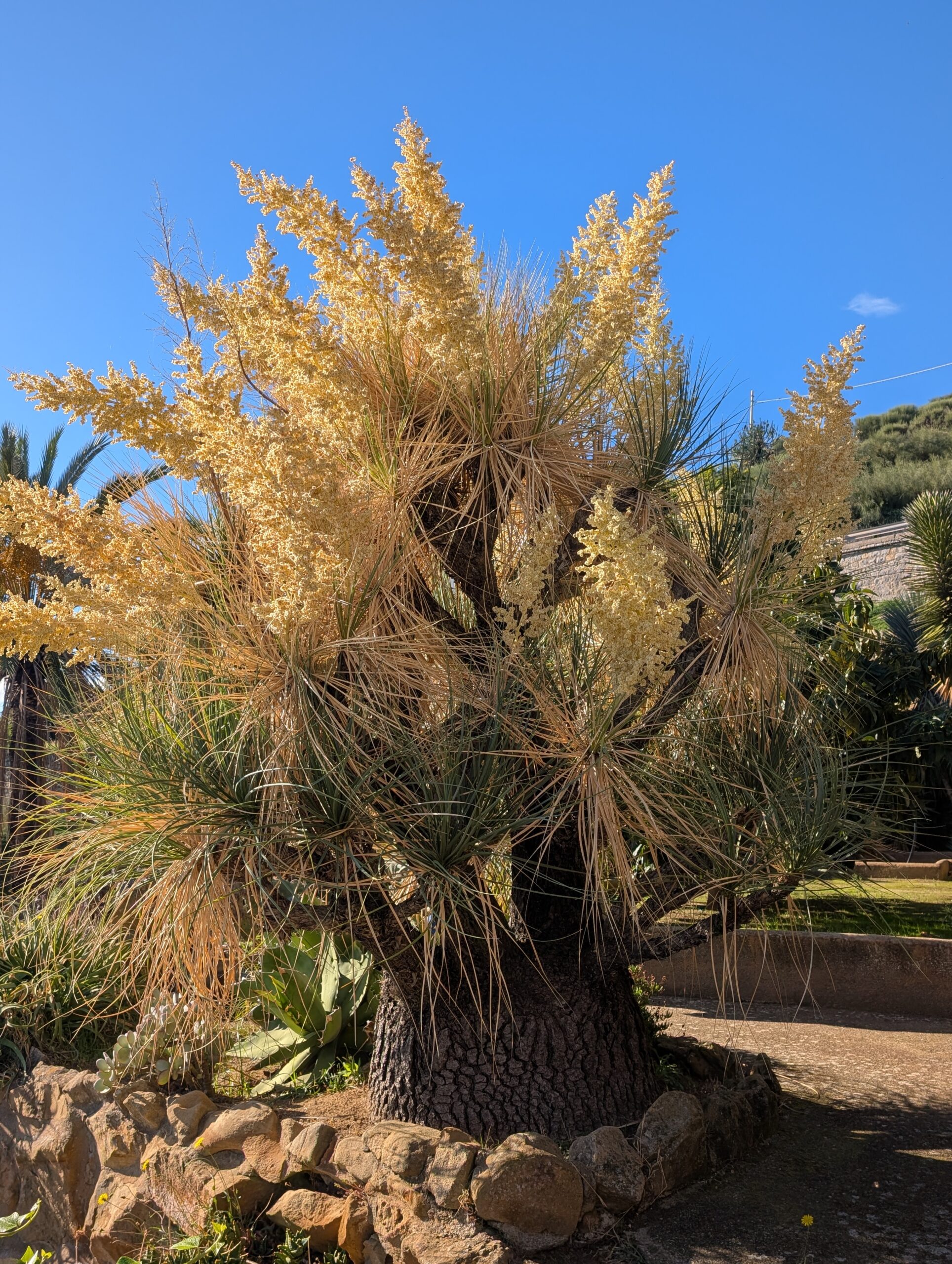
The flowers are very small, borne in a wide terminal panicle, and slightly fragrant. Plants are either male or female: both sexes are needed to obtain seed. The fruit is a three-winged capsule about 9 mm across, holding small seeds of about 3 mm.
Distribution and habitat
Beaucarnea gracilis is endemic to Mexico: it is recorded only from the states of Puebla and Oaxaca, in the semi-arid Tehuacán Valley, where it grows notably around Zapotitlán de las Salinas. Its habitat is xerophytic vegetation on dry, well-drained soils. We found no reliable altitude range for this species.
Conservation and regulation
In Mexico, Beaucarnea gracilis is listed as “threatened” (amenazada) in the standard NOM-059-SEMARNAT-2010. All species of the genus have been in CITES Appendix II since 2016, so international trade requires permits. Small plants are dug up in the wild for ornamental use, which puts pressure on wild populations, all the more so as growth is slow and reproduction requires male and female plants to grow close together. Choose nursery-grown plants. Micropropagation of this species has been studied as an alternative to wild collection.
Some sources give an IUCN status of “Endangered” (EN); we could not verify this on the Red List itself.
Cultivation
Hardiness
Growers report tolerance of about −5 °C for short periods on a mature plant in dry soil, but its exact hardiness is not established. At the Jardin Zoologique Tropical in La Londe-les-Maures (Var, France), the species came through −6 °C well in 2012. In practice, in-ground cultivation is limited to regions with light or no frost, such as the French Riviera and the Ligurian coast, in a sheltered position. Elsewhere it is grown in a pot and brought indoors for winter. Wet cold is more dangerous than dry cold: protect valuable plants from winter rain.
Exposure and soil
Full sun or very bright light. In the ground it needs very free-draining soil, possibly raised, with dry air circulating. In a container, use a mineral substrate and a pot with a drainage hole; it likes to be a little rootbound and can stay in the same pot for years.
Watering
Moderate watering during active growth, much reduced the rest of the year once established. The caudex stores water: excess moisture, especially in winter, makes it rot far more surely than drought does.
Propagation
From seed (plants of both sexes are needed to obtain seed) or from stem cuttings; leaf cuttings do not root. Growth is slow.
Pests
Beaucarnea species are among the documented or suspected hosts of the agave snout weevil where it is established. In cultivation, the main risk remains caudex rot from excess water.
Beaucarnea gracilis or Beaucarnea recurvata?
- Leaves: upright, slender and glaucous in B. gracilis; drooping and broader in B. recurvata.
- Habit: B. gracilis is more branched and more like a tree yucca; B. recurvata often keeps a single ponytail head.
- Range: B. gracilis is restricted to Puebla and Oaxaca; B. recurvata is more widespread in eastern Mexico.
Variegated form
A horticultural form with leaves striped in white, cream and yellow is sold as Beaucarnea gracilis f. variegata. It is rarer and less vigorous than the typical form.
FAQ
Are Nolina gracilis and Beaucarnea gracilis the same plant?
Yes. Nolina gracilis is an old name, now a synonym of Beaucarnea gracilis.
Is Beaucarnea gracilis frost hardy?
Slightly: about −5 °C briefly, in dry conditions, according to growers, and the species came through −6 °C well at La Londe-les-Maures in 2012. It is a plant for mild climates or container growing.
Can I buy it freely?
Yes, if it is nursery-grown and legally sold. The genus is in CITES Appendix II, which regulates international trade. Avoid wild-collected plants.
Why is the base of my ponytail palm soft?
Almost always because of too much water. Let the substrate dry between waterings and check the drainage.
Sources
- Wikipedia, Beaucarnea gracilis: taxonomy, synonyms, description.
- LLifle, Beaucarnea gracilis: description, cultivation, indicative hardiness.
- eFloraMex (UNAM): endemism to Puebla and Oaxaca.
- CITES, proposal CoP17 Prop. 50: listing of the genus in Appendix II; NOM-059 status.
- Rojas-Piña, V., Olson, M.E., Alvarado-Cárdenas, L.O. & Eguiarte, L.E. (2014). Taxon 63(6): 1193–1211: separation of Beaucarnea from Nolina.
See also: the genus Beaucarnea.