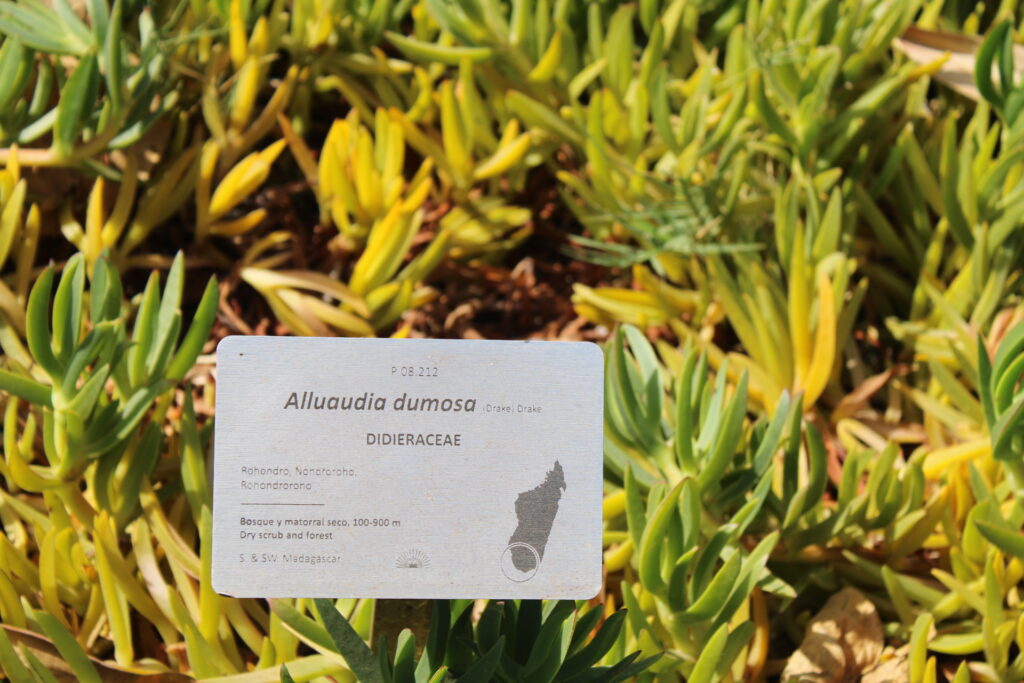
Alluaudia dumosa (Drake) Drake is a succulent shrub endemic to the spiny forests of south-western Madagascar, belonging to the family Didieraceae. Less imposing in stature than its relative Alluaudia procera, known in Madagascar as Rohondro, Nondroroho or Rohondroroho, it is distinguished by its densely branched, bushy habit and slender, closely-packed stems — a silhouette that is particularly striking during the dry season, when the plant sheds all its leaves and stands completely bare.
Classification and nomenclature
Systematic position
Alluaudia dumosa belongs to the order Caryophyllales, family Didieraceae, subfamily Didiereoideae. It was first described by French botanist Emmanuel Drake del Castillo in 1903 as Didierea dumosa, before being transferred to the genus Alluaudia by the same author. The specific epithet dumosa derives from the Latin dumus (thorny bush), a direct reference to the plant’s dense, shrubby growth form.
Synonyms
Key synonyms include: Didierea dumosa Drake; Alluaudia dumosa var. australis Rauh.
Morphological description
Habit and dimensions
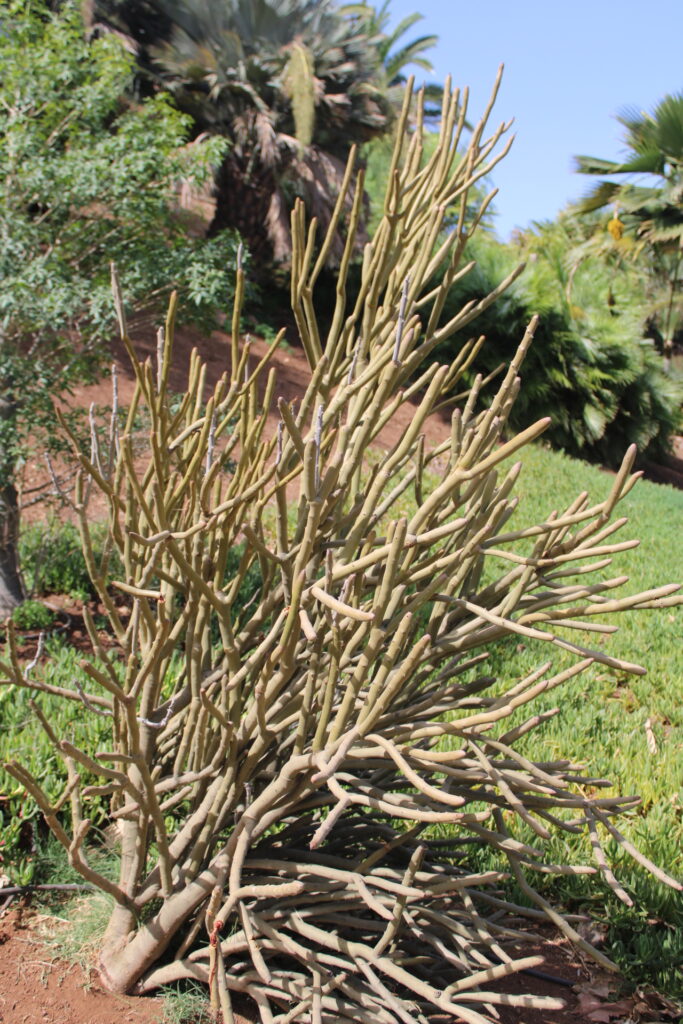
Alluaudia dumosa forms a multi-stemmed shrub, typically reaching 2 to 5 metres in height under natural conditions. Unlike the more columnar Alluaudia procera, this species branches profusely from the base, producing a compact, rounded silhouette. Its densely interlocking branches create an almost impenetrable thicket in the wild.
Stems
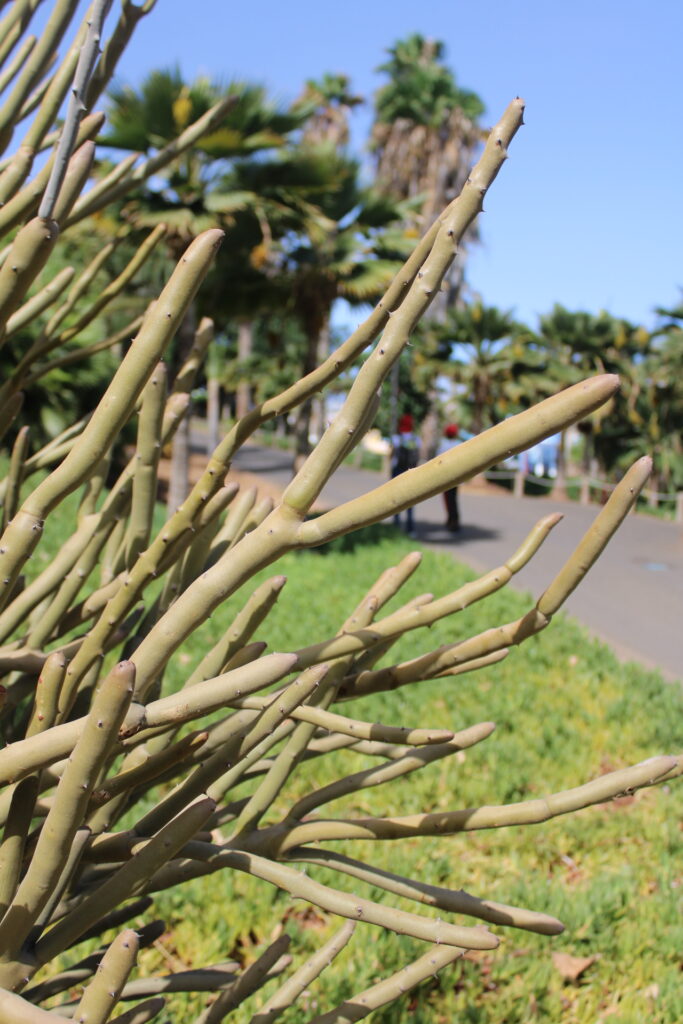
The stems are cylindrical and slender — around 1 to 2 cm in diameter — greyish-green to khaki in colour. At regular intervals along each stem, pairs of small stipular spines (3–6 mm long) are visible; these are characteristic of the genus Alluaudia and serve as the insertion points for leaves during the growing season.
Leaves
Leaves are small (5–12 mm long), sessile, obovate to spatulate, and bright green. They are entirely deciduous: the plant drops them completely during the dry season to minimise water loss through transpiration. Outside the growing season, the stems appear completely bare — creating a deceptively dead appearance, as clearly shown in the photographs taken at the Palmetum de Tenerife.
Flowers and inflorescences
The species is dioecious, with male and female plants being separate individuals. Flowers are small, yellowish-green, and grouped in terminal cymes at the tips of the stems. Flowering occurs during the warm season, typically coinciding with the emergence of new leaves.
Ecology and distribution
Range
Alluaudia dumosa is endemic to the south-western tip of Madagascar, where it is one of the structural pillars of the spiny forest ecosystem. Found at altitudes between 100 and 900 m, its range extends roughly from the region around Toliara (Tuléar) southward through the Anosy and Androy regions. It frequently co-occurs with other Didieraceae — Didierea madagascariensis, Alluaudia procera, and Decaryia madagascariensis — alongside Malagasy Euphorbia species.
Habitat
The Madagascan spiny forest is one of the most distinctive and threatened ecosystems on Earth. Subject to a severe dry season lasting six to nine months, it is dominated by highly drought-adapted plants. The soil is sandy to rocky, low in nutrients, and annual rainfall rarely exceeds 400 mm. A. dumosa shares this habitat with Pachypodium, baobabs (Adansonia), radiated tortoises, and several species of lemur.
Cultivation
Climate and exposure
Outside its native range, Alluaudia dumosa can be grown in Mediterranean climates or in heated glasshouses. It requires maximum sunlight and a dry atmosphere. Winter temperatures should remain above freezing; the plant tolerates brief, light frosts (down to −2°C) only if the substrate is perfectly dry and free-draining. It is slightly less cold-hardy than Alluaudia procera.
Substrate and watering
A sharply draining mineral substrate is essential: a mix of coarse sand, pumice or perlite, and minimal organic matter. Watering should follow the plant’s natural rhythm — moderate and regular during the growing season, then completely suspended as soon as the leaves are shed, and kept dry until growth resumes in spring.
Propagation
Propagation is most reliably achieved by stem cuttings taken in summer, left to callous for several days before being placed in a dry, sandy substrate. Seed germination is possible but slower and less predictable.
Conservation
Alluaudia dumosa is classified as Vulnerable (VU) on the IUCN Red List. Madagascar’s spiny forest faces severe pressure from slash-and-burn agriculture, charcoal production, and overgrazing. Over 90% of the original spiny forest habitat has already been lost. Conservation initiatives by local and international NGOs are ongoing, but the situation remains critical.
References
Drake del Castillo, E. (1903). Flore de Madagascar. — Rauh, W. (1995). Succulent and Xerophytic Plants of Madagascar, vol. 1 & 2. — Callmander, M. et al. (2011). Phylogenetics and taxonomic revision of Alluaudia (Didieraceae). — IUCN (2024). Alluaudia dumosa. The IUCN Red List of Threatened Species.